Why in News?
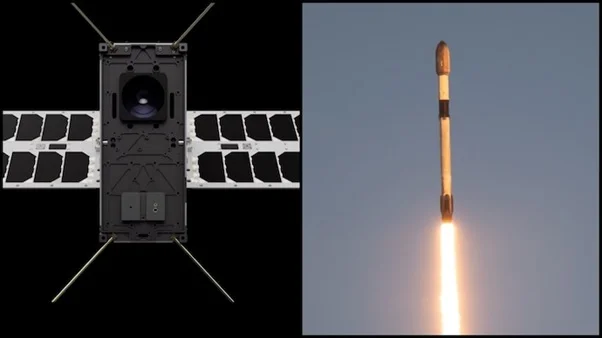
- Indian space startup TakeMe2Space is set to launch its MOI-1A orbital computing satellite on October 1, 2026, aboard SpaceX’s Transporter-18 rideshare mission.
- The mission aims to process data directly in space using onboard computing and Artificial Intelligence (AI), reducing the need to send large amounts of raw data back to Earth.
What is MOI-1A?
- MOI-1A is a small orbital computing satellite developed by TakeMe2Space. The spacecraft weighs around 14 kg and is designed in a 6U CubeSat configuration.
- It is equipped with NVIDIA Orin NX edge-computing processors, which can provide up to 117 trillion operations per second (TOPS) of computing capability.
- The satellite also features:
- 2 terabytes of onboard storage
- Nine-band multispectral imaging
- Peak power capacity of around 120 watts
- Onboard AI and edge-computing capabilities
How Will Orbital Computing Work?
- Normally, Earth-observation satellites collect large amounts of data and transmit the raw data to ground stations for processing.
- MOI-1A will follow a different approach. Customers will be able to upload AI models to the satellite. The satellite will then process the data while passing over a particular region.
- After processing, it will send the results or analysis back to Earth instead of transmitting the complete raw dataset.
- This can help reduce data-transfer requirements, processing time and the cost of downloading large datasets.
Applications of the Satellite
TakeMe2Space has signed 23 customers for the mission, according to company statements reported by Reuters.
Potential applications include:
- Geospatial and Geographic Information Systems (GIS)
- Agriculture
- Mining
- Supply-chain management
- Insurance
- Education
- Space-data analytics
US-based space-data analytics company Little Place Labs is among the customers.
From Technology Demonstration to Commercial Mission
- TakeMe2Space previously conducted a technology-demonstration mission in late 2024.
- The mission demonstrated the company's ability to:
- Upload applications to a spacecraft
- Perform AI inference in orbit
- Process data in space
- Download the resulting information to Earth
- A subsequent MOI-1 satellite was lost following a third-stage failure of its launch vehicle.
- The upcoming MOI-1A mission is therefore aimed at taking the company's orbital-computing technology towards commercial operations.
Future Plans of TakeMe2Space
- TakeMe2Space plans to develop larger and networked satellites from 2027.
- The objective is to increase computing capacity, serve multiple customers and reduce the cost of orbital computing.
- The company also plans to explore orbital cold storage, which would involve storing critical data in space as an additional backup location beyond terrestrial cloud infrastructure.
- The proposed service could target sectors such as financial services and defence.
India’s Growing Space-Tech Ecosystem
- The development of MOI-1A reflects the growing role of private space startups in India’s space sector.
- TakeMe2Space designs and manufactures most of its satellite subsystems in India, while some components such as computing chips, solar cells and propulsion systems are sourced externally.
- The mission also highlights the growing integration of space technology, artificial intelligence and edge computing.
Significance
- The MOI-1A mission represents a shift from simply collecting and transmitting satellite data towards processing data directly in orbit.
- With the growing use of Artificial Intelligence and satellite-based Earth observation, orbital computing could help reduce the volume of data that needs to be transmitted to Earth and enable faster access to processed information.
Conclusion
TakeMe2Space’s MOI-1A mission represents an emerging approach in which satellites can collect, process and analyse data in orbit before transmitting the results to Earth. By combining satellite technology with artificial intelligence and edge computing, the mission aims to reduce the need for transmitting large volumes of raw data and create new commercial applications for space-based computing.
Prelims Practice Question
MOI-1A satellite, recently in the news, is associated with which of the following?
- Orbital computing
- Artificial Intelligence-based data processing
- Earth observation
- Space-based data storage
Select the correct answer using the code given below:
(A) 1 and 2 only
(B) 1, 2 and 3 only
(C) 2, 3 and 4 only
(D) 1, 2, 3 and 4
Mains practice Question
Q. What is orbital computing? Discuss how processing satellite data directly in space can transform Earth-observation services. Also examine the challenges associated with this emerging technology.
|
FAQs
1. What is MOI-1A?
MOI-1A is an orbital computing satellite developed by Indian space startup TakeMe2Space.
2. What is orbital computing?
Orbital computing means processing and analysing data directly on a satellite in space instead of sending all raw data to Earth.
3. When will MOI-1A be launched?
MOI-1A is scheduled to launch on October 1, 2026, aboard SpaceX’s Transporter-18 rideshare mission.
4. What is the main purpose of MOI-1A?
Its main purpose is to process satellite data in orbit using onboard computing and Artificial Intelligence, and send processed results back to Earth.
5. What type of satellite is MOI-1A?
MOI-1A is a 6U CubeSat weighing around 14 kg.
|







 Contact Us
  New Batch : 9555124124/ 7428085757
  Tech Support : 9555124124/ 7428085757