Why in the News?
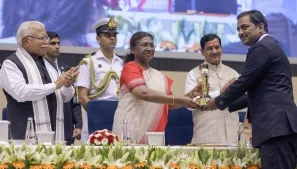
- On 11 November 2026, President Droupadi Murmu presented the Swachh Survekshan Awards 2025-26 at Vigyan Bhawan, New Delhi.
- The event was organised by the Department of Urban Development under the Ministry of Housing and Urban Affairs.
- The objective of Swachh Survekshan is to assess sanitation, solid waste management, sanitation services, and citizen participation in urban areas.
- For the first time, special categories such as Clean Riverfront Cities, Clean Coastal Cities, and Clean Himalayan Cities were introduced in this year's survey.
Swachh Survekshan
- Swachh Survekshan was launched in 2016 by the Ministry of Housing and Urban Affairs.
- Initially, only 73 cities were included in the survey.
- Its objective is to promote healthy competition among cities and Urban Local Bodies (ULBs) regarding cleanliness.
- It has become one of the world's largest urban sanitation surveys.
Major Award Categories of Swachh Survekshan 2025-26
- A total of 60 awards were announced at the national level this year.
(A) Super Swachh League
- This category includes cities that have consistently demonstrated excellent performance, allowing their achievements to be recognised separately.
Top Three Cities:
- Navi Mumbai
- Surat
- Vijayawada
Cities with a Population of More Than 1 Million
Top Three Cities:
- Visakhapatnam
- Jabalpur
- Lucknow
Cities with a Population of 3–10 Lakh
- First Position – Ujjain, Madhya Pradesh
- Second Position – Chandigarh
- Third Position – Guntur, Andhra Pradesh
Cities with a Population of 50,000 to 3 Lakh
- First Position – Dewas, Madhya Pradesh
- Second Position – NDMC, Delhi
- Third Position – Sagar, Madhya Pradesh
Cities with a Population of 20,000 to 50,000
- First Position – Vita, Maharashtra
- Second Position – Aska, Odisha
- Third Position – Panaji, Goa
Cities with a Population of Less Than 20,000
- First Position – Bilha, Chhattisgarh
- Second Position – Panchgani, Maharashtra
- Third Position – Budhni, Madhya Pradesh
(B) Swachh Shehar Jodi (Clean City Partnership)
- This initiative promotes cooperation, knowledge exchange, and improved sanitation management among cities.
- Under this initiative, a better-performing city (Mentor City) is paired with a relatively weaker-performing city (Mentee City).
Top Three City Pairs:
- Ahmedabad – Sanand
- Indore – Depalpur
- Tirupati – Kuppam
(C) Clean Riverfront Cities
- This category has been introduced to promote cleanliness and waste management in cities located along riverbanks.
Top Three Cities:
- Rewa
- Bilaspur
- Varanasi
(D) Clean Coastal Cities
- This category has been introduced to promote cleanliness of beaches, protect coastal ecosystems, and reduce marine pollution.
Top Three Cities:
- Puri
- Alappuzha
- Ratnagiri
(E) Clean Himalayan Cities
- This category has been introduced keeping in mind the specific waste management challenges faced by hilly and Himalayan regions.
Top Three Cities:
- Rudrapur – Uttarakhand
- Jammu – Jammu and Kashmir
- Shopian – Jammu and Kashmir
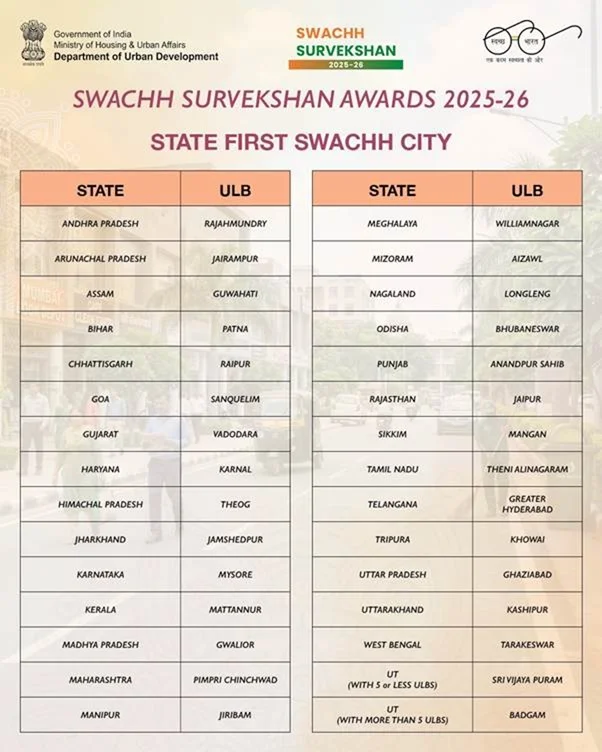
Evaluation Methodology
Under Swachh Survekshan 2025-26, Urban Local Bodies were evaluated on the basis of 43 indicators across 10 major assessment areas.
10 Major Assessment Areas
1. Waste Segregation: Separate collection of wet, dry, and other types of waste.
2. Collection and Transportation: Door-to-door waste collection and its safe transportation.
3. Solid Waste Management: Processing, recycling, and disposal of waste.
4. Visible Cleanliness: Cleaning of roads, public places, and markets.
5. Access to Sanitation: Availability of public and community toilets.
6. Mechanisation of Faecal Sludge Management: Safe mechanical cleaning of septic tanks.
7. Institutional and Ecosystem Framework: Strengthening institutional capacity and sanitation systems.
8. Used Water Management: Treatment and reuse of wastewater.
9. Sanitation Awareness: Public awareness and behavioural change.
10. Safai Mitra Welfare and Citizen Participation: Welfare of sanitation workers, citizen feedback, and grievance redressal.
Significance of Swachh Survekshan
- Promotes healthy competition among cities and states.
- Encourages local bodies to adopt new technologies and management practices to improve their performance.
- Incorporates citizens' feedback into the evaluation process.
- Promotes cleanliness as a collective responsibility rather than merely a government responsibility.
- Scientific waste disposal helps reduce land, water, and air pollution.
- Special categories for riverfront and coastal cities give importance to ecological conservation.
- Focuses on the safety, health, and dignified working conditions of Safai Mitras.
- Encourages efforts to eliminate manual scavenging and unsafe sewer cleaning practices.
- GPS-based monitoring, digital verification, and data-driven evaluation enhance accountability.
- Enables comparative assessment of the performance of local administrations.
Major Challenges
- Effective segregation of wet and dry waste is not practised in many areas.
- Mixed waste makes recycling and scientific processing difficult.
- Legacy waste dumps in cities cause land and groundwater pollution.
- Landfills release greenhouse gases such as methane.
- Many municipal bodies lack adequate financial resources, trained personnel, and technical capacity.
- Small cities have weak waste management infrastructure.
- Workers face serious risks to their lives while cleaning sewers and septic tanks.
- Lack of protective equipment and mechanisation remains a major challenge.
- Citizens continue to engage in littering, excessive use of plastic, and polluting public spaces.
- Sometimes, cities may focus more on securing rankings than achieving actual improvements in cleanliness.
There may be a gap between special cleaning efforts during the survey period and regular maintenance throughout the year.
Preliminary Examination Question (Prelims)
Question: Which of the following is the correct order of the top three cities under the Super Swachh League in Swachh Survekshan 2025-26?
(a) Indore, Surat, Navi Mumbai
(b) Navi Mumbai, Surat, Vijayawada
(c) Surat, Vijayawada, Navi Mumbai
(d) Vijayawada, Navi Mumbai, Surat
Mains Question
Question: Swachh Survekshan has emerged as an important instrument for improving sanitation and solid waste management in urban areas. Discuss its objectives, evaluation methodology, and significance while analysing the challenges associated with its effective implementation.
|
FAQ (Frequently Asked Questions)
Q1. When and by which ministry was Swachh Survekshan launched?
Answer:
- Year of launch – 2016.
- Ministry – Ministry of Housing and Urban Affairs.
Q2. Which city secured the first position in the Super Swachh League?
Answer: Navi Mumbai.
Q3. Which city secured the first position among cities with a population of more than 1 million?
Answer: Visakhapatnam.
Q4. Which city secured the first position in the Clean Riverfront Cities category?
Answer: Rewa.
Q5. What is the main objective of the Swachh Shehar Jodi initiative?
Answer: To transfer the experiences and best practices of better-performing cities (Mentor Cities) to relatively weaker-performing cities (Mentee Cities), thereby improving sanitation management through cooperation and knowledge sharing.
|