Why in the News ?
Scientists have discovered two new species of micro-snails in limestone caves in India's northeastern state of Meghalaya. The discovery highlights the undiscovered diversity hidden in India's biodiversity-rich Indo-Burma Biodiversity Hotspot. Researchers identified two new species—Georissa meghalayaensis and Acmella bensoni-in the Krem Puri and Arwah cave systems of Meghalaya.
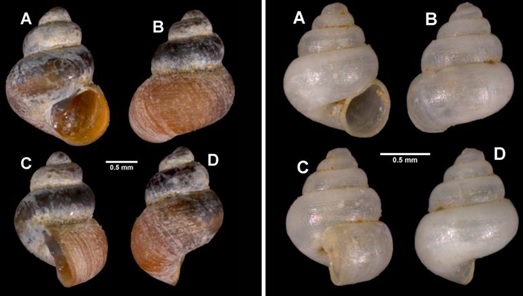
Georissa meghalayaensis: A new species named after Meghalaya
- The first new species, Georissa meghalayaensis, was discovered near the entrance of the Krem Puri Cave.
- It is distinguished from its closely related snails by its orange-red color and the reticulated projections on its shell.
- Scientists named it "meghalayaensis" in honor of the state of Meghalaya, as the species is currently found only in this region.
Acmella bensoni: A tribute to the pioneer of Indian malacology
- The second new species, Acmella bensoni, was found on the inner walls of the Krem Puri and Arwah caves. Its shell is small, slightly translucent, and white in color.
- This species is named in honor of the renowned 19th-century scientist William H. Benson, who is considered a pioneer of malacology (the study of molluscs) in India.
Microscopic in size, but of great scientific importance
- Both of these snails are so small that they are difficult to see with the naked eye. Their distinctive features can only be clearly identified with the aid of a microscope.
- Scientists believe that studying the structure and evolution of these species will contribute significantly to understanding subterranean ecosystems.
The Rich Biodiversity of the Indo-Burma Hotspot
- Northeast India is part of the Indo-Burma Biodiversity Hotspot, one of the world's 36 major biodiversity hotspots. This region represents a confluence of biodiversity from Southeast Asia, China, and the Indian subcontinent.
- According to experts, the region contains more than 1,200 limestone caves, which provide ideal habitats for shellfish like mollusks. Despite this, limited studies have been conducted on its microbial diversity.
Tourism poses a growing threat
- Researchers have warned that increasing tourism activities in caves could pose a threat to these fragile ecosystems.
- Specifically:
- Excessive tourist traffic
- Artificial lighting
- Construction of stairs and other structures
- Can impact the natural habitat of these microorganisms. Scientists have stressed the need for sustainable tourism to preserve cave ecosystems.
Why is this discovery important for biodiversity conservation ?
- This discovery demonstrates that India's underground ecosystems harbor numerous species yet to be identified. Despite their tiny size, these organisms play a vital role in maintaining ecological balance.
- The discovery of new species not only enriches India's biodiversity but also provides new directions for conservation science, evolutionary studies, and ecological research.






 Contact Us
  New Batch : 9555124124/ 7428085757
  Tech Support : 9555124124/ 7428085757