Prelims: Science & Technology | Defence Technology | Missile Systems | International Relations
Mains: GS-II – International Relations | GS-III – Defence & Security
Keywords: Typhon, Mid-Range Capability (MRC), Tomahawk, SM-6, Mk 41 VLS, Precision Strike, Sea Denial, First Island Chain, Indo-Pacific, Missile Deterrence |
Why in News?
- Russia recently warned Japan over the deployment of the U.S. Typhon missile system, describing such deployment as unacceptable and a potential threat to Russian security.
- The development has drawn attention to the growing deployment of land-based long-range precision-strike systems in the Indo-Pacific and their implications for regional security.
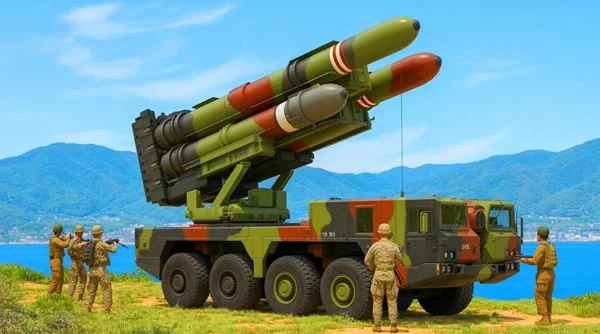
About Typhon Missile System
- The Typhon Weapon System, also known as the Mid-Range Capability (MRC), is a land-based surface-to-surface missile system operated by the U.S. Army.
- It provides ground forces with the capability to conduct long-range precision strikes against both land and maritime targets.
- The system uses a modular and mobile architecture that allows military units to deploy missile launchers across dispersed locations.
Who Manufactures Typhon?
- The Typhon system has been developed for the U.S. Army, with Lockheed Martin serving as a major industry partner.
- One of its important features is that it adapts the Mk 41 Vertical Launching System (VLS) technology, which has traditionally been used aboard U.S. Navy warships, for land-based operations.
Missiles Used by Typhon
The Typhon system can launch two important missile types:
- Tomahawk Cruise Missile: The Tomahawk is a long-range cruise missile primarily designed for precision strikes against land targets. Its long range allows Typhon units to strike targets located deep inside contested areas while remaining relatively far from the battlefield.
- SM-6 Missile: The Standard Missile-6 (SM-6) is a highly versatile missile that can be employed against different types of targets. In the Typhon configuration, it significantly strengthens the U.S. Army's ability to conduct precision strikes and maritime targeting operations.
Structure of a Typhon Battery
- A Typhon battery consists of several mobile components designed to operate together.
- A typical configuration includes four trailer-mounted launchers. Each launcher contains four launch cells, giving the battery a total of 16 launch cells.
- The battery is supported by a mobile command-and-control system and associated support vehicles, allowing the system to be deployed and repositioned according to operational requirements.
Why is Typhon Strategically Important?
- Long-Range Precision Strike: Typhon provides ground forces with the ability to attack important targets from considerable distances. This reduces dependence on aircraft or naval vessels for some long-range strike missions.
- Sea Denial Capability: Its ability to engage maritime targets makes the system important in areas containing strategically significant seas and maritime chokepoints. Land-based missile batteries can potentially threaten hostile naval forces operating within their strike envelope.
- High Mobility: The system is road-mobile, allowing launchers to relocate after deployment. Mobility improves survivability because adversaries must locate and track dispersed launch units before targeting them.
- Distributed Operations: Typhon batteries can be dispersed across allied territories or strategically important islands. This supports the U.S. military concept of creating distributed precision-strike networks rather than relying only on a few large military bases.
Why is Typhon Important in the Indo-Pacific?
- The Indo-Pacific contains several strategically important maritime zones, including the East China Sea, South China Sea and Western Pacific.
- Land-based long-range missile systems deployed on islands or allied territories can significantly influence the military balance in these areas.
Why is Russia Concerned?
- Russia views the deployment of U.S. long-range missile systems close to its territory as a potential security challenge.
- Japan's geographical position is particularly significant because it lies close to Russia's Far East, while also occupying a strategically important position in the Western Pacific.
- Moscow therefore fears that expansion of U.S. missile infrastructure in Japan could alter the regional military balance and increase strategic pressure on Russia.
Japan's Strategic Importance
Japan occupies a crucial geographical position along the First Island Chain, stretching across the Western Pacific.
Its location places it close to:
- Russian Far East
- Korean Peninsula
- East China Sea
- Taiwan
- Western Pacific
Therefore, deployment of long-range U.S. missile capabilities in or around Japan has implications extending beyond Russia to the wider Indo-Pacific strategic balance.
Way Forward
- Growing deployment of intermediate and long-range missile systems makes strategic communication and confidence-building measures increasingly important.
- Major powers need mechanisms to reduce misunderstanding regarding missile deployments, military exercises and strategic intentions.
- At the same time, Indo-Pacific countries are likely to continue investing in precision-strike, missile-defence and surveillance capabilities, making missile technology an increasingly important element of the regional balance of power.
Prelims MCQ
Q. With reference to the Typhon Missile System, consider the following statements:
- It is a land-based missile system operated by the U.S. Army.
- It is capable of launching Tomahawk and SM-6 missiles.
- It is designed exclusively for ballistic missile defence.
Which of the statements given above are correct?
(a) 1 only
(b) 1 and 2 only
(c) 2 and 3 only
(d) 1, 2 and 3
Mains Question
Q. The deployment of land-based long-range precision-strike systems is emerging as an important feature of the Indo-Pacific security architecture. Examine with reference to the U.S. Typhon missile system.
|
FAQs
What is the Typhon Missile System?
Typhon, also known as the Mid-Range Capability (MRC), is a land-based missile system operated by the U.S. Army for long-range precision-strike missions.
Which missiles can Typhon launch?
The system is designed to launch Tomahawk cruise missiles and SM-6 missiles.
Is Typhon a mobile missile system?
Yes. Typhon uses road-mobile, trailer-mounted launchers, allowing military units to disperse and reposition the system.
Why is Typhon important in the Indo-Pacific?
Its combination of mobility, long-range precision strike and maritime targeting capability makes it useful for operations across the island-dominated geography of the Western Pacific.
Why is Russia opposing its deployment in Japan?
Russia considers the deployment of U.S. long-range strike capabilities near its Far Eastern territory a potential threat to its security and regional strategic balance.
|






 Contact Us
  New Batch : 9555124124/ 7428085757
  Tech Support : 9555124124/ 7428085757