UAE's Withdrawal from OPEC and OPEC+: A Major Shift in Global Energy Politics
A major and unusual development has occurred in the global energy system, with the United Arab Emirates (UAE) formally announcing its withdrawal from OPEC and OPEC+.
This decision is not only impacting oil markets but also has the potential to alter the global geopolitical balance.
Background:
This decision was taken on April 28, 2026. It came at a time when global oil markets were already under stress, and the ongoing conflict with Iran has destabilized energy supplies.
The risk of disruptions to crude oil and gas supplies increased in many countries.
Key Reasons for UAE's Withdrawal
(i) Security Discontent and Lack of Military Support
The UAE alleged that other Arab countries failed to provide adequate support during Iranian attacks against it.
The collective security system in the Gulf region weakened.
Defense cooperation remained limited to paperwork, with no real action.
(ii) Disappointment with Regional Organizations
The UAE described the role of the Gulf Cooperation Council (GCC) as weak.
The Arab League's response was also considered ineffective.
The UAE believes that these organizations did not show decisive leadership during the crisis.
(iii) Strait of Hormuz Crisis
The Strait of Hormuz is one of the world's most important oil routes.
Approximately 20% of global crude oil and LNG passes through it.
Attacks and threats on ships by Iran have made this route extremely vulnerable.
This has affected oil trade in the entire Gulf region, including the UAE.
(iv) Policy of Strategic Independence
The UAE now wants greater control over its energy production and export policy.
It wants to increase flexibility by exiting OPEC's production quota system.
A strategy is being adopted to play a more competitive role in the global market.
Impact on OPEC and OPEC+
The UAE has long been a key member of OPEC; its exit could weaken the organization's unity.
Saudi Arabia's leadership role would be under pressure.
Internal differences in setting production quotas could deepen, impacting OPEC+'s ability to make collective decisions.
Impact on the Global Energy Market
Oil Price Volatility : Sharp fluctuations in crude oil prices are possible, increasing investor uncertainty.
Supply Chain Pressure : The risk of disruptions to global oil and gas supplies will increase. Importing countries in Europe and Asia may be more affected.
Possibility of New Energy Alliances : New energy agreements may be formed with non-OPEC countries, making global energy politics more multipolar.
Role of the United States and Western Countries
Donald Trump previously accused OPEC of raising oil prices; this move by the UAE is considered favorable to US strategic thinking.
This could change the energy-political equation between the Gulf countries and the US.
The US may have to redefine its energy security strategy in the Middle East.
Impact on Middle East Geopolitics
The lack of unity among Gulf countries may become more pronounced, and Iran-Gulf tensions are likely to escalate.
A reconsideration of the regional security framework may be necessary.
Changes to military alliances and defense agreements are possible.
OPEC and OPEC+
OPEC and OPEC+ are the world's most important oil-producing organizations.
Their primary function is to control the price and supply of crude oil worldwide.
What is the Organization of the Petroleum Exporting Countries (OPEC) ?
OPEC stands for Organization of the Petroleum Exporting Countries.
Founded at the Baghdad (Iraq) Conference in September 1960, OPEC was originally established by five founding members: Iran, Kuwait, Iraq, Saudi Arabia, and Venezuela.
It was created in response to the dominance of Western multinational oil companies (the "Seven Sisters"), which previously controlled prices.
The United Arab Emirates (UAE) formally joined OPEC in 1967.
Headquarters: Its headquarters are in Vienna, Austria.
Objective : To harmonize the oil policies of member countries so that oil prices remain stable and producing countries receive fair profits.
Saudi Arabia is considered the most powerful country in this group.
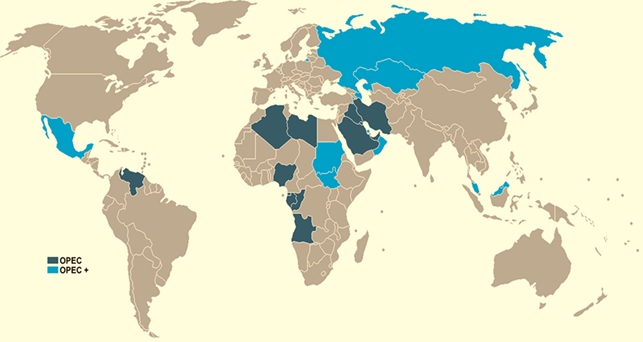
Current member countries (12 countries) : United Arab Emirates (UAE) as well as Algeria, Congo, Equatorial Guinea, Gabon, Iran, Iraq, Kuwait, Libya, Nigeria, Saudi Arabia, Venezuela.
What is OPEC+?
OPEC+ is not a separate organization, but an alliance of OPEC and 10 other non-OPEC oil-producing countries.
Formation : It was formed in 2016 when oil prices fell sharply.
Objective : It included major oil producers like Russia to gain greater control over the global oil market.
Russia is the most important non-OPEC member of this group.
10 additional countries of OPEC+ :
Russia, Kazakhstan, Azerbaijan, Bahrain, Brunei, Malaysia, Mexico, Oman, South Sudan and Sudan.





 Contact Us
  New Batch : 9555124124/ 7428085757
  Tech Support : 9555124124/ 7428085757