
- UPSC Exam
- State PCS
- One Day Exam
- Current Affairs
- PT Quiz
- Downlaods
- About Coaching
- Blog
- Videos

| Prelims: (Economy + CA) Mains: (GS 2 – Governance, Urban Development, Local Bodies; GS 3 – Infrastructure, Growth, Public Investment) |
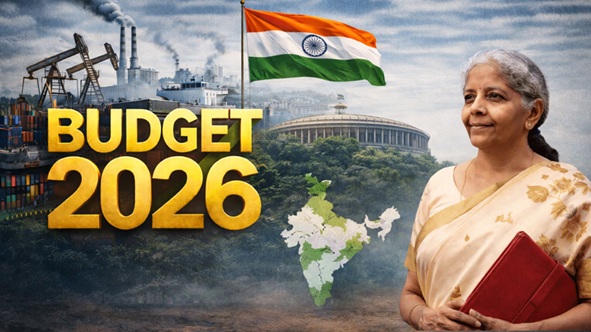
The Union Budget 2026 has reduced central allocations for urban development by 11.6%, triggering debate over the government’s commitment to India’s cities at a time of rapid urbanisation, infrastructure stress, and climate vulnerability.
Urban India lies at the heart of the country’s economic and social transformation:
The 74th Constitutional Amendment Act envisaged empowered municipalities with financial and functional autonomy. However, in practice, inadequate devolution of funds, functions, and functionaries has constrained the capacity of urban local bodies (ULBs).
To bridge this gap, the Centre introduced flagship schemes such as:
These interventions aimed to create a minimum standard of urban services across Indian cities.
Urban development financing in India rests on four pillars:
While capital-intensive projects such as metro rail have received consistent support, everyday urban services—such as:
depend on stable and predictable funding, which remains inadequate.
The growing impact of climate risks—including heatwaves, floods, and water scarcity—has further increased the need for resilient and adaptive urban infrastructure, making urban investment a macroeconomic imperative rather than merely a welfare concern.
The Union Budget 2026 has reduced total central outlay for urban development from ₹96,777 crore to ₹85,522 crore, a nominal cut of 11.6%.
The reduction signals a shift in fiscal priorities, with urban development increasingly treated as a residual sector rather than a growth-critical investment area.
Despite the overall reduction, urban spending remains heavily skewed towards metro rail projects:
While metros are important for large cities, they are:
By contrast, bus-based public transport, non-motorised transport, and last-mile connectivity—used by the majority of urban residents—receive relatively limited attention.
This reflects a policy bias towards high-visibility infrastructure over inclusive, scalable, and everyday mobility solutions.
All major urban welfare and service delivery schemes have faced budgetary reductions:
These cuts directly affect the quality of urban life and risk reversing progress in basic services.
The Budget does not offset reduced central spending through:
As a result:
At a macro level, weakening urban investment undermines India’s growth aspirations. Globally, successful development trajectories are built on well-funded, inclusive, and productive cities. Treating urban development as a cost centre rather than a growth engine risks long-term economic, social, and environmental consequences.
To realign urban development with India’s growth and sustainability goals, policymakers should:
Such reforms can reposition cities as engines of inclusive growth, social mobility, and climate resilience.
FAQsWhy is the reduction in urban allocations significant ? Because cities drive economic growth and service delivery, and reduced funding can weaken infrastructure, governance, and long-term development outcomes. Which urban schemes faced major budget cuts in 2026 ? PMAY-Urban, Swachh Bharat Mission-Urban, and AMRUT have all seen significant reductions. Why is spending on metro rail considered skewed ? Metro systems are capital-intensive and serve limited populations, while mass everyday mobility needs—such as buses and non-motorised transport—remain underfunded. How does reduced urban spending affect municipalities ? It limits their ability to plan long-term projects, maintain infrastructure, and respond to local needs due to continued fiscal dependence. What reforms are needed to strengthen urban development ? Increased funding, greater fiscal devolution, stronger municipal revenues, inclusive mobility investments, and climate-resilient urban planning. |



Our support team will be happy to assist you!

 Contact Us
  New Batch : 9555124124/ 7428085757
  Tech Support : 9555124124/ 7428085757