Why in news?
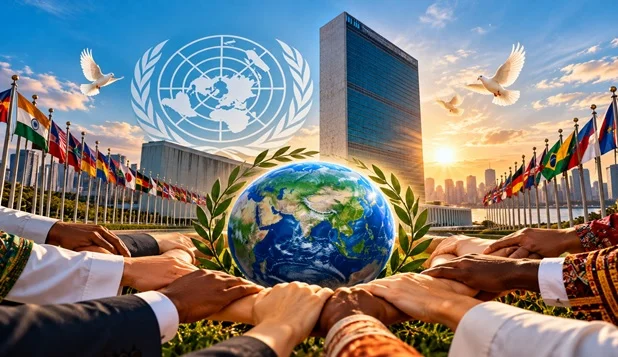
United Nations Day is observed every year on 24 October to mark the anniversary of the entry into force of the United Nations Charter in 1945.
Key Facts
|
Fact
|
Detail
|
|
United Nations Day
|
24 October
|
|
Year of establishment of UN
|
1945
|
|
UN Charter signed
|
26 June 1945
|
|
UN Charter came into force
|
24 October 1945
|
|
Original member states
|
51
|
|
Current member states
|
193
|
|
Headquarters
|
New York City, USA
|
|
Founding document
|
United Nations Charter
|
|
Main objectives
|
Peace, security, human rights and international cooperation
|
|
UN Day officially designated
|
1947
|
|
First annual observance
|
1948
|
|
Universal Declaration of Human Rights
|
1948
|
|
Sustainable Development Goals adopted
|
2015
|
What is the United Nations?
- The United Nations (UN) is an international organisation established in 1945 after the Second World War.
- It was created to prevent future wars, maintain international peace and security, promote human rights and encourage cooperation among countries.
- The UN provides a common platform where countries can discuss international problems, negotiate agreements and work towards shared solutions.
- Its work also includes humanitarian assistance, public health, education, environmental protection and sustainable development.
- The organisation currently has 193 member states, making it a central forum for international cooperation.
Why is 24 October observed as United Nations Day?
- The United Nations Charter was signed on 26 June 1945 in San Francisco, United States.
- It came into force on 24 October 1945, after ratification by the required countries, including the five permanent members of the Security Council.
- The United Nations officially came into existence on this date.
- In 1947, the UN General Assembly designated 24 October as United Nations Day.
- The day has been observed annually since 1948 to increase awareness of the organisation's aims and achievements.
Main Objectives of the United Nations
- Maintaining international peace and security: Preventing conflicts and encouraging peaceful settlement of disputes.
- Promoting friendly relations: Developing cooperation among nations based on equal rights and self-determination.
- Protecting human rights: Promoting dignity, equality and fundamental freedoms for all people.
- Encouraging international cooperation: Addressing economic, social, cultural and humanitarian problems.
- Supporting sustainable development: Improving living standards and promoting inclusive economic and social progress.
- Upholding international law: Encouraging countries to respect international agreements and legal principles.
Major Organs of the United Nations
|
Organ
|
Main Function
|
|
General Assembly
|
Provides a forum for all member states to discuss international issues.
|
|
Security Council
|
Has primary responsibility for maintaining international peace and security.
|
|
Economic and Social Council (ECOSOC)
|
Coordinates work on economic, social and related development issues.
|
|
International Court of Justice (ICJ)
|
Settles legal disputes between states that fall within its jurisdiction and gives advisory opinions.
|
|
Secretariat
|
Carries out the day-to-day administrative work of the UN.
|
|
Trusteeship Council
|
Suspended its operations in 1994 after the completion of its original mission.
|
Role of the United Nations in Global Affairs
- Peacekeeping: UN peacekeeping missions help support ceasefires, protect civilians under authorised mandates and assist political transitions.
- Humanitarian assistance: UN agencies provide food, shelter, healthcare and other assistance to people affected by conflicts and disasters.
- Global health: The World Health Organization (WHO) coordinates international public health efforts and disease-control initiatives.
- Child welfare: UNICEF works to protect children's rights and improve access to healthcare, nutrition, education and clean water.
- Refugee protection: The United Nations High Commissioner for Refugees (UNHCR) helps protect refugees and other displaced people.
- Environmental protection: The UN supports international cooperation on climate change, biodiversity and environmental sustainability.
- Sustainable development: The organisation promotes the 17 Sustainable Development Goals adopted in 2015.
India's Role in the United Nations
- Founding member: India was among the original 51 members of the United Nations in 1945.
- Peacekeeping contributions: India has a long history of contributing military personnel, police officers and other specialists to UN peacekeeping operations.
- Decolonisation: India has supported the principle of self-determination and the end of colonial rule.
- Sustainable development: India's development priorities, including sanitation, healthcare, education and clean energy, are connected with the Sustainable Development Goals.
- Climate action: India participates in international climate negotiations and supports cooperation on sustainable development.
- Security Council reforms: India advocates reform of the UN Security Council to make it more representative of contemporary global realities.
- Global South: India has called for greater consideration of the priorities and concerns of developing countries in international decision-making.
What is the UN Security Council?
- The United Nations Security Council is one of the six principal organs of the organisation.
- It has 15 members, including five permanent members and ten non-permanent members elected for two-year terms.
- The five permanent members are China, France, Russia, the United Kingdom and the United States.
- The permanent members possess veto power over substantive decisions.
- The Security Council has primary responsibility for maintaining international peace and security.
- India seeks permanent membership in an expanded Security Council, arguing that its current composition does not adequately reflect today's global realities.
Sustainable Development Goals (SDGs)
- The United Nations adopted 17 Sustainable Development Goals in 2015 as part of the 2030 Agenda for Sustainable Development.
- These goals aim to address poverty, hunger, health, education, gender equality, clean water, affordable energy and other development priorities.
- They also cover decent work, reduced inequalities, sustainable cities, responsible consumption, climate action and environmental protection.
- The goals are interconnected and require cooperation among governments, international organisations, businesses and communities.
- The target year for achieving the SDGs is 2030.
Importance
- Promotes peace: Encourages countries to resolve disputes through dialogue and diplomacy.
- Raises awareness: Helps people understand the role of international institutions.
- Supports human rights: Reinforces the importance of dignity, equality and freedom.
- Encourages cooperation: Highlights the need for joint action on global problems.
- Promotes development: Draws attention to poverty reduction, education, healthcare and environmental sustainability.
- Strengthens multilateralism: Emphasises the importance of countries working together through international institutions.
Challenges
- Ongoing conflicts: The UN often struggles to stop wars when conflicting parties refuse negotiations or major powers disagree.
- Security Council reform: Disagreements over permanent membership and veto powers make reform difficult.
- Climate change: International commitments need stronger implementation, finance and cooperation.
- Poverty and inequality: Many communities continue to lack adequate food, healthcare, education and economic opportunities.
- Funding constraints: Limited or delayed contributions can affect humanitarian and development programmes.
- Geopolitical rivalries: Competition among major powers can weaken collective decision-making.
- New global risks: Cyber security threats, artificial intelligence and misinformation require greater international cooperation.
Prelims MCQ
Q. United Nations Day is observed on which date?
A. 5 June
B. 24 October
C. 10 December
D. 21 September
Mains Practice Questions
Explain the role of the United Nations in maintaining international peace and security. Discuss its major limitations.
|
FAQs
When is United Nations Day observed?
24 October.
When was the United Nations established?
24 October 1945.
What is the UN Charter?
The UN Charter is the founding document of the United Nations. It defines the organisation's objectives, principles, structure and powers.
How many member states does the UN have?
193 member states.
Where is the UN headquarters located?
New York City, United States.
|





 Contact Us
 New Batch : 9555124124/ 7428085757
 Tech Support : 9555124124/ 7428085757
