Why in News?
- To reduce the risk of Glacial Lake Outburst Flood (GLOF) in Uttarakhand, the state’s first Glacial Lake Early Warning System is being installed.
- The system is being installed at Vasundhara Tal in Chamoli district. Its objective is to conduct real-time monitoring of changes in water level, weather, snow and water flow in and around the glacial lake.
- This initiative is significant because the expansion of glacial lakes and the associated flood risk are increasing across the Himalayan region, including Uttarakhand.
What is a Glacial Lake?
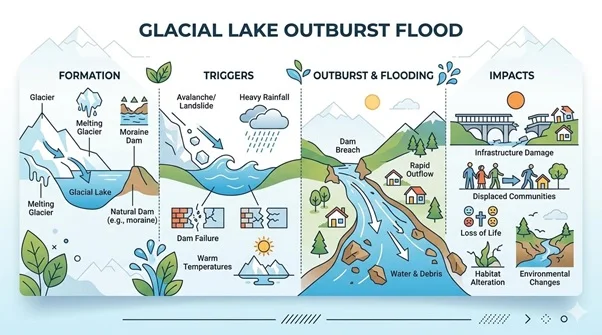
- A glacial lake is a lake formed by water accumulating around a glacier due to glacier retreat or melting.
- Such lakes are often surrounded by natural dams made of ice, debris and rocks. If this natural dam suddenly breaks, a large volume of water can rapidly flow downstream. This phenomenon is known as a Glacial Lake Outburst Flood (GLOF).
- A GLOF can cause a sudden rise in river water levels and damage villages, roads, bridges, hydropower projects and other infrastructure located downstream.
Status of Glacial Lakes in Uttarakhand
- According to the National Remote Sensing Centre (NRSC), 344 glacial lakes were identified in Uttarakhand in 2023.
- The National Disaster Management Authority (NDMA) has identified 13 glacial lakes as high-risk lakes.
- Among these 13 lakes:
- 5 lakes fall under Category-A, the highest-risk category.
- 6 high-risk lakes are located in Pithoragarh.
- 4 are located in Chamoli.
- 1 each is located in Bageshwar, Tehri Garhwal and Uttarkashi.
- Vasundhara Tal is also among these high-risk glacial lakes.
From Survey to Real-Time Monitoring
- The Uttarakhand State Disaster Management Authority (USDMA) has prepared a comprehensive plan for the study and regular monitoring of glacial lakes.
- The process has two major stages:
- Scientific Survey: The first stage involves studying the lake’s length, width, depth, topography and water-holding capacity, along with assessing the potential water flow that could emerge from the lake.
- Real-Time Monitoring: The second stage involves installing sensors and other equipment to continuously monitor changes in water level, weather, snow and water flow.Uttarakhand is now moving towards this second stage.
What Sensors Will Be Installed at Vasundhara Tal?
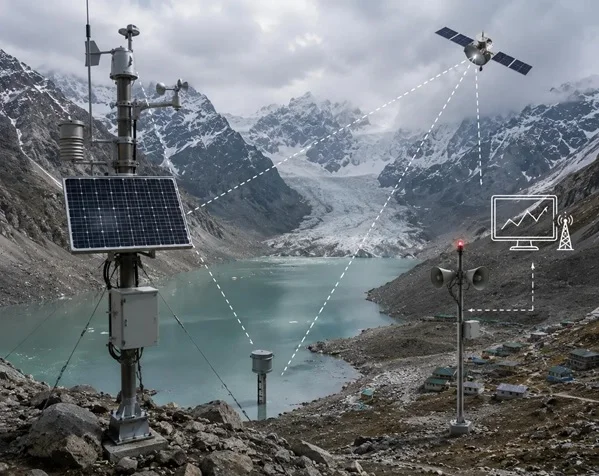
The system being installed at Vasundhara Tal will monitor various environmental and hydrological parameters.
- Water Level Sensor:-It will record normal as well as abnormal changes in the lake’s water level.
- Automatic Weather Station :-It will record weather-related parameters such as temperature, humidity, rainfall, wind speed and direction, atmospheric pressure and light intensity.
- Snow-Depth and Sub-Surface Temperature Sensors :-These sensors will monitor changes in snow thickness and temperature below the surface.
- Tilt and Accelerometer Sensors :-These sensors will detect movement and vibrations of the ground or selected structures.
- Water-Flow Sensor :-It will record changes in the flow of water emerging from the lake.
How Will the System Work?
- The Early Warning System will be powered by solar energy.
- Since mobile network connectivity is unavailable in remote high-altitude Himalayan areas such as Vasundhara Tal, data will be transmitted through satellite communication.
- A data logger and monitoring dashboard will record data received from the sensors. When an abnormal change crosses a predetermined threshold, the system will generate an alert.
- This will help identify potential hazards at an early stage and enable disaster management agencies to take timely action.
Why is Bathymetric Survey Important?
- A Bathymetric Survey of a glacial lake helps determine its depth and estimate the volume of water stored in it.
- In Uttarakhand, bathymetric surveys of six lakes have been completed:
- Saraswati Tal — Chamoli
- Vasundhara Tal — Chamoli
- Kedartal — Uttarkashi
- Mabang — Pithoragarh
- Pyungaru — Pithoragarh
- Syunkati Yankti — Pithoragarh
- These data can be used to estimate the volume of water that could be released during a potential GLOF and assess its possible downstream impact.
Why is the Risk of GLOF Increasing?
- Rising temperatures in the Himalayas can accelerate glacier melting and retreat. This may lead to the formation of new glacial lakes and the expansion of existing ones.
- Weakening of the natural dams surrounding such lakes can increase the possibility of sudden lake outburst events.
- In recent years, floods, landslides, avalanches and glacier-related events across the Himalayan region have highlighted the need for enhanced monitoring of these risks.
Lessons from Recent Events
- Following a recent flood event in Nepal, greater attention was given to monitoring glacial lakes and glacier-related processes.
- Similarly, during the Dharali flash flood in Uttarakhand, experts discussed several possible causes, including the possibility of a glacial lake outburst. However, different possibilities were reported regarding the exact trigger of the event.
- These events have highlighted that merely identifying vulnerable lakes is not sufficient. Continuous scientific and real-time monitoring systems are also necessary.
Importance of the Early Warning System
Early Warning of Disasters
Abnormal changes in water level, weather and water flow can be detected at an early stage.
Reducing Loss of Life
Early warnings can help authorities alert people living in downstream areas and prepare for evacuation.
Protection of Infrastructure
Roads, bridges, hydropower projects and other critical infrastructure can receive advance information about potential risks.
Scientific Disaster Management
Real-time data can enable more scientific assessment and management of disaster risks.
Monitoring Himalayan Ecology
Over the long term, the system can help understand changes in temperature, snow cover, water levels and glacial lakes.
Major Challenges
Difficult Geographical Conditions
Extreme altitude, difficult terrain and harsh weather conditions in the high Himalayas make the installation and maintenance of equipment challenging.
Communication Infrastructure
The absence of mobile networks creates a strong dependence on satellite-based communication systems.
Timely Delivery of Warnings
Detecting changes in a glacial lake is not enough. The biggest challenge is ensuring that the information reaches people living in downstream areas in time.
Multi-Hazard Risk
The Himalayas face multiple hazards, including GLOFs, landslides, avalanches, extreme rainfall and flash floods. Therefore, an integrated disaster monitoring system is essential.
Way Forward
- Uttarakhand should gradually develop a real-time monitoring network for all high-risk glacial lakes.
- Sensor-based data should be integrated with weather forecasts, satellite imagery and Digital Elevation Models (DEMs) to develop a multi-hazard early warning system.
- Local communities should be regularly trained in post-warning actions, safe evacuation routes and disaster response.
- Data and information-sharing mechanisms among central and state disaster management agencies, scientific institutions and security forces should also be strengthened.
Conclusion
- The Early Warning System at Vasundhara Tal represents an important shift in glacial lake management in Uttarakhand—from mapping and assessment to real-time monitoring.
- However, effective disaster management cannot depend solely on sensor-based monitoring. Scientific data, timely warnings, robust communication systems, community participation and rapid response mechanisms must be developed together.
MCQ
Q1. Consider the following statements regarding GLOF:
- The full form of GLOF is Glacial Lake Outburst Flood.
- It can occur when the natural dam of a glacial lake suddenly breaks.
- GLOF can pose a risk of flooding in downstream areas.
Which of the statements given above are correct?
A. Only 1 and 2
B. Only 2 and 3
C. Only 1 and 3
D. 1, 2 and 3
|
FAQs
1. What is a Glacial Lake Outburst Flood (GLOF)?
Answer: GLOF (Glacial Lake Outburst Flood) refers to a sudden flood caused by the outburst of a glacial lake. When the natural dam holding back a glacial lake suddenly breaks, a large volume of water rapidly flows downstream, potentially causing flash flooding.
2. Where is Uttarakhand’s first Glacial Lake Early Warning System being installed?
Answer: The system is being installed at Vasundhara Tal in Chamoli district.
3. What is the main objective of the Glacial Lake Early Warning System?
Answer: The main objective is to conduct real-time monitoring of the lake’s water level, weather conditions, snow, water flow and surrounding activities, and generate timely alerts when abnormal changes are detected.
|







 Contact Us
  New Batch : 9555124124/ 7428085757
  Tech Support : 9555124124/ 7428085757