Prelims: V-Dem Institute, Electoral Democracy Index, Liberal Democracy Index, Constitutional Democracy, Election Commission of India, Fundamental Rights
Mains: GS Paper II: Indian Constitution, Democracy, Electoral Reforms, Constitutional Institutions, Freedom of Speech, Civil Society, and Governance |
Why in news?
Senior Congress leader and Rajya Sabha MP P. Chidambaram has drawn attention to India's position in the Electoral Democracy Index (EDI) published by the Sweden-based Varieties of Democracy (V-Dem) Institute.
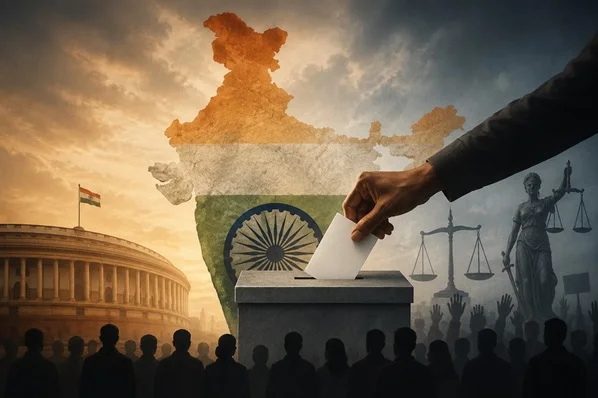
What is the V-Dem Institute?
- The Varieties of Democracy (V-Dem) Institute is an academic research institute based at the University of Gothenburg, Sweden.
- It describes democracy as a multidimensional concept rather than measuring it only through the existence of elections. Its dataset assesses different dimensions such as electoral, liberal, participatory, deliberative and egalitarian democracy.
- The 2026 dataset covers 179 countries for 2025. The V-Dem Dataset Version 16 and Democracy Report 2026, titled “Unraveling the Democratic Era?” were released in March 2026.
What is the Electoral Democracy Index (EDI)?
The EDI measures the extent to which the electoral principle of democracy is achieved in a country. The EDI broadly examines five major components:
|
Component
|
What it examines
|
|
Elected Officials
|
Whether political authority is held by elected representatives
|
|
Clean Elections
|
Whether elections are free from major fraud and systematic irregularities
|
|
Freedom of Association
|
Ability of political parties and civil society organisations to function
|
|
Freedom of Expression
|
Ability of citizens and media to express alternative political views
|
|
Suffrage
|
Extent to which adult citizens have voting rights
|
India's Position in V-Dem Democracy Report 2026
|
Indicator
|
India's Position/Score
|
|
Electoral Democracy Index
|
106th out of 179 countries
|
|
EDI Score
|
0.38
|
|
Liberal Democracy Index
|
105th
|
|
LDI Score
|
0.26
|
|
V-Dem Regime Classification
|
Electoral Autocracy
|
Why is 1975 Significant?
- The comparison to 1975 is significant because that year marks the imposition of the “National Emergency (1975–77)” under Prime Minister Indira Gandhi-a period widely regarded as the most serious rupture in India's post-Independence democratic history, marked by suspension of civil liberties, press censorship, and large-scale detention of political opponents without trial.
- By stating that India's current score is the lowest since that period, Chidambaram's remark implies that, on V-Dem's metrics, India's electoral democracy indicators today are statistically comparable to their weakest historical point-a claim that itself has been the subject of considerable methodological debate.
What Does “Electoral Autocracy” Mean?
Electoral autocracy is a regime in which multiparty elections for the executive exist but, according to V-Dem's criteria, the requirements necessary to make those elections meaningfully democratic are not sufficiently fulfilled. This does not mean elections do not occur. V-Dem's 2026 report places India in this category and argues that democratic institutions have weakened over time.
Electoral Democracy vs Liberal Democracy
- Electoral Democracy: Primarily focuses on whether rulers are accountable to citizens through competitive elections, alongside universal suffrage, freedom of association, clean elections and freedom of expression.
- Liberal Democracy: Goes further by examining whether electoral democracy is supported by rule of law, civil liberties, judicial and legislative constraints on the executive, protection of individual and minority rights, checks and balances. Thus, holding elections is not sufficient to achieve a high Liberal Democracy Index score.
How Does V-Dem Collect its Data?
- V-Dem uses a combination of factual information and expert-coded assessments. According to its methodology, it draws on a pool of more than 4,000 country experts, and typically around five or more experts assess an expert-coded indicator for a particular country-year.
- Statistical models are then used to aggregate judgments and account for differences in expert reliability, perceptions and uncertainty. This allows V-Dem to assess concepts that cannot always be directly observed.
Why Have V-Dem's Rankings Been Criticised in India?
- A 2022 working paper by members of the Economic Advisory Council to the Prime Minister (EAC-PM) criticised indices including V-Dem, Freedom House and the Economist Intelligence Unit's Democracy Index.
- The paper raised concerns regarding dependence on assessments by relatively small groups of experts, subjectivity of some questions, transparency and comparability of assessments, suitability of applying identical questions across very different political systems; and omission of some factors that the authors believed were relevant to assessing democracy.
- The paper argued that some global perception-based democracy indices have methodological limitations and called for greater transparency and accountability.
- V-Dem says expert assessments are necessary because many dimensions of democracy cannot be measured through directly observable statistics alone.
- It uses multiple experts and statistical measurement models designed to reduce individual bias and explicitly reports uncertainty in its estimates.
Constitutional Foundations of Indian Democracy
- Representative Government: India follows a parliamentary democratic system, with governments accountable to elected legislatures.
- Universal Adult Suffrage: Article 326 provides for elections to the Lok Sabha and State Legislative Assemblies on the basis of adult suffrage, subject to constitutional and statutory qualifications.
- Independent Election Commission: Article 324 provides for the Election Commission of India and vests it with the superintendence, direction and control of elections.
- Freedom of Speech: Article 19(1)(a) guarantees freedom of speech and expression, subject to reasonable restrictions under Article 19(2).
- Freedom of Association: Article 19(1)(c) protects the right to form associations or unions or cooperative societies, subject to constitutionally permitted restrictions.
- Independent Judiciary: The Supreme Court and High Courts exercise judicial review, which serves as an important constitutional check on legislative and executive action.
- Free and Fair Elections: The Supreme Court has repeatedly recognised free and fair elections as fundamental to India's constitutional democracy and linked democratic governance to the basic structure doctrine.
Why Does the Issue Matter for India?
- Institutional credibility matters. Independent and trusted institutions—including election-management bodies, courts, legislatures and accountability mechanisms—are central to democratic legitimacy.
- Freedom of expression and media pluralism matter. Citizens require access to competing ideas and information to make meaningful electoral choices.
- A strong opposition is part of parliamentary democracy. Democracy requires not merely majority rule but space for political competition, legislative scrutiny and dissent.
- Civil society strengthens participatory governance. Civil society organisations, academic institutions and citizen groups provide channels between the state and society beyond periodic elections.
- International perceptions have diplomatic significance. Democracy and rule of law increasingly feature in global discussions concerning governance, investment, human rights and international partnerships.
Prelims MCQ
Q. The Varieties of Democracy (V-Dem) Institute is based in which country?
A. Norway
B. Sweden
C. Switzerland
D. Denmark
Mains Practice Question
Q. “International democracy indices have raised concerns regarding the quality of electoral democracy in India. Critically examine the findings and limitations of such indices in the context of India’s constitutional and democratic framework.”
|
FAQs
What is the Electoral Democracy Index (EDI)?
The EDI assesses the extent to which a country fulfils key principles of electoral democracy, including meaningful elections and political freedoms.
Who publishes the Electoral Democracy Index?
It is produced by the Varieties of Democracy (V-Dem) Institute at the University of Gothenburg, Sweden.
What is India's rank in the Electoral Democracy Index discussed in the 2026 report?
India has been reported at 106th among 179 countries, with an EDI score of 0.38, based on 2025 data.
What does V-Dem's “electoral autocracy” classification mean?
In V-Dem's framework, it refers to a system where multiparty elections exist, but the institute assesses that sufficient conditions for meaningful electoral democracy are not fully met.
What dimensions of democracy does V-Dem study?
V-Dem distinguishes five broad principles: Electoral, Liberal, Participatory, Deliberative and Egalitarian Democracy.
|






 Contact Us
  New Batch : 9555124124/ 7428085757
  Tech Support : 9555124124/ 7428085757