Prelims: (Defence + CA)
Mains: (GS 3 – Defence Preparedness, Internal Security, Technology in Warfare) |
Why in News ?
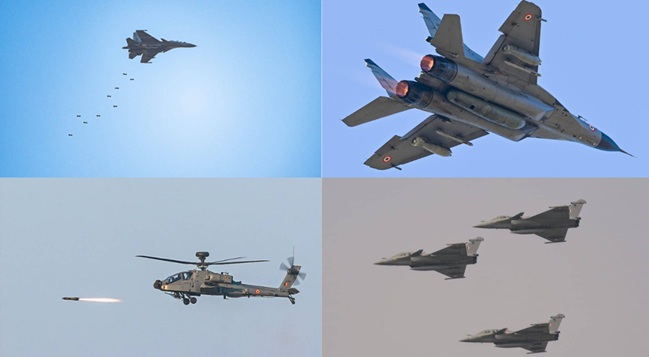
The Indian Air Force (IAF) will conduct Vayu Shakti 2026, a major air combat exercise near the Pakistan border, aimed at showcasing its full spectrum of offensive and defensive capabilities in a simulated war environment.
The exercise will be held at the Pokaran Field Firing Range in Jaisalmer district, Rajasthan, and is expected to be the IAF’s largest air combat drill of the year, involving nearly all frontline aircraft and air defence systems.
Background and Context
- India’s security environment is shaped by a two-front challenge, with unresolved borders with both Pakistan and China, and a history of cross-border terrorism and conventional military standoffs.
- The Indian Air Force has been undergoing rapid modernisation, including the induction of Rafale fighters, Tejas light combat aircraft, advanced air defence systems, and network-centric warfare platforms.
- Previous exercises like Vayu Shakti, Gagan Shakti, and Garuda have served as platforms to validate doctrine, test new technologies, and signal deterrence.
- Vayu Shakti 2026 comes in the backdrop of:
- Increased focus on jointness and integrated theatre commands
- The need to demonstrate credible deterrence
- The lessons learned from recent conflicts worldwide, highlighting the importance of air superiority, precision strike, and real-time command and control
About Vayu Shakti 2026
- Type: Major air combat exercise of the Indian Air Force
- Location: Pokaran Field Firing Range, Jaisalmer district, Rajasthan
- Scale: Expected to be the largest IAF air combat drill of 2026
- Scenario: Simulated wartime environment
Participating Aircraft and Systems
Almost all frontline fighter aircraft and air defence systems will be deployed, including:
- Rafale
- Su-30 MKI
- Tejas
- MiG-29
- Jaguar
- Mirage-2000
- Hawk
These platforms will engage both ground and aerial targets with high precision.
Operational Significance
1. Validation of Combat Readiness
- Tests the IAF’s ability to conduct simultaneous offensive and defensive air operations.
- Evaluates strike, interception, air defence, electronic warfare, and close air support roles.
2. Interoperability and Force Integration
- Ensures seamless coordination among:
- Fighters
- Surveillance platforms
- Air defence systems
- Command and control networks
3. Realistic Warfighting Simulation
- Conducted under a simulated high-intensity conflict environment, replicating real battlefield conditions.
- Enhances preparedness for short-notice, high-tempo operations.
Role of Technology and Network-Centric Warfare
- The exercise will be monitored and coordinated through the Integrated Air Command and Control System (IACCS).
- IACCS enables:
- Real-time tracking of airborne assets
- Seamless data sharing between sensors, shooters, and decision-makers
- Faster decision cycles and improved situational awareness
This reflects the IAF’s shift towards network-centric warfare, where information superiority is as critical as kinetic power.
Strategic and Geopolitical Significance
1. Deterrence Signalling
- Conducting the exercise near the Pakistan border sends a strong message of operational readiness and deterrence.
- Demonstrates India’s ability to respond decisively to external aggression or provocation.
2. Regional Stability and Power Projection
- Reinforces India’s position as a major regional air power.
- Enhances confidence among partners and allies regarding India’s defence capabilities.
3. Defence Modernisation Showcase
- Displays the integration of legacy platforms with modern aircraft and indigenous systems, particularly Tejas.
- Highlights India’s progress under Atmanirbhar Bharat in defence manufacturing.
Way Forward
- Continued emphasis on jointness, including coordination with the Army and Navy, is essential for integrated warfighting.
- Regular large-scale exercises like Vayu Shakti should be complemented by:
- Joint tri-service drills
- Cyber and space warfare simulations
- Greater integration of unmanned systems and AI-enabled decision tools
- Investment in air defence, ISR (Intelligence, Surveillance, Reconnaissance), and electronic warfare must remain a priority to maintain air superiority.
FAQs
1. What is Vayu Shakti 2026 ?
It is a major air combat exercise of the Indian Air Force showcasing offensive and defensive capabilities in a simulated war environment.
2. Where will Vayu Shakti 2026 be conducted ?
At the Pokaran Field Firing Range in Jaisalmer district, Rajasthan.
3. Which aircraft will participate in the exercise ?
Rafale, Su-30 MKI, Tejas, MiG-29, Jaguar, Mirage-2000, and Hawk aircraft, among others.
4. What is the role of IACCS in the exercise ?
The Integrated Air Command and Control System enables real-time tracking, coordination, and decision-making during air operations.
5. Why is Vayu Shakti 2026 strategically important ?
It strengthens deterrence, demonstrates combat readiness, showcases defence modernisation, and reinforces India’s regional air power.
|






 Contact Us
  New Batch : 9555124124/ 7428085757
  Tech Support : 9555124124/ 7428085757