New
Hindi Medium: (Delhi) - GS Foundation (P+M) : 6th July 2026, 6:00 PM Hindi Medium: (Prayagraj) - GS Foundation (P+M) : 5th July 2026, 8:00 AM English Medium: (Delhi) - GS Foundation (P+M) : 20th July 2026 English Medium: (Prayagraj) - GS Foundation (P+M) : 15th July 2026, 8:00 AM Hindi Medium: (Delhi) - GS Foundation (P+M) : 6th July 2026, 6:00 PM Hindi Medium: (Prayagraj) - GS Foundation (P+M) : 5th July 2026, 8:00 AM English Medium: (Delhi) - GS Foundation (P+M) : 20th July 2026 English Medium: (Prayagraj) - GS Foundation (P+M) : 15th July 2026, 8:00 AM

What Changes with the New EPFO Portal: Centralised Database, Withdrawal Eligibility, and More

Prelims

Economy | Social Security | Governance | Current Affairs

Mains

GS Paper II – Welfare Schemes & Governance | GS Paper III – Inclusive Growth and Digital Governance

Why Is This in the News?

  • The EPFO recently completed one of its largest technology upgrades by launching the Centralised IT Enabled Services (CITES 2.01) platform after consolidating its member databases into a single national system.
  • Alongside this rollout EPFO announced faster credit of EPF interest, Auto-settlement of eligible advance claims has been expanded, and Members can increasingly access services from any EPFO office instead of being restricted to their regional office.

What is EPFO ?

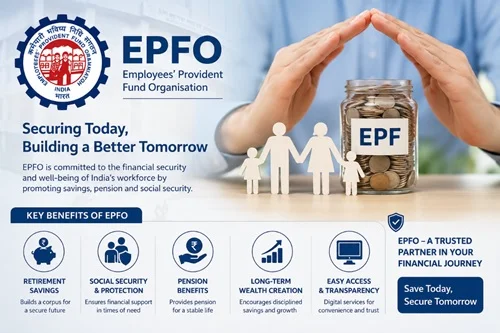
  • The Employees' Provident Fund Organisation (EPFO) is India's premier statutory social security institution responsible for administering retirement benefits for employees in the organised sector.
  • It functions under the Employees' Provident Funds and Miscellaneous Provisions Act, 1952. Its Administrative Ministry is Ministry of Labour and Employment. 
  • Its governing body are Central Board of Trustees (CBT) and Tripartite representation (Government, Employers, and Employees).

Why Was a New Portal Needed ?

  • Decentralised Databases : Every regional office maintained separate records which resulted in duplication, inconsistencies, and delayed verification.
  • Slow Claim Settlement : Claims often required manual verification, employer validation, regional office approvals, and leading to long processing times.
  • Difficult PF Transfers : Changing jobs often required transfer requests, document verification, multiple approvals, and employees frequently experienced delays.
  • Regional Dependency : Members were tied to the office where their account originated and Inter-state migration often created administrative hurdles.
  • Manual Intervention : Several services still required physical visits, document submission, and human verification. 
  • Poor Data Synchronisation : Differences in Aadhaar, PAN, Bank Account, UAN often delayed claims.

What is Centralised Database ?

  • A centralised database stores all records in one integrated national repository instead of maintaining separate databases at multiple locations.
  • Earlier, each office maintained independent records. But now, every authorised EPFO office accesses the same updated member record.

Key Features of the New EPFO Portal

  • Centralised Member Database : This is the foundation of the reform. Instead of maintaining over a hundred fragmented office-level databases, EPFO has consolidated member information into a unified national system.
  • Facility to View Withdrawable Amount : Earlier many employees had to estimate eligibility or wait until claim processing. But now the system provides clearer visibility into eligible withdrawal amounts based on applicable rules, helping members make informed decisions.
  • Improved Claim Tracking : Members can monitor claim submission, verification, processing, approval, and settlement. This reduces uncertainty and improves transparency.
  • Strengthened Universal Account Number (UAN) -Based Services: Employees can access one consolidated account, update KYC, manage multiple employments, and authenticate identity without depending extensively on regional offices.
  • Simplified PF Transfers : Earlier changing jobs often involved separate transfer requests and verification but now the unified database enables much smoother transfers, reducing paperwork and delays.

Benefits for Employees

The new EPFO portal represents a major shift from a region-centric administrative model to a member-centric digital service model. 

  • Faster Settlement of Claims: One of the most significant benefits is the reduction in claim processing time. Earlier, claims often required manual scrutiny by regional offices, employer verification, and physical record matching. Under the new centralised system, automation and a unified database reduce repetitive verification and enable quicker processing of eligible claims.
  • Seamless Portability across Jobs: India's labour market is increasingly mobile, with employees frequently changing jobs and relocating across states. Previously, changing employment often involved delays in transferring Provident Fund accounts due to region-specific databases. With the centralised platform PF accounts remain linked through the Universal Account Number (UAN), transfer processes become simpler and less dependent on regional offices, and employees experience continuity in retirement savings.
  • Better Transparency: The portal enables employees to view PF balance,  contributions made by employers, interest credited, claim status and eligible withdrawal amount.
  • Improved Accessibility: Members can increasingly access EPFO services online through EPFO Member Portal, UMANG application, and other integrated digital platforms. This reduces dependence on physical visits to EPFO offices and benefits employees working in remote locations.
  • Reduced Paperwork: Digital KYC integration and electronic verification reduce the need for physical forms, multiple signatures, and repeated document submissions. This saves time and minimizes administrative burden.
  • Enhanced Financial Planning: Real-time access to account information enables employees to track retirement savings, estimate future corpus, make informed decisions regarding withdrawals, and integrate EPF into broader financial planning.
  • Better Grievance Resolution: A unified database allows officials to access member records more efficiently, facilitating quicker resolution of complaints related to claim delays, KYC mismatches, transfer issues, and contribution discrepancies.

Benefits for Employers

  • Simplified Compliance : Employers can manage employee PF obligations more efficiently through a unified digital platform. Benefits include easier submission of contributions, simplified record maintenance, and reduced paperwork.
  • Faster Employee Onboarding : A centralised database linked to the UAN facilitates quicker onboarding of new employees by reducing repetitive verification processes.
  • Reduced Administrative Burden : Automation minimizes manual tasks such as record reconciliation, physical document handling, and verification requests.
  • Improved Data Accuracy : A single source of truth reduces errors arising from duplicate records, incorrect employee details, and mismatched identifiers.

Earlier System vs New EPFO Portal

Aspect

Earlier System

New Centralised Portal (CITES 2.01)

Database

Separate regional databases

Single national database

Access to Records

Mostly tied to the originating regional office

Accessible from any authorised EPFO office

Claim Processing

Significant manual verification; processing often slower

Greater automation and standardised workflows improve efficiency

PF Transfer

Transfers between employers could involve multiple verification steps

Simplified through the centralised database and UAN integration

Transparency 

Limited real-time visibility into claim progress

Better online visibility of claim status and account information

Paperwork

Greater reliance on physical forms and manual documentation

Increased use of digital services and electronic verification

Data Consistency 

Higher possibility of duplicate or inconsistent records

Single source of truth improves consistency

Grievance Handling 

Depended on regional records and office-specific processes

Easier access to complete member records supports faster resolution

Support for Migrant Workers 

Administrative hurdles when changing states or employers

Better portability for a mobile workforce

Governance Model

Decentralised administration

Digitally integrated and citizen-centric administration

Challenges and Concerns

  • Cybersecurity Risks : A centralised database contains sensitive personal and financial information. Potential risks include data breaches, cyberattacks, identity theft, and unauthorized access.
  • Data Privacy : The collection and integration of large volumes of personal information raise concerns regarding data protection, user consent, appropriate data usage, and compliance with India's data protection framework.
  • Data Migration Challenges : Consolidating decades of records from multiple regional databases may lead to duplicate records, missing information, and data inconsistencies.
  • Infrastructure Requirements : A nationwide digital platform demands reliable servers, high system availability, disaster recovery mechanisms, and continuous technical maintenance.

Way Forward 

  • To maximise the benefits of the new EPFO portal, the government should strengthen cybersecurity and data protection measures, ensure seamless integration with other digital public infrastructure, and regularly update the platform based on user feedback. 
  • Capacity building of EPFO officials, employer awareness programmes, and digital literacy initiatives for employees should be prioritised. 
  • Continuous data validation, robust grievance redressal, and reliable IT infrastructure will enhance public trust. These measures will make India's social security system more efficient, transparent, inclusive, and resilient.

PRELIMINARY MCQ

Q. Consider the following statements regarding the Employees' Provident Fund Organisation (EPFO):

1. EPFO functions under the Ministry of Labour and Employment.

2. EPFO administers the Employees' Pension Scheme (EPS).

3. The Centralised IT Enabled Services (CITES 2.01) platform replaces fragmented regional databases with a unified member database.

4. Universal Account Number (UAN) is issued by the Reserve Bank of India.

Which of the statements given above are correct?

A. 1 and 2 only

B. 1, 2 and 3 only

C. 2, 3 and 4 only

D. 1, 2, 3 and 4

MAINS PRACTICE QUESTION 

Q. Digital governance reforms are transforming the delivery of social security services in India. Discuss the significance of EPFO's Centralised IT Enabled Services (CITES 2.01) platform in improving transparency, efficiency, and portability of social security benefits. Also examine the challenges associated with its implementation.

FAQs

1. What is the new EPFO portal ?

The new EPFO portal is built on the Centralised IT Enabled Services (CITES 2.01) platform, which uses a unified national member database to improve service delivery, claim processing, and portability.

2. Why was a new EPFO portal introduced ?

It was introduced to replace fragmented regional databases, reduce delays, improve transparency, simplify PF transfers, and provide faster digital services to members.

3. What is a centralised member database ?

It is a single national repository of EPFO member records that can be accessed by authorised EPFO offices across India, ensuring consistency and reducing duplication.

4. What is the Universal Account Number (UAN) ?

The UAN is a unique number allotted by EPFO that links all Provident Fund accounts of an employee throughout their career, making PF management easier.

5. How does the portal benefit employers ?

It simplifies compliance, reduces paperwork, improves data accuracy, streamlines employee onboarding, and enhances coordination with EPFO.

Have any Query?

Our support team will be happy to assist you!

OR