Prelims : Defence + CA
Mains : GS 3 – Internal Security, Defence Technology, Strategic Deterrence |
Why in News ?
- India has inducted its third nuclear-powered ballistic missile submarine, INS Aridaman, significantly enhancing its sea-based nuclear deterrence capabilities.
- With this induction, India now has three operational SSBNs at sea simultaneously, strengthening its second-strike capability and nuclear triad.
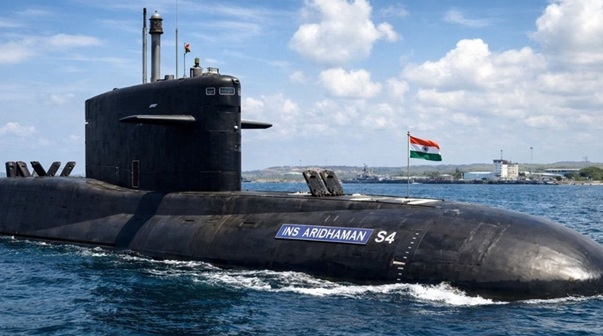
About INS Aridaman
- INS Aridaman is an indigenously developed nuclear-powered ballistic missile submarine (SSBN).
- Key features include :
- Displacement: ~7,000 tonnes, making it larger and more capable than its predecessors
- Missile Capacity: Equipped with 8 vertical launch system (VLS) tubes, nearly double that of earlier submarines
- Missile Capability :
- K-15 (range ~700 km)
- K-4 (range ~3,500 km)
- Advanced Nuclear Reactor: Enables long-duration submerged operations (months) without surfacing
What is an SSBN ?
- SSBN stands for Ship Submersible Ballistic Nuclear submarine.
- These submarines :
- Are powered by nuclear reactors
- Carry nuclear-tipped ballistic missiles
- Operate stealthily underwater for extended periods
- They form the most survivable leg of nuclear deterrence systems.
India’s Nuclear Triad Explained
- A nuclear triad refers to the ability to launch nuclear weapons from :
- Land (e.g., Agni missile series)
- Air (fighter aircraft like Rafale, Su-30MKI, Mirage 2000)
- Sea (SSBNs like INS Aridaman)
- India is among a select group of countries possessing a nuclear triad :
- United States
- Russia
- China
- France
Significance of INS Aridaman
1. Strengthening Second-Strike Capability
- India follows a No First Use (NFU) nuclear doctrine, meaning nuclear weapons are used only in retaliation.
- SSBNs like INS Aridaman ensure :
- Survivability even after a first strike
- Ability to launch a retaliatory nuclear attack, maintaining deterrence credibility
2. Enhanced Sea-Based Deterrence
- Compared to earlier submarines like :
- Aridaman offers :
- Greater missile capacity
- Longer strike range
- Improved stealth and endurance
3. Strategic Depth and Survivability
- Sea-based platforms are :
- Harder to detect and target
- Less vulnerable than land and air bases
- This enhances credible minimum deterrence, a key pillar of India’s nuclear doctrine.
4. Boost to Indigenous Defence Capability
- The submarine reflects India’s progress in :
- Indigenous shipbuilding
- Nuclear propulsion technology
- Advanced missile integration
- Supports Aatmanirbhar Bharat in defence manufacturing.
India’s Submarine Fleet: Current Status
- India operates :
- SSBNs (Nuclear ballistic submarines) : 3 (with Aridaman)
- Conventional submarines : ~16
- Major classes include :
- Kalvari-class (Scorpene)
- Kilo-class (Sindhughosh)
- Shishumar-class
- However :
- Around 30% of submarines are under refit at any time, reducing operational strength
Global Comparison
- United States : ~14 SSBNs + 50+ attack submarines
- China : ~12 nuclear submarines
- India is still expanding its underwater capabilities, but making steady progress
Related Developments
1. Project-75I
- India is planning next-generation conventional submarines with Air Independent Propulsion (AIP)
- Collaboration with Germany’s ThyssenKrupp Marine Systems
2. Nuclear Attack Submarines (SSNs)
- India is also working on SSNs (attack submarines) to complement SSBNs
Challenges
1. Limited Fleet Size
- India’s submarine numbers are still below authorised strength, affecting operational readiness
2. Technological Complexity
- Nuclear submarines require :
- Advanced reactors
- Stealth technology
- High-end maintenance
3. Strategic Competition
- Increasing naval presence of China in the Indian Ocean Region (IOR) adds pressure
Way Forward
- Expand submarine fleet to meet strategic requirements
- Accelerate indigenous submarine programs
- Strengthen underwater surveillance and anti-submarine warfare
- Enhance jointness among triad components
Practice Questions
Prelims :
Q. What is the primary role of a nuclear-powered ballistic missile submarine (SSBN) ?
(a) Air defence
(b) Anti-submarine warfare
(c) Nuclear deterrence
(d) Surveillance
Mains :
“Discuss the significance of sea-based nuclear deterrence in India’s nuclear doctrine.”
FAQs
Q1. What is INS Aridaman ?
INS Aridaman is India’s third nuclear-powered ballistic missile submarine, designed for strategic deterrence.
Q2. What is a nuclear triad ?
It is the capability to launch nuclear weapons from land, air, and sea-based platforms.
Q3. Why are SSBNs important ?
They provide second-strike capability, ensuring retaliation even after a nuclear attack.
Q4. Which missiles does INS Aridaman carry ?
It can carry K-15 and K-4 submarine-launched ballistic missiles.
Q5. What is India’s nuclear doctrine ?
India follows No First Use and maintains credible minimum deterrence.
|






 Contact Us
  New Batch : 9555124124/ 7428085757
  Tech Support : 9555124124/ 7428085757