Why in News?
Despite receiving the Geographical Indication (GI) tag in 2010, Punjab's traditional embroidery Phulkari continues to face challenges such as declining artisan incomes, competition from machine-made products, and inadequate market recognition. The issue has once again highlighted the need to preserve India's traditional handicrafts and support artisan livelihoods.
What is Phulkari?
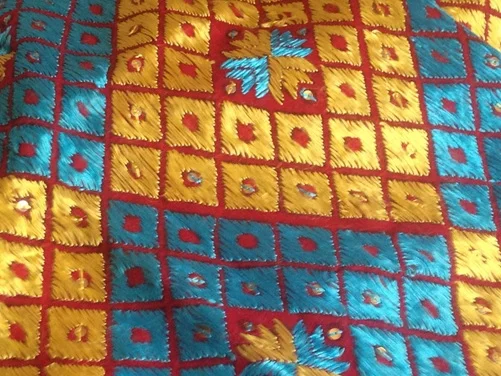
- Phulkari, literally meaning "flower work," is the traditional embroidery art of Punjab and is one of India's most renowned textile traditions. Traditionally embroidered by women, it reflects the cultural heritage, social customs, and artistic skills of Punjabi society. Although floral motifs dominate the embroidery, Phulkari also features geometric patterns, birds, animals, and motifs inspired by rural life.
- The exact origin of Phulkari remains uncertain. Some historians trace it back to the 7th century CE, while others believe it evolved from the Persian embroidery tradition known as Gulkari. Over time, however, the craft developed its own distinctive style and became an integral part of Punjab's cultural identity. References to Phulkari are found in Punjabi folklore and literature, with one of the earliest literary mentions appearing in 18th-century Punjabi writings.
Key Features of Phulkari
- Phulkari is embroidered on handwoven cotton cloth known as 'Khaddar', using fine silk threads called 'Pat'. The base fabric is traditionally dyed red, although white, grey, and black fabrics are also used. Bright silk threads in multiple colours create vibrant floral and geometric designs.
- The embroidery is executed from the reverse side of the fabric using darning stitches, producing a unique shadow effect on the front. The motifs include flowers, peacocks, elephants, camels, birds, trees, and geometric patterns, reflecting the close relationship between Punjabi life and nature. Traditionally, Phulkari is used for dupattas, chaddars, shawls, stoles, and bridal attire, making it an important part of Punjabi ceremonies and festivals.
Geographical Indication (GI) Tag
-
Phulkari received the Geographical Indication (GI) tag in 2010 under the Geographical Indications of Goods (Registration and Protection) Act, 1999. The GI tag recognizes its unique regional identity, protects the craft from imitation, and helps preserve the traditional knowledge of local artisans.
Cultural Significance
- Phulkari is more than an embroidery tradition; it is a symbol of Punjab's cultural identity and community life. Historically, it was embroidered by women for family occasions such as weddings and festivals, with each piece representing emotions, traditions, and blessings.
- The craft also serves as an important example of India's rich intangible cultural heritage and demonstrates the diversity of regional textile traditions.
Challenges
- Despite its GI status, Phulkari artisans face several challenges:
- Competition from machine-made and imported products.
- Declining demand for handmade embroidery.
- Low and irregular incomes for artisans.
- Limited access to national and international markets.
- Lack of awareness about authentic GI-certified Phulkari products among consumers.
- Younger generations showing reduced interest in continuing the traditional craft.
Government Initiatives
- To preserve traditional handicrafts such as Phulkari, the Government supports artisans through initiatives like:
- National Handicrafts Development Programme (NHDP)
- National Handloom Development Programme (NHDP)
- One District One Product (ODOP)
- Geographical Indication (GI) promotion initiatives
- Marketing support through handicraft fairs, exhibitions, and e-commerce platforms.
Way Forward
Strengthening artisan cooperatives, improving market access through digital platforms, promoting GI-certified products, enhancing skill development, and increasing consumer awareness can ensure the long-term sustainability of Phulkari. Linking the craft with tourism, exports, and the Vocal for Local initiative can further enhance artisans' incomes while preserving India's rich cultural heritage.
Conclusion
Phulkari represents the artistic excellence and cultural richness of Punjab. While the GI tag has provided legal recognition to the craft, sustained policy support, better marketing opportunities, and consumer awareness are essential to protect this centuries-old tradition and ensure dignified livelihoods for its artisans.
Prelims Practice Question
Q. Consider the following statements regarding Phulkari:
- It is a traditional embroidery art associated with Punjab.
- It received the Geographical Indication (GI) tag in 2010.
- Traditionally, the embroidery is done on handwoven cotton cloth known as Khaddar using silk thread called Pat.
Which of the statements given above is/are correct?
-
1 and 2 only
-
2 and 3 only
-
1 and 3 only
-
1, 2 and 3
Mains Practice Question
Q."Traditional handicrafts are not merely economic activities but repositories of India's cultural identity." Discuss with reference to Phulkari.
|
FAQs on Phulkari
Q1. What is Phulkari?
Phulkari is a traditional embroidery art of Punjab, literally meaning "flower work." It is known for its vibrant silk thread embroidery on handwoven cotton fabric and is an important part of Punjab's cultural heritage.
Q2. Which state is associated with Phulkari?
Phulkari is primarily associated with the Punjab region of India.
Q3. When did Phulkari receive the Geographical Indication (GI) tag?
Phulkari was awarded the Geographical Indication (GI) tag in 2010, recognizing its unique regional identity and protecting the traditional craft.
Q4. What materials are used in Phulkari embroidery?
Phulkari is traditionally embroidered on handwoven cotton fabric (Khaddar) using fine silk threads known as Pat.
Q5. What are the common motifs used in Phulkari?
Phulkari designs feature flowers, geometric patterns, peacocks, elephants, camels, birds, trees, and other motifs inspired by nature and rural life.
|






 Contact Us
  New Batch : 9555124124/ 7428085757
  Tech Support : 9555124124/ 7428085757