Reference
The communication system between bacteria is called 'quorum sensing'. It could prove to be extremely revolutionary for modern medical science. It also offers new opportunities for developing anti-quorum sensing-based treatments, reducing the dependence on traditional antibiotics.
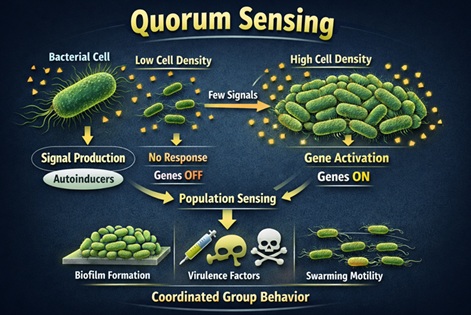
About Quorum Sensing
- Quorum sensing is a biological (chemical) process through which bacteria regulate gene activity according to their cell density. They produce and secrete specific signal molecules.
- In this process, bacteria release tiny molecules called 'autoinducers' that collectively control gene expression and work together when a certain number is reached.
- This mechanism allows bacteria to 'communicate' with each other and collectively determine their behavior. Disease-causing microorganisms often use this mechanism to spread infection and increase their virulence.
- The first scientific observation of this phenomenon was made in the 1960s by Hungarian microbiologist Alexander Tomasz. While researching Streptococcus pneumoniae, he discovered that the bacterium is capable of absorbing free DNA present in its surroundings.
Working Process
- The quorum sensing mechanism is primarily based on three components:
- Bacterial population
- Signal molecules
- Genes that control behavior
- Signal molecules are called autoinducers. These molecules are released by bacteria, and their quantity increases as the number of cells increases.
- When the concentration of these molecules reaches a certain level, the bacteria recognize them and activate specific genes. As a result, many important biological processes are initiated, such as:
- Development of virulence
- Horizontal gene transfer
- Biofilm formation
- Competence (the ability to assimilate DNA)
- These activities are generally effective only when bacterial numbers are sufficient. Therefore, quorum sensing is considered a key means of collective coordination in microorganisms.
Variation in Individual Bacteria
- Although this mechanism is found in many bacteria, its structure and the types of signal molecules used can vary between species.
- For example, Pseudomonas aeruginosa, a bacterium that causes pneumonia and blood infections, uses quorum sensing to control its pathogenic activities.
- In contrast, in some bacteria, this process is linked to symbiotic relationships and growth. For example, nitrogen fixation in Rhizobium leguminosarum is influenced by this mechanism.
Conclusion
Thus, quorum sensing is not merely a strategy for disease transmission, but is a crucial basis for the collective survival, adaptation, and evolution of bacteria. Future therapeutics targeting this mechanism may offer new possibilities for infection control.






 Contact Us
  New Batch : 9555124124/ 7428085757
  Tech Support : 9555124124/ 7428085757