New
Hindi Medium: (Delhi) - GS Foundation (P+M) : 6th July 2026, 6:00 PM Hindi Medium: (Prayagraj) - GS Foundation (P+M) : 5th July 2026, 8:00 AM English Medium: (Delhi) - GS Foundation (P+M) : 20th July 2026 English Medium: (Prayagraj) - GS Foundation (P+M) : 15th July 2026, 8:00 AM Hindi Medium: (Delhi) - GS Foundation (P+M) : 6th July 2026, 6:00 PM Hindi Medium: (Prayagraj) - GS Foundation (P+M) : 5th July 2026, 8:00 AM English Medium: (Delhi) - GS Foundation (P+M) : 20th July 2026 English Medium: (Prayagraj) - GS Foundation (P+M) : 15th July 2026, 8:00 AM

Why Is the US Opposing the International Criminal Court? Marco Rubio's Stand Explained

Prelims

International Relations | International Organisations | Current Affairs

Mains

GS Paper II – Effect of Policies and Politics of Developed and Developing Countries on India's Interests | International Institutions

Why Is This in the News ?

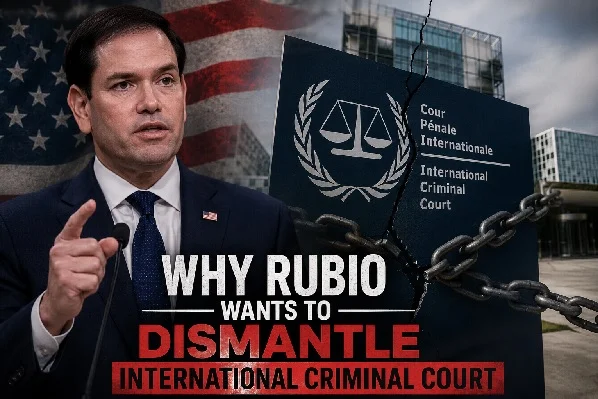
  • U.S. Secretary of State Marco Rubio strongly criticized the ICC and urged the international community to oppose and isolate the court, arguing that it has exceeded its mandate.
  • His remarks followed the ICC's continued investigations and arrest warrants related to the Israel-Hamas conflict.
  • The United States has imposed sanctions on certain ICC officials and reiterated that it does not recognize the Court's jurisdiction over U.S. citizens or those of allied nations such as Israel.

What Is the International Criminal Court (ICC)?

The ICC is the world's first permanent international criminal tribunal established to prosecute individuals—not states—for the most serious international crimes.
Particular  Details 
Established  17 July 1998 (Rome Statute)
Operational Since  1 July 2002
Headquarters  The Hague, Netherlands
Governing Treaty  Rome Statute
Current Members States  125 (as of 2026)
Nature  Independent international judicial institution
Jurisdiction  Individuals responsible for genocide, war crimes, crimes against humanity and aggression

Background of the US-ICC Standoff

  • Originated in the First Trump Term : US hostility towards the court is not new. During his first term, President Trump targeted the ICC over its attempt to investigate alleged war crimes by US forces in Afghanistan, including sanctioning the then chief prosecutor.
  • Sanctions Regime since 2025 : Early in his second term, President Trump issued an executive order declaring a “national emergency” over what he called the ICC's “illegitimate and baseless actions” against the US and Israel, leading to sanctions on Chief Prosecutor Karim Khan, his deputies, and several judges over investigations into conduct in Afghanistan and the Israel-Palestine conflict.
  • Widening the Net : The administration expanded sanctions and restrictions to additional individuals associated with investigations involving Israel.
  • The Judges' Lawsuit : Three sitting ICC judges sued the US administration in a New York court, arguing that the sanctions amounted to unlawful “extra-judicial pressure” intended to undermine their independence — the first time sitting ICC judges have taken such legal action against the US.

Why Does Rubio Want to Dismantle the ICC?

  • Sovereignty Argument : The State Department maintains that the ICC poses an “intolerable threat” to US sovereignty by claiming authority to prosecute American service members and officials, an authority successive US administrations across parties have rejected.
  • Framing as an Attack on America : Rubio has accused the court of “waging a war” against the US, not through military means but through “the force of so-called international law,” and has described it as being driven by NGOs and governments hostile to the US.
  • Protecting Israel : A significant driver has been the ICC's investigations and arrest-warrant proceedings related to Israel's conduct in Gaza, which Washington views as an illegitimate targeting of a close ally.
  • Pre-empting Future Cases : Some analysts argue that the campaign could also discourage future ICC scrutiny of U.S. military or foreign-policy actions.
  • Response to the Judges' Lawsuit : The renewed and more forceful campaign comes directly after ICC judges challenged the legality of existing US sanctions in court, which the administration appears to be countering with an even broader offensive.

Key Elements of the US Campaign

  • Diplomatic Pressure : Calls from the Secretary of State, Deputy Secretary, and US ambassadors to foreign governments urging them to reject the ICC's authority and consider withdrawing support for the court.
  • Conditional Alliances : Countries that partner with US law enforcement, host US military presence, or benefit from the US security umbrella are being asked to publicly reject the ICC's jurisdiction over American nationals.
  • Expanded Sanctions : Increased sanctions, travel bans, and visa revocations against ICC officials, judges, and organisations seen as supporting the court's investigations.
  • Coalition-Building : Encouraging other non-member states of the Rome Statute to use their own diplomatic networks to pressure the ICC alongside the US.
  • Possible Institution-Wide Sanctions : Reports suggest the administration may consider sanctioning the ICC as an institution, which could bar American citizens, banks, and companies from any dealings with the court.

Criticism of the US Campaign

  • Mischaracterisation of Jurisdiction : Legal experts, including former Human Rights Watch head Kenneth Roth, argue the ICC does not claim jurisdiction over conduct occurring within the United States itself.
  • Threat to the Rules-Based Order : Civil society groups argue that undermining the ICC weakens the broader post-World War II framework of international law rather than merely curbing one institution.
  • Selective Application of International Law : Critics note the campaign follows calls for the ICC to examine alleged war crimes linked to recent US military actions, raising questions about whether the effort is aimed at shielding American personnel from scrutiny.
  • Impact on Global Justice : Human rights advocates warn that weakening the ICC could reduce access to international justice mechanisms for victims in conflicts from Ukraine to Sudan.

India's Position on the ICC

  • India is not a party to the Rome Statute and has historically stayed out of the ICC, citing concerns over the court's jurisdiction potentially extending to peacekeeping operations and sovereign military decisions.
  • India has consistently supported the broader idea of international accountability for war crimes and genocide but has favoured strengthening national judicial mechanisms over ceding jurisdiction to an external body.
  • As a non-member, India is not directly bound by US pressure tactics aimed at Rome Statute signatories, but the episode is relevant to India's foreign policy discourse on multilateralism, sovereignty, and reform of global institutions.

Way Forward

  • Institutional Resilience: The ICC and its member states may need to strengthen internal mechanisms to protect judicial independence from external political and economic pressure.
  • Reform Conversations: The episode renews calls for reforming international justice mechanisms to make them more broadly accepted, including addressing concerns of major powers that currently remain outside the Rome Statute.
  • Balancing Sovereignty and Accountability: The standoff highlights the continuing global tension between state sovereignty and international efforts to hold individuals accountable for the gravest crimes, a balance that will shape the future credibility of international law.

PRELIMINARY MCQ

Q. Assertion (A): The United States opposes the exercise of ICC jurisdiction over its nationals.
Reason (R): The United States is not a State Party to the Rome Statute and argues that the ICC should not exercise jurisdiction without its consent.
(a) Both A and R are true, and R is the correct explanation of A.
(b) Both A and R are true, but R is not the correct explanation of A.
(c) A is true, but R is false.
(d) A is false, but R is true.

MAINS PRACTICE QUESTION

Q. “The recent US campaign to dismantle the International Criminal Court reflects the enduring tension between national sovereignty and international accountability.” Discuss the reasons behind the United States' opposition to the ICC and examine its implications for the global rules-based order.

FAQs

1. What is the International Criminal Court ? 

It is a permanent international tribunal established under the 1998 Rome Statute and became operational on 1 July 2002 to prosecute individuals for genocide, war crimes, crimes against humanity, and aggression.

2. Why has the US launched a campaign against the ICC ?

The US views the ICC's claimed authority over American service members and officials as a threat to its sovereignty, and the current campaign follows a lawsuit by ICC judges challenging existing US sanctions.

3. Is the United States a member of the ICC ?

No. The US has never ratified the Rome Statute and does not accept the court's jurisdiction over its nationals.

4. Is India a member of the ICC?

No. India is not a party to the Rome Statute, citing sovereignty concerns, though it supports international accountability for grave crimes through other means.

5. What actions has the US taken against the ICC so far?

Actions include sanctions, travel bans, and visa revocations against ICC officials and affiliated individuals, along with diplomatic pressure on other countries to reject the court's authority.

Have any Query?

Our support team will be happy to assist you!

OR