Why in news?
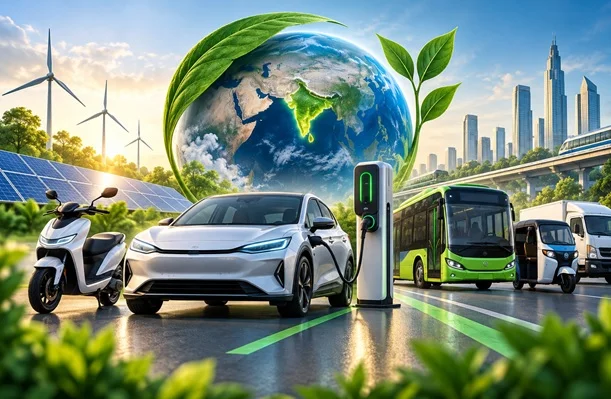
World EV Day is observed every year on 9 September to promote awareness about electric vehicles (EVs), clean mobility and the transition away from fossil-fuel-dependent transport.
Key Facts
|
Date
|
9 September 2026
|
|
Observed
|
Annually
|
|
2026 Theme
|
Switching Electric: driving down the cost of motoring
|
|
Focus
|
Promotion of electric mobility
|
|
Major issues
|
EV affordability, charging infrastructure, battery technology, clean energy, sustainable transport and consumer adoption
|
What is World EV Day?
It is a global campaign dedicated to electric mobility. The initiative was launched in 2020 and has since developed into an international platform for discussions surrounding electric vehicles and sustainable transportation.
Why are Electric Vehicles important?
The transport sector continues to depend heavily on petroleum-based fuels. Electric vehicles provide an alternative by using electric motors powered by batteries or other electrical energy systems. Their significance can be understood through these dimensions:
- Lower tailpipe emissions: Battery EVs produce zero tailpipe emissions, which can help reduce local air pollutants in congested urban areas.
- Climate mitigation: EVs can contribute to transport-sector decarbonisation, particularly as the electricity used to charge them increasingly comes from renewable and other low-carbon sources.
- Energy security: Greater electrification can reduce the transport sector's dependence on petroleum fuels and therefore improve energy security for oil-importing countries such as India.
- Lower operating costs: Electric motors are highly efficient and EVs generally have fewer moving components than conventional internal-combustion vehicles, potentially lowering energy and maintenance costs.
- Technological transformation: The EV transition is creating new industries around batteries, power electronics, semiconductors, motors, software, charging systems and battery recycling.
How Does an Electric Vehicle Work?
- Charging Point → Battery Pack → Power Electronics/Inverter → Electric Motor
- The battery pack stores electrical energy. The power electronics system regulates the flow of electricity, while the electric motor converts electrical energy into mechanical motion.
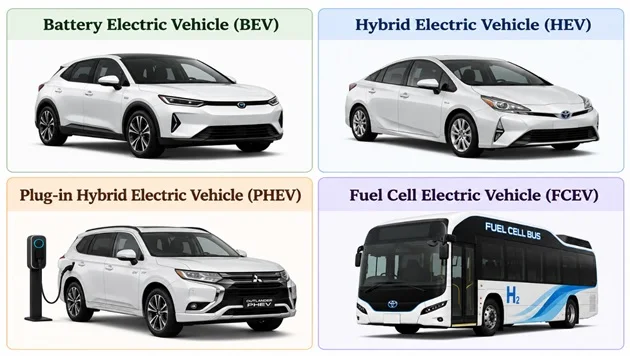
Major Types of Electric Vehicles
- Battery Electric Vehicle (BEV): It runs entirely on electricity stored in a rechargeable battery.
- Hybrid Electric Vehicle (HEV): It combines an internal combustion engine and electric motor. Its battery is generally charged internally through the engine and regenerative braking.
- Plug-in Hybrid Electric Vehicle (PHEV): It combines an engine with a battery-electric drivetrain.
- Fuel Cell Electric Vehicle (FCEV): These vehicles generate electricity through a fuel cell, commonly using hydrogen.
Why World EV Day matters for India?
- India's EV transition is connected with broader national objectives such as reducing petroleum dependence, improving urban air quality, developing domestic manufacturing, creating new industrial supply chains, promoting battery manufacturing, expanding renewable-energy use, generating employment and achieving long-term climate commitments.
- In August 2026, CNG, hybrid and electric passenger vehicles together accounted for roughly 42% of Indian passenger-vehicle sales, slightly exceeding petrol vehicles at about 41%, according to FADA data reported by Reuters.
India's Major EV Initiative
- The PM Electric Drive Revolution in Innovative Vehicle Enhancement (PM E-DRIVE) scheme was originally approved with an outlay of ₹10,900 crore.
- The government originally allocated ₹4,391 crore for 14,028 electric buses, along with dedicated support for other vehicle categories.
- The scheme covers Electric Two-Wheelers (e-2W), Electric Three-Wheelers (e-3W), Electric Buses, Electric Ambulances, Electric Trucks, Public Charging Infrastructure and Upgradation of Vehicle Testing Agencies.
- The scheme has been extended until 31 March 2028 for applicable segments, except the e-3W L5 segment, whose incentivisation was closed after achieving its target.
Battery: The Heart of an EV
- The battery is among the most important and expensive components of an electric vehicle. Modern EVs predominantly use lithium-ion battery technologies, though different chemistries are used depending on requirements relating to cost, energy density, safety and durability.
Environmental Benefits of EVs
- Reduced Urban Air Pollution: Battery EVs eliminate exhaust emissions of pollutants such as nitrogen oxides and particulate matter from the vehicle tailpipe.
- Reduced Greenhouse-Gas Emissions: Lifecycle emissions can fall substantially when EVs are charged with increasingly cleaner electricity.
- Reduced Noise Pollution: Electric motors generally produce much less drivetrain noise than combustion engines, particularly at lower speeds.
- Higher Energy Efficiency: Electric motors convert a much larger proportion of input energy into motion compared with conventional combustion engines.
Challenges
- High Upfront Cost: Although running costs can be lower, many EVs still have higher initial purchase prices than comparable conventional vehicles, largely because of battery costs.
- Range Anxiety: Consumers may worry whether the battery will last until the next available charging station.
- Charging Infrastructure: The number, distribution and reliability of charging stations remain important constraints, especially for long-distance highway travel.
- Charging Time: Even fast charging generally takes longer than filling a petrol or diesel tank.
- Critical Mineral Dependency: Battery supply chains depend on minerals whose production and processing are geographically concentrated.
- Recycling: India will require a large, safe and economically viable battery collection, reuse and recycling ecosystem.
EVs and India's Climate Commitments
- At COP26, India announced its Panchamrit climate commitments, including a target to achieve net-zero emissions by 2070.
- Transport electrification can contribute to this objective, particularly when combined with renewable energy, energy storage, public transport, EVs, green hydrogen and energy efficiency.
FAQs
When is World EV Day celebrated?
World EV Day is celebrated every year on 9 September.
When was World EV Day first observed?
World EV Day was first observed in 2020.
What is the main objective of World EV Day?
It aims to promote electric mobility, clean transportation and EV awareness worldwide.
What is an Electric Vehicle (EV)?
An EV is a vehicle powered fully or partly by an electric motor.
What are the major types of Electric Vehicles?
The major types are BEV, HEV, PHEV and FCEV.
|







 Contact Us
  New Batch : 9555124124/ 7428085757
  Tech Support : 9555124124/ 7428085757