Why in news?
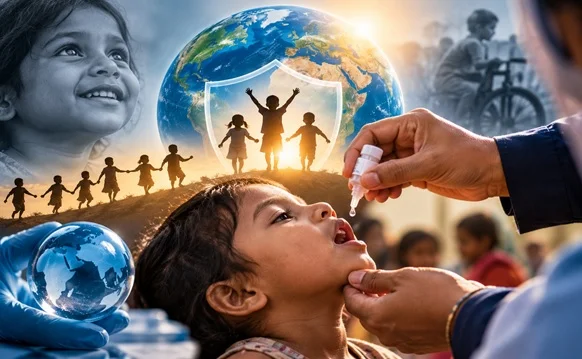
World Polio Day is observed every year on 24 October to raise awareness about polio prevention and highlight global efforts to eradicate the disease.
Key Facts
|
Particular
|
Details
|
|
Observed on
|
24 October
|
|
Disease
|
Poliomyelitis (Polio)
|
|
First observed
|
2014
|
|
Main objective
|
To eradicate polio worldwide
|
|
Major organisation
|
World Health Organization (WHO)
|
|
Global initiative
|
Global Polio Eradication Initiative (GPEI)
|
|
India’s status
|
Certified polio-free in 2014
|
|
2026 campaign theme
|
Together, We End Polio
|
What is Polio?
- Polio, or poliomyelitis, is a highly contagious disease caused by the poliovirus.
- It mainly affects children under five years of age, although anyone who is not adequately protected can be infected.
- The virus can attack the nervous system and cause permanent paralysis.
- In severe cases, it can affect the muscles used for breathing and may lead to death.
- There is no specific cure for polio, but vaccination can prevent the disease.
History
- World Polio Day was established to recognise the global fight against polio and encourage continued vaccination.
- The observance is associated with the efforts of Rotary International and the wider global polio eradication movement.
- In 1988, the World Health Assembly committed to eradicating polio worldwide.
- This led to the launch of the Global Polio Eradication Initiative, involving the WHO, Rotary International, UNICEF and other partners.
- Since then, vaccination programmes have reduced the global number of wild polio cases by more than 99%.
Types of Polio Vaccines
- Oral Polio Vaccine (OPV)
- Given as drops through the mouth.
- Widely used in mass vaccination campaigns.
- Helps build immunity in the intestine and can help interrupt the spread of the virus.
- Inactivated Polio Vaccine (IPV)
- Given as an injection by a trained healthcare professional.
- Uses inactivated poliovirus.
- Protects against paralytic disease.
India’s Efforts to Eradicate Polio
- India has made significant progress in the fight against polio through large-scale vaccination campaigns, public awareness and disease surveillance.
- India was declared polio-free by the WHO in 2014, following the absence of wild poliovirus cases for the required period.
Major Initiatives of India
- Pulse Polio Programme: The programme aims to protect children by providing oral polio vaccine doses during special immunisation campaigns. Vaccination teams visit homes and public places to reach children who might otherwise be missed.
- Universal Immunization Programme (UIP): This programme provides essential vaccines to children and pregnant women. Polio vaccination is an important part of India’s routine immunisation efforts.
- Disease Surveillance: Health authorities monitor suspected cases and test environmental samples, including sewage, to detect poliovirus circulation and respond quickly to potential threats.
- Public Awareness Campaigns: Government agencies, healthcare workers, schools and community organisations encourage parents to vaccinate their children and participate in immunisation drives.
- International Cooperation: India works with international health organisations to maintain high vaccination coverage and prevent the virus from re-entering the country.
Why is Polio eradication important?
- Protecting children: Vaccination prevents a disease that can cause lifelong disability.
- Public health: Eradication reduces the risk of outbreaks and the need for repeated emergency responses.
- Economic benefits: Preventing disease reduces long-term medical expenses and the burden on families.
- Global health security: International cooperation helps prevent the spread of poliovirus across borders.
- Equality in healthcare: Vaccination programmes help reach children in remote and underserved communities.
Major Challenges in Polio Eradication
- Low vaccination coverage: Children who miss vaccine doses remain vulnerable to infection.
- Misinformation: False information and fear about vaccines can discourage parents from vaccinating their children.
- Conflict and difficult access: Health workers may struggle to reach children in conflict-affected or remote areas.
- Cross-border transmission: The virus can travel between countries through human movement.
- Funding and surveillance: Sustained financial support and effective monitoring are needed to detect and respond to outbreaks.
Prelims Practice Question
Q. Consider the following statements about polio:
- Polio is caused by a virus.
- Polio vaccination can prevent the disease.
- India was certified polio-free in 2014.
Which of the statements given above are correct?
(a) 1 only
(b) 1 and 2 only
(c) 2 and 3 only
(d) 1, 2 and 3
Mains Practice Question
Q. Explain the importance of vaccination in preventing polio and discuss India’s efforts to eradicate the disease.
|
FAQs
When is World Polio Day observed?
24 October.
What is polio?
Polio is a viral disease that can damage the nervous system and cause permanent paralysis.
When was India declared polio-free?
In 2014.
Which two countries still have endemic wild poliovirus?
Afghanistan and Pakistan.
What is the theme of World Polio Day 2026?
Together, We End Polio.
|





 Contact Us
 New Batch : 9555124124/ 7428085757
 Tech Support : 9555124124/ 7428085757
