Why in News?
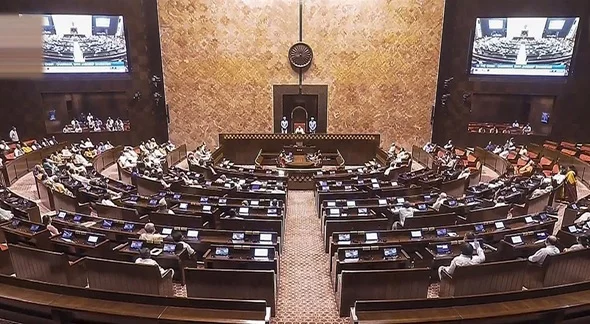
The Association for Democratic Reforms (ADR) and National Election Watch (NEW) have released an analysis of the affidavits of sitting Rajya Sabha Members of Parliament (MPs), revealing that 31% of Rajya Sabha MPs have declared criminal cases against themselves, while 16% have declared serious criminal cases.
The report has once again brought the issue of criminalisation of politics and the growing influence of money power in Indian democracy into focus.
What are ADR and National Election Watch?
- The Association for Democratic Reforms (ADR) is a non-governmental, non-profit organization established in 1999 with the objective of promoting transparency, accountability, and electoral reforms in India. It works on issues such as electoral transparency, political funding, candidate disclosures, and voter awareness.
- National Election Watch (NEW) is a nationwide network of civil society organizations that collaborates with ADR to analyze the criminal, financial, educational, and other background details of electoral candidates and elected representatives based on their election affidavits.
Key Highlights of the Report
- The report analyzed the affidavits of 226 out of the 233 sitting Rajya Sabha MPs. Four Rajya Sabha seats from West Bengal are currently vacant, while affidavits of three MPs were unavailable and therefore could not be analyzed.
- Out of the 226 MPs analyzed, 69 MPs (31%) have declared criminal cases against themselves, whereas 36 MPs (16%) have declared serious criminal cases.
- The report further reveals that one Rajya Sabha MP has declared a case related to murder, four MPs have declared cases related to attempt to murder, and four MPs have declared cases related to crimes against women.
- The financial analysis shows that 31 MPs (14%) have declared assets worth more than ₹100 crore, while the average assets of all sitting Rajya Sabha MPs stand at ₹115.25 crore.
What Constitutes a Serious Criminal Case ?
- According to ADR, a serious criminal case refers to a non-bailable, cognizable offence punishable with imprisonment of five years or more.
- It includes offences involving murder, attempt to murder, crimes against women or children, corruption, electoral offences, violent crimes, and offences causing financial loss to the public exchequer.
Political Party-wise Criminal Cases
- Among major political parties, 28 out of 107 BJP MPs (26%), 12 out of 29 Congress MPs (41%), 2 out of 9 AITC MPs (22%), 2 out of 8 DMK MPs (25%), and 2 out of 4 SP MPs (50%) have declared criminal cases.
- Similarly, 3 out of 4 TDP MPs (75%), all 3 BRS MPs (100%), all 3 CPI(M) MPs (100%), 2 out of 3 RJD MPs (67%), 1 out of 4 AIADMK MPs (25%), 1 out of 4 NCP MPs (25%), and 1 out of 3 AAP MPs (33%) have also declared criminal cases in their affidavits.
Money Power in the Rajya Sabha
- The report also highlights the increasing role of wealth in Indian politics. It states that 31 sitting Rajya Sabha MPs (14%) have declared assets exceeding ₹100 crore.
- Among major political parties, 7% of BJP MPs, 21% of Congress MPs, 50% of YSRCP MPs, 50% of TDP MPs, 67% of BRS MPs, and 50% of NCP MPs have declared assets worth more than ₹100 crore.
What is Criminalisation of Politics ?
-
Criminalisation of politics refers to the increasing participation of individuals with criminal backgrounds in electoral politics, their election to legislatures, and the willingness of political parties to nominate candidates with criminal records due to their financial strength, political influence, or perceived electoral viability.
Reasons Behind Criminalisation of Politics
- One of the major reasons is the politico-criminal nexus, where politicians and criminals develop mutually beneficial relationships involving campaign finance, muscle power, and political protection. This issue was highlighted by the N.N. Vohra Committee (1993).
- Political parties often prioritize winnability over integrity by selecting candidates with strong financial resources and local influence.
- The slow pace of judicial proceedings allows accused individuals to contest elections for several years before their cases are decided.
- The high cost of elections encourages parties to field wealthy candidates capable of financing expensive election campaigns.
- In many constituencies, voter preferences based on caste, community, local influence, or patronage also contribute to the electoral success of candidates with criminal backgrounds.
Other Important Findings
-
According to ADR, nearly 45% (1,861) of MLAs across India have declared criminal cases, indicating that criminalisation is not confined to Parliament but is also widespread in State Legislatures.
Measures Taken to Address Criminalisation of Politics
- The Representation of the People Act, 1951 (RPA) contains provisions to curb criminalisation.
- Section 8 of the Act disqualifies convicted representatives from contesting elections or continuing as legislators under specified conditions.
- Section 33A mandates every election candidate to disclose all pending criminal cases through a sworn affidavit.
Committees and Commission Recommendations
- The Goswami Committee (1990) recommended comprehensive electoral reforms and greater transparency in candidate disclosures.
- The Law Commission of India, through its 170th and 244th Reports, recommended barring candidates from contesting elections after charges are framed in serious criminal offences and strengthening disclosure norms.
- The Second Administrative Reforms Commission (2nd ARC, 2008) also recommended comprehensive reforms to reduce the criminalisation of politics and improve electoral integrity.
Important Supreme Court Judgments
- In Union of India v. Association for Democratic Reforms (2002), the Supreme Court made it mandatory for candidates to disclose their criminal antecedents, assets, liabilities, and educational qualifications.
- In Lily Thomas v. Union of India (2013), the Supreme Court struck down Section 8(4) of the Representation of the People Act, resulting in the immediate disqualification of convicted MPs and MLAs upon conviction.
- In Public Interest Foundation v. Union of India (2019), the Supreme Court directed political parties to publish the criminal records of their candidates on their websites, social media platforms, and newspapers, along with reasons for selecting such candidates.
Way Forward
- Addressing the criminalisation of politics requires speedy disposal of serious criminal cases through fast-track courts, greater transparency in political funding, stricter scrutiny of candidates by political parties, enhanced voter awareness, and stronger enforcement powers for the Election Commission of India.
- Implementing the recommendations of various committees, commissions, and judicial pronouncements will be crucial for strengthening the integrity of India's democratic institutions.






 Contact Us
  New Batch : 9555124124/ 7428085757
  Tech Support : 9555124124/ 7428085757