Why in the News ?
- Recently, the Supreme Court took suo motu cognizance of two road accidents that occurred in November 2025, in which 34 people died. In the case of Phalodi Accident vs. NHAI and Others (2025), the Court recognized the right to safe travel on national highways as a fundamental right under Article 21 (right to life and personal liberty).
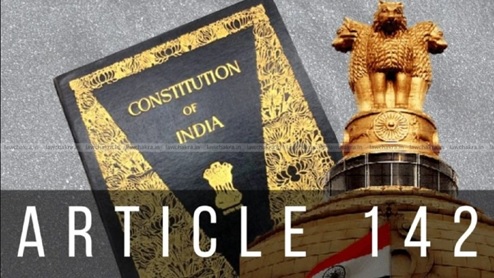
- During this period, the Court exercised its extraordinary powers under Article 142 and issued comprehensive directions to the government to ensure "complete justice." This has sparked debate about the scope, necessity, and impact of Article 142.
Road Safety Crisis in India: Background to Court Intervention
- The Supreme Court's intervention was prompted by alarming road accident statistics:
- National highways constitute only 2% of India's total roads, but account for approximately 30% of road accident deaths
- Approximately 26,770 people died on national highways in the first six months of 2025.
- The death rate decreased by approximately 11% compared to 2024, yet the situation remains serious.
- The Government of India has set a target of reducing road accidents by 50% by 2030.
- A "4E strategy" has been adopted for this:
- Four Pillars of Road Safety (4E Strategy)
- Education - Promoting traffic awareness and safe driving behavior.
- Engineering - Improving road design and infrastructure.
- Enforcement - Effective enforcement of traffic rules.
- Emergency Medical Services - Providing prompt treatment after an accident.
What is Article 142 ?
- Article 142 of the Indian Constitution empowers the Supreme Court of India to issue such order or decree as is necessary to ensure "complete justice" in any pending suit or matter.
Article 142(1)
- The Supreme Court may, in the exercise of its jurisdiction, pass such order or decree as is necessary to do complete justice in any pending suit or matter.
- This power allows the Court to grant relief in situations where existing laws are inadequate, procedural hurdles are obstructing justice, and a legal gap exists.
- For this reason, Article 142 is also called the "Constitutional Safety Valve."
Nature of Article 142
- The power under Article 142 is residuary and extraordinary in nature.
- Its main dimensions are:
- A means of filling legal gaps
- This power is exercised when ordinary law fails to provide a solution.
- Constitutional power
- This power derives directly from the Constitution, not from an Act.
- Beyond procedural justice
- It allows the court to go beyond strict procedural limits and ensure substantive justice.
- Use in exceptional circumstances
- It is generally used when there is a clear error and serious injustice would result from the court's failure to intervene.
Judicial Interpretation of Article 142
Delhi Judicial Services Association v. State of Gujarat (1991)
- In this case, the Supreme Court held that the power to provide "complete justice" under Article 142 is a constitutional power distinct from and superior to ordinary laws, and therefore, ordinary legal provisions cannot limit it.
- This decision reinforced the concept of ensuring substantive justice by placing constitutional justice above procedural hurdles.
Canara Bank v. Debashis Das (2003)
- In this case, the Supreme Court held that the Constitution aims to ensure substantive justice, not merely formal or procedural justice; therefore, where legal justice is insufficient or fails to provide justice, the principles of natural justice must be prioritized.
Hitesh Bhatnagar v. Deepa Bhatnagar (2011)
- In this case, the Supreme Court held that the extraordinary powers under Article 142 must be exercised with utmost caution, judicial restraint, and prudence, so as to maintain constitutional balance and judicial decorum while ensuring “complete justice.”
Why is “complete justice” needed ?
- The question naturally arises: can justice ever be imperfect? The answer lies in the distinction between law and justice.
- Laws are made according to the social, economic, and political circumstances of a particular time, but over time, new changes and challenges emerge in society, such as live-in relationships, LGBTQ+ rights, environmental crises, digital privacy, and technological change.
- In such circumstances, the existing legal framework is often insufficient to provide justice. Therefore, Article 142 empowers the Supreme Court with the constitutional power to ensure “complete justice” by bridging the gap between formal justice and substantive justice.
Can High Courts also deliver “complete justice”?
- In Anil Kumar Jain v. Maya Jain (2009), the Supreme Court clarified that the powers granted to High Courts under Article 226 are not the same as the Supreme Court's extraordinary powers to deliver “complete justice” under Article 142.
- Nevertheless, High Courts can ensure justice within a limited scope within their constitutional jurisdiction. That is, the difference between the two is not one of principle, but of jurisdiction and scope.
Article 142 and the Separation of Powers Debate
- The most prominent criticism of the use of Article 142 has been that of judicial overreach. Critics argue that this provision allows the judiciary to interfere in the domain of the executive and legislature, sometimes going beyond established legal procedures, and even influencing matters that primarily fall within the scope of policy decisions.
- According to them, the extensive use of Article 142 can sometimes lead to judicial activism, which can lead to judicial overreach, raising concerns about weakening the role of the legislature, undermining the principle of separation of powers, and overextending judicial discretion.
Counter-Argument: Judicial Activism
- According to supporters of Article 142, it is not appropriate to view it solely as judicial overreach, as judicial activism is an important means of ensuring justice in changing social, economic, and political circumstances.
- According to them, the fundamental purpose of Article 142 is to effectively enforce social, economic, political, and legal justice. The Court exercises this extraordinary power not in normal circumstances, but when other constitutional institutions become inactive, or existing laws prove inadequate to provide justice in accordance with changing circumstances.
- In such cases, Article 142 provides the Court with the constitutional basis to ensure true and complete justice.
Conclusion
- Article 142 is one of the most distinctive provisions of the Indian Constitution. It empowers the Supreme Court to transcend procedural boundaries and ensure “complete justice.”
- However, due to its extraordinary nature, it must be exercised with restraint, discretion, and constitutional balance.
- The recent road safety judgment demonstrates that Article 142 continues to serve as a bridge between law and justice, especially in situations where the legislative system is unable to provide immediate solutions.






 Contact Us
  New Batch : 9555124124/ 7428085757
  Tech Support : 9555124124/ 7428085757