
- UPSC Exam
- State PCS
- One Day Exam
- Current Affairs
- PT Quiz
- Downlaods
- About Coaching
- Blog
- Videos

| Prelims: (Polity & Governance + CA) Mains: (GS 2: Constitution, Judiciary, Governance; GS 4: Ethics in Public Administration) |
Recent observations by the Allahabad High Court have renewed scrutiny of the practice termed “bulldozer justice” in Uttar Pradesh, where properties of individuals accused of crimes are demolished soon after allegations surface.
Despite clear directions issued in 2024 by the Supreme Court of India against unlawful demolitions, such actions continue to raise concerns about due process, presumption of innocence, and constitutional safeguards.
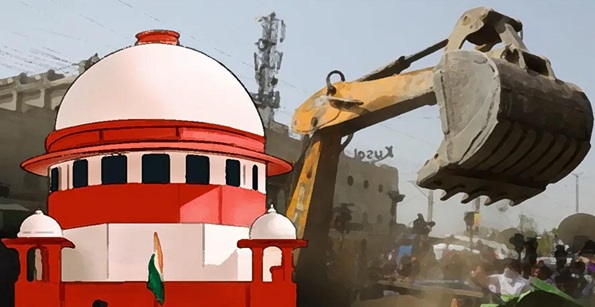
“Bulldozer justice” refers to the demolition of properties belonging to accused persons — often immediately after the registration of an FIR — under municipal or urban planning laws.
Critics argue that such demolitions invert the constitutional sequence:
Allegation → Investigation → Adjudication → Punishment
Instead, executive action precedes judicial determination, raising questions under:
The debate highlights tensions between administrative enforcement and constitutional due process in a democratic system.
A family from Hamirpur district approached the court after municipal authorities threatened demolition of their home and commercial property following an FIR against a relative.
Key facts:
The Division Bench reaffirmed that criminal punishment lies exclusively within the judiciary’s domain, not the executive.
The court framed critical questions, including:
Under statutes such as:
Authorities may remove unauthorised constructions. However, due process requires:
These laws are regulatory — not punitive — in nature.
In In Re: Directions in the Matter of Demolition of Structures (2024), the Supreme Court held:
Courts examine:
If intent appears punitive rather than regulatory, the action may be unconstitutional.
When lawful authority is used to achieve an impermissible objective (e.g., punishment without trial), it constitutes a colourable exercise of power.
Such misuse:
Article 21 protects individuals from deprivation of life and liberty without procedure established by law.
An accused remains innocent until proven guilty.
Punishment is a judicial function; the executive enforces law but cannot impose sanctions without trial.
Demolition can permanently destroy homes, livelihoods, and social standing — even if the accused is later acquitted.
Perceived arbitrariness may weaken faith in rule-based administration.
Municipal authorities must act against illegal constructions to maintain urban order.
However, enforcement must:
|
Regulatory Action |
Punitive Action |
|---|---|
|
Based on building violations |
Triggered by criminal allegation |
|
Follows due process |
Immediate post-FIR action |
|
Neutral application |
Targeted enforcement |
|
Subject to appeal |
Often expedited |
Bulldozers are tools of urban governance — not instruments of criminal adjudication.
FAQsQ1. What is meant by “bulldozer justice” ? It refers to demolition of properties linked to accused individuals, often immediately after criminal allegations arise. Q2. Is demolition illegal in all cases ? No. Demolition of unauthorised constructions is lawful if due process is followed and action is regulatory, not punitive. Q3. What did the Supreme Court clarify in 2024 ? It ruled that property cannot be demolished merely because the owner is accused of a crime and emphasised due process safeguards. Q4. Why is the practice constitutionally contentious ? It may violate Articles 14 and 21 by bypassing judicial adjudication and due process. Q5. What is a “colourable exercise of power” ? It occurs when lawful authority is used to achieve an unlawful objective — such as punishing without trial. |



Our support team will be happy to assist you!

 Contact Us
  New Batch : 9555124124/ 7428085757
  Tech Support : 9555124124/ 7428085757