
- UPSC Exam
- State PCS
- One Day Exam
- Current Affairs
- PT Quiz
- Downlaods
- About Coaching
- Blog
- Videos

The Cabinet Committee on Economic Affairs (CCEA), chaired by Prime Minister Narendra Modi, has approved the National Investment Policy for Urea-2026 for Atmanirbhar Bharat (NIPU-2026). The policy aims to encourage fresh investments in India's urea sector by promoting the establishment of new gas-based urea manufacturing plants. It seeks to increase domestic production, reduce import dependence, strengthen India's fertilizer security, and support the vision of Atmanirbhar Bharat.
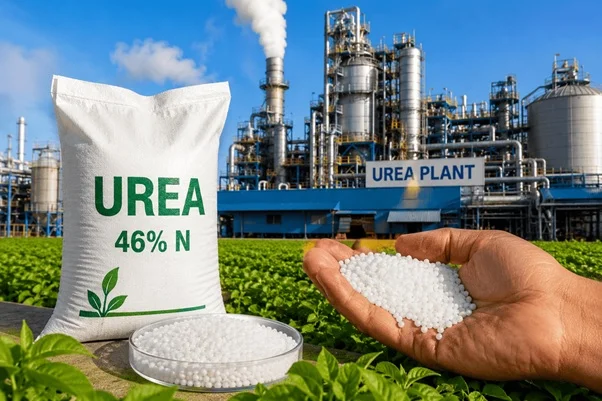
Urea is the most widely used nitrogenous fertilizer in the world and plays a crucial role in increasing agricultural productivity. It supplies Nitrogen (N), which is an essential nutrient required for plant growth, chlorophyll formation, and protein synthesis. Since nitrogen is the primary nutrient responsible for the growth of leaves and stems, urea is considered one of the most important fertilizers for crops such as rice, wheat, maize, sugarcane, cotton, and vegetables.
Chemically, urea is an organic compound with the molecular formula CO (NH₂)₂. It contains 46% nitrogen, the highest nitrogen content among all solid nitrogenous fertilizers, making it highly efficient and cost-effective for farmers.
Industrial urea is produced using natural gas as the primary feedstock.
The manufacturing process involves two major steps :
This is why the Government of India is encouraging the establishment of gas-based urea plants under NIPU-2026, as they are more energy-efficient and environmentally cleaner than older production technologies.
Urea is considered indispensable for Indian agriculture because it:
Nearly every major food crop cultivated in India depends on nitrogen supplied through urea.
India is one of the largest consumers of urea globally due to :
Although India has significantly increased domestic production, the country's annual demand still exceeds production capacity. Therefore, India imports a substantial quantity of urea every year to meet farmers' requirements.
At present :
This production gap is the primary reason behind introducing National Investment Policy for Urea-2026 (NIPU-2026).
India is one of the world's largest consumers of urea because agriculture remains heavily dependent on nitrogen-based fertilizers. Although domestic production has increased in recent years, it is still insufficient to meet the country's annual demand.
As a result, India imports millions of tonnes of urea every year, making it vulnerable to :
To bridge this gap, the government has introduced NIPU-2026 to encourage fresh investments and expand domestic manufacturing capacity.
To increase domestic fertilizer production, the Government of India introduced the New Investment Policy (NIP-2012).
The policy encouraged investments through :
Under NIP-2012 :
The policy remained effective until October 2019.
|
Feature |
NIP-2012 |
NIPU-2026 |
|---|---|---|
|
Investment Period |
Till October 2019 |
New policy from 2026 |
|
Cost Structure |
Combined |
Fixed and Variable Costs separated |
|
Return on Equity |
No defined band |
12%–16% RoE |
|
Forex Risk |
Higher |
Reduced through INR conversion |
|
Transparency |
Moderate |
Higher |
|
Estimated Government Savings |
Lower |
Over ₹250 crore per plant |
The policy encourages investors to establish new gas-based urea manufacturing units across the country. Gas-based plants are considered more energy-efficient and environmentally cleaner than older production technologies.
Unlike the previous policy, NIPU-2026 separates :
This change improves transparency in subsidy calculations and project evaluation while making the pricing mechanism more predictable.
For the first time, the policy introduces a clearly defined Return on Equity (RoE) :
This provides investors with a reasonable return while protecting public finances.
Under the policy, the fixed cost component will be converted into Indian Rupees after four years based on prevailing exchange rates.
This mechanism reduces the impact of exchange rate fluctuations on project viability and minimizes financial uncertainty for investors.
According to the government, every new plant established under NIPU-2026 is expected to generate savings of more than ₹250 crore compared to projects established under the previous NIP-2012 policy.
The implementation of the policy will focus on encouraging investments in new gas-based urea manufacturing units.
The Department of Fertilizers has already received multiple proposals from companies interested in establishing new urea plants. These proposals will now be considered under the framework of NIPU-2026.
While the policy is promising, successful implementation will require addressing several challenges :
The approval of NIPU-2026 marks a significant policy reform aimed at strengthening India's fertilizer sector. By creating a transparent and investor-friendly framework, the government seeks to attract fresh investments in gas-based urea manufacturing, reduce import dependence, and enhance fertilizer security. If implemented effectively, the policy will support India's long-term goals of food security, agricultural sustainability, and Atmanirbhar Bharat, while also improving the efficiency of public expenditure in the fertilizer sector.
UPSC Prelims MCQQ. With reference to the National Investment Policy for Urea-2026 (NIPU-2026), consider the following statements:
Select the correct answer using the code below: A. 1 and 2 only UPSC GS-3 Mains Practice Question"The National Investment Policy for Urea-2026 (NIPU-2026) is a major step towards achieving fertilizer self-sufficiency in India. Discuss its key features, expected benefits, and implementation challenges in the context of agricultural sustainability and Atmanirbhar Bharat." |
Frequently Asked Questions (FAs)1. What is NIPU-2026 ?NIPU-2026 is the National Investment Policy for Urea introduced by the Government of India to encourage investment in new gas-based urea manufacturing plants and increase domestic fertilizer production. 2. Why has the government introduced NIPU-2026?The policy has been introduced to reduce India's dependence on imported urea, strengthen fertilizer security, promote self-reliance, and ensure a stable supply of fertilizers for agriculture. 3. What are the major reforms under NIPU-2026 ?Key reforms include separation of fixed and variable costs, a defined Return on Equity (12%–16%), reduction of foreign exchange risk, and greater transparency in project financing. 4. How is NIPU-2026 different from NIP-2012?Unlike NIP-2012, the new policy introduces a transparent cost structure, a defined RoE band, mechanisms to reduce forex risk, and is expected to save more than ₹250 crore per plant. 5. Why is NIPU-2026 important for UPSC preparation ?The policy is relevant for topics such as agricultural reforms, fertilizer subsidies, food security, public policy, manufacturing, economic reforms, and Atmanirbhar Bharat under GS Paper III. |



Our support team will be happy to assist you!

 Contact Us
  New Batch : 9555124124/ 7428085757
  Tech Support : 9555124124/ 7428085757