
- UPSC Exam
- State PCS
- One Day Exam
- Current Affairs
- PT Quiz
- Downlaods
- About Coaching
- Blog
- Videos

Japan was hit by Typhoon Dujuan on September 21–22, 2026, bringing torrential rain, strong winds, flooding and landslides to Tokyo and nearby regions.

The typhoon caused widespread disruption across Tokyo and neighbouring prefectures.
The evacuation advisories were not mandatory.
Typhoons mainly form due to the following conditions:
Prelims Practice QuestionQ1. Consider the following statements about Typhoons:
Which of the statements given above is/are correct? A. Only 1 Mains Practice QuestionQ. How do tropical cyclones such as Typhoon Dujuan affect urban areas? Discuss the importance of early-warning systems and disaster preparedness in reducing their impact. |
1. What is a Typhoon?A typhoon is a powerful tropical cyclone that forms over the northwestern Pacific Ocean. 2. What causes Typhoons?Typhoons develop mainly due to warm ocean water, high atmospheric moisture, low pressure, the Coriolis effect and low vertical wind shear. 3. What is the difference between a Typhoon and a Cyclone?They are essentially the same type of weather system. The name varies by region. Typhoon is used mainly for the northwestern Pacific, while cyclone is commonly used in the Indian Ocean and South Pacific. 4. Which agency monitors Typhoons in Japan?The Japan Meteorological Agency (JMA) monitors typhoons and issues weather and disaster warnings. |
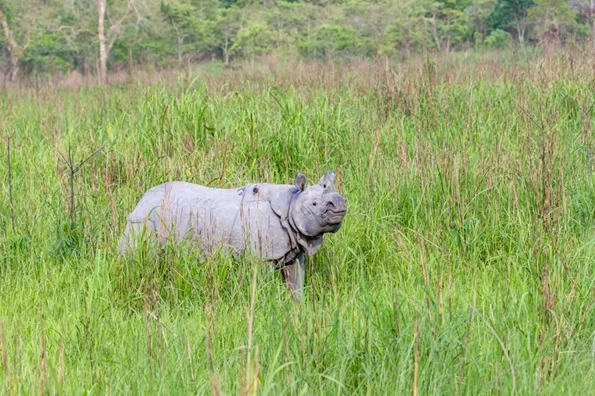
World Rhino Day is celebrated annually on 22 September to raise awareness about the conservation of all five surviving rhinoceros species.
|
World Rhino Day |
22 September |
|
First announced |
2010 |
|
First international observance |
2011 |
|
Initiating organisation |
WWF-South Africa |
|
Conservation message |
Five Rhino Species Forever |
|
Living rhino species |
5 |
|
African rhino species |
White and Black |
|
Asian rhino species |
Greater One-Horned, Javan and Sumatran |
|
Indian rhino's scientific name |
Rhinoceros unicornis |
|
Indian rhino's IUCN status |
Vulnerable |
|
India's principal rhino habitat |
Kaziranga National Park, Assam |
|
Indian Rhino Vision 2020 |
Launched in 2005 |
|
National Rhino Conservation Strategy |
2019 |
|
Year |
Important development |
|
2010 |
World Rhino Day announced by WWF-South Africa |
|
2011 |
International observance expanded to all five species |
|
2005 |
Indian Rhino Vision 2020 launched |
|
2019 |
India launched its National Conservation Strategy for the Indian One-Horned Rhinoceros |
|
Protected area |
State |
|
Kaziranga National Park |
Assam |
|
Pobitora Wildlife Sanctuary |
Assam |
|
Orang National Park |
Assam |
|
Manas National Park |
Assam |
|
Laokhowa–Burachapori landscape |
Assam |
|
Jaldapara National Park |
West Bengal |
|
Gorumara National Park |
West Bengal |
|
Ecological role |
Importance |
|
Grassland management |
Helps maintain vegetation structure |
|
Seed dispersal |
Supports plant regeneration |
|
Nutrient cycling |
Dung returns nutrients to the soil |
|
Habitat modification |
Wallowing and movement influence habitat features |
|
Biodiversity conservation |
Protecting rhino habitats benefits other wildlife |
|
IUCN |
Assesses extinction risk through the Red List |
|
CITES |
Regulates international trade in rhinos and their parts |
|
WWF |
Supports habitat protection and anti-poaching initiatives |
|
International Rhino Foundation |
Supports research and conservation programmes |
|
TRAFFIC |
Monitors wildlife trade and helps combat illegal trade |
When is World Rhino Day celebrated?World Rhino Day is celebrated every year on 22 September. When was World Rhino Day first observed internationally?It became an international observance in 2011. How many rhinoceros species exist worldwide?There are five surviving rhinoceros species. What is the scientific name of the Indian rhinoceros?The scientific name is Rhinoceros unicornis. What is the IUCN status of the Greater One-Horned Rhinoceros?It is classified as Vulnerable. |

|
International Day of Sign Languages |
23 September |
|
2026 theme |
Declaring Deaf People's Human Rights |
|
First observance |
2018 |
|
World Federation of Deaf established |
23 September 1951 |
|
India's nodal institution for ISL |
ISLRTC |
|
ISLRTC established |
2015 |
|
National sign languages |
International Sign |
|
Naturally developed within deaf communities |
Used for communication across different sign languages |
|
Have established linguistic structures |
More flexible and context-dependent |
|
Used in everyday communication |
Mainly used in international settings |
|
Examples: ISL, ASL and BSL |
International Sign (IS) |
|
Article |
Key provision |
|
Article 2 |
Includes sign languages within the definition of language |
|
Article 9 |
Accessibility, including access to information and communication |
|
Article 21 |
Freedom of expression and access to information |
|
Article 24 |
Inclusive education and facilitation of sign-language learning |
|
Article 30 |
Recognition and support for cultural and linguistic identity, including sign languages and deaf culture |
When is the International Day of Sign Languages celebrated?It is celebrated annually on 23 September. What is the theme of International Day of Sign Languages 2026?The 2026 theme is “Declaring Deaf People's Human Rights.” When was the International Day of Sign Languages first celebrated? It was first observed on 23 September 2018. Which organisation proposed the International Day of Sign Languages? The World Federation of the Deaf (WFD) proposed its establishment. When was the World Federation of the Deaf established? The WFD was established on 23 September 1951. |
| Prelims: Narcotics Control Bureau, Anti-Narcotics Task Force, Vision Document on Narcotics Control, synthetic drugs, darknet and cryptocurrency. Mains – GS Paper III:- Internal Security Keywords:- 3rd ANTF Conference 2026, Anti-Narcotics Task Force, ANTF, Narcotics Control Bureau, NCB, Vision Document on Narcotics Control 2026–2029, drug trafficking, drug abuse, narcotics control, synthetic drugs, darknet investigation, cryptocurrency investigation, drug-free India, drug law enforcement, organised drug networks, illicit drug cultivation, precursor chemicals, internal security, India’s anti-drug strategy |

The discussions will focus on strengthening three major areas:
The conference will also promote a whole-of-government approach, bringing together central agencies, State governments and other stakeholders.
The conference will review the implementation of the Vision Document on Narcotics Control (2026–2029).
The document is based on four strategic pillars:
Eight technical sessions have been planned during the conference. These include:
The 3rd ANTF Conference will focus on strengthening India's institutional and enforcement mechanisms against drug trafficking. The implementation of the 2026–2029 Vision Document is expected to provide a coordinated framework for tackling drug supply, demand and associated harms across the country.
Prelims Practice QuestionThe 3rd National Conference of Anti-Narcotics Task Force (ANTF) Heads in 2026 is being organised by which organisation? A. Central Bureau of Investigation Mains Practice QuestionQ. Drug trafficking is evolving with the use of synthetic drugs, darknet and cryptocurrencies. Discuss the major challenges in controlling narcotics in India and suggest measures to strengthen the country’s anti-drug strategy. |
1. What is the 3rd ANTF Conference 2026?It is a national conference of the Anti-Narcotics Task Force (ANTF) heads of States and Union Territories, organised to strengthen India's efforts against drug trafficking and substance abuse. 2. When and where is the conference being held?The conference is being held in New Delhi on September 22–23, 2026. 3. Who will inaugurate the 3rd ANTF Conference?Union Home Minister Amit Shah will inaugurate the conference. 4. What is the Vision Document on Narcotics Control 2026–2029?It is a strategic framework focusing on strengthening India's efforts against drug trafficking and substance abuse during 2026–2029. 5. What are the four pillars of the Vision Document?The four pillars are enforcement, intelligence and operations; precursors and synthetic drugs control; demand and harm reduction; and capacity building and coordination. |
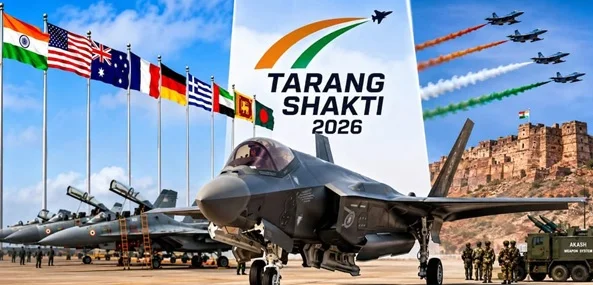
| Prelims: Tarang Shakti; Veer Guardian; Indian Air Force; F-35; Rafale; AEW&C. Mains: GS Paper II International relations and defence cooperation; GS Paper III Defence technology and security preparedness. |
|
Aspect |
Reported details |
|
Edition |
Second |
|
Host |
Indian Air Force |
|
Venue |
Air Force Station Jodhpur, Rajasthan |
|
Dates |
September 26–October 12, 2026 |
|
International participation |
More than 40 countries expected |
|
Main purpose |
Joint tactical manoeuvres and operational cooperation |
|
Country |
Expected platforms |
|
United States |
Two to three F-35 fifth-generation combat aircraft |
|
France |
Rafale fighter aircraft |
|
United Arab Emirates |
F-16 fighter aircraft |
|
India |
Rafale and Sukhoi-30 fighters, alongside support aircraft |
|
Other participating countries |
Support assets, including transport aircraft, as reported |
The IAF is also expected to deploy airborne early warning and control (AEW&C) aircraft, transport aircraft and air-to-air refuelling tankers. Their inclusion would allow training to extend beyond fighter manoeuvres to surveillance, coordination, logistics and sustained air operations.
These are potential benefits of multinational exercises; their achievement depends on the activities conducted and subsequent implementation of lessons.
Prelims MCQs1. Exercise Tarang Shakti is primarily associated with which of the following? (a) Multinational naval anti-piracy operations Mains Practice Question“Multinational air exercises serve both operational and diplomatic objectives.” Discuss with reference to Exercise Tarang Shakti. |
1. What is Exercise Tarang Shakti?Tarang Shakti is a multinational air exercise hosted by the Indian Air Force to promote joint training, operational understanding and defence cooperation. 2. Where and when is Tarang Shakti 2026 scheduled?According to the supplied report, it is scheduled at Air Force Station Jodhpur in Rajasthan from September 26 to October 12, 2026. 3. Which foreign fighter aircraft are expected to participate?The report identifies US F-35s, French Rafales and UAE F-16s among the planned foreign deployments. 4. How does Tarang Shakti differ from Veer Guardian?Tarang Shakti is a multinational air exercise, while Veer Guardian is a bilateral air exercise between India and Japan. 5. Why is Tarang Shakti important for India?It offers opportunities to improve operational coordination, learn from foreign air forces and strengthen defence relationships with participating countries. |
| Prelims: KAL; IG Defence; One-Way Attack Drones; GNSS; INS; Pokhran. Mains: GS Paper III Defence technology, indigenisation of technology, and security challenges. |

|
Parameter |
Company-reported details |
|
Developer |
IG Defence, headquartered in Noida |
|
Category |
Long-range one-way attack drone |
|
Test location |
Pokhran, Rajasthan |
|
Launch configuration |
Vehicle-mounted platform |
|
Range |
Up to 1,000 km |
|
Endurance |
Seven to eight hours |
|
Payload capacity |
Up to 50 kg |
|
Operating altitude |
Up to 5,000 metres above mean sea level |
|
Navigation |
Multi-band GNSS combined with INS |
|
Mission profile |
Autonomous flight for a designated one-way strike mission |
The reported payload capacity should not automatically be treated as the weight of explosive material carried.
According to the supplied report, several Gulf nations have expressed interest in KAL. Any export would remain subject to government approvals and export clearances. Expressions of interest should not be interpreted as confirmed procurement contracts.
A successful flight test is an important development milestone, but it does not establish operational readiness. Reliability, navigation accuracy, endurance and performance under realistic conditions require further assessment. The supplied report does not confirm armed-forces induction.
Navigation and communications may face interference in contested environments. Combining GNSS and INS is relevant to navigation continuity, but the report does not provide detailed evidence of performance under jamming or spoofing conditions.
Scaling production requires consistent component quality, dependable suppliers, skilled personnel and adequate testing capacity. Dependence on imported critical components could affect the depth of self-reliance.
The operational value of any platform depends on acquisition costs, support requirements, reliability and compatibility with military systems. KAL’s unit cost and independently verified accuracy figures are not provided in the supplied report.
Prelims Practice QuestionsQ. With reference to KAL, consider the following statements:
Which of the statements given above are correct? (a) 1 and 2 only Mains Practice Question“Indigenous unmanned systems can contribute to strategic autonomy, but technological demonstrations must translate into reliable operational capabilities.” Discuss with reference to India’s defence modernisation. |
1. What is KAL?KAL is an indigenous long-range one-way attack drone developed by IG Defence for designated strike missions. 2. Where was KAL tested?According to the company, KAL was flight-tested from a vehicle-mounted platform at the Pokhran range in Rajasthan. 3. What are KAL’s reported range, endurance and payload capacity?IG Defence states that KAL has a range of up to 1,000 km, endurance of seven to eight hours and payload capacity of up to 50 kg. 4. How does KAL navigate?Its reported navigation architecture combines multi-band GNSS with INS to support autonomous flight through its mission profile. 5. Has KAL been inducted into the Indian armed forces?The supplied report announces a successful flight test. It does not confirm formal induction, a procurement contract or operational deployment by the Indian armed forces. |

Our support team will be happy to assist you!

 Contact Us
  New Batch : 9555124124/ 7428085757
  Tech Support : 9555124124/ 7428085757

