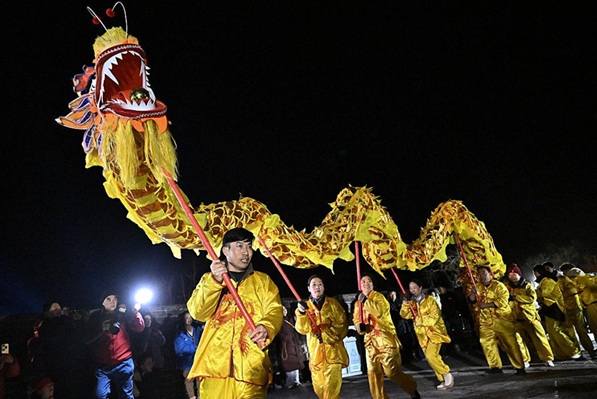
Lunar New Year marks the beginning of a new year based on the lunisolar calendar (a calendar based on both the moon’s cycles and the sun’s position).
Since the lunar calendar follows the moon’s cycles, its dates differ from the Gregorian (Western) calendar.
To balance this difference, an extra (leap) month is occasionally added to keep the calendar aligned with the seasons.
Lunar New Year is celebrated across many Asian countries under different names:
It is also widely celebrated in:
Each country has its own unique customs and traditions.
Recent celebrations in Moscow included:
These events also highlighted cultural ties between Russia and China.
Today, Lunar New Year:
During the recent visit of Brazilian President Luiz Inácio Lula da Silva to New Delhi, the two countries elevated their bilateral relations to a new level by signing a total of nine important agreements, including one on rare earth elements.
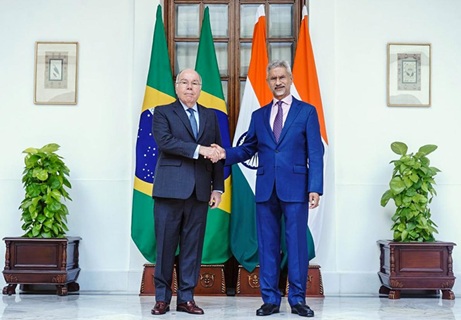
This visit is a decisive step towards diversifying global supply chains and making the voice of the 'Global South' more effective in international forums. This partnership will not only reduce dependence on countries like China but will also lay a strong foundation for the digital economy of the future.
At the recent India AI Impact Summit, the National Institute of Electronics and Information Technology (NIELIT), under the Ministry of Electronics and Information Technology (MeitY), Government of India, signed a Memorandum of Understanding (MoU) with the Government of Andhra Pradesh to establish India's first dedicated Quantum and Artificial Intelligence University Campus in Amaravati.
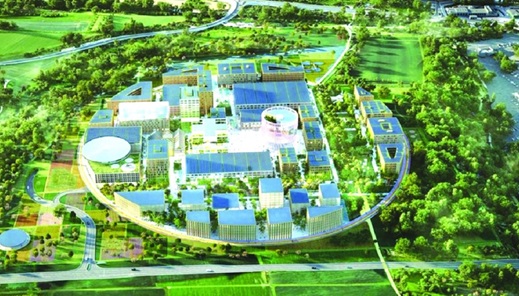
This initiative is expected to significantly strengthen India's capabilities in quantum technologies and AI, establishing the country as a global leader in next-generation innovation and deep-tech education.
| Prelims: (Polity & Governance + CA) Mains: (GS 2 – Federalism; Constitutional Provisions; Centre–State Relations; Identity Politics) |
The Union Cabinet has approved the proposal to rename the State of Kerala as Keralam, reflecting the linguistic and cultural identity of the Malayalam-speaking population.
The proposed Kerala (Alteration of Name) Bill, 2026 will now be referred to the Kerala Legislative Assembly under Article 3 of the Constitution, after which Parliament will consider amending the First Schedule.
The move follows unanimous resolutions passed by the Kerala Assembly in 2023 and 2024 and is viewed as an assertion of linguistic identity and historical continuity.
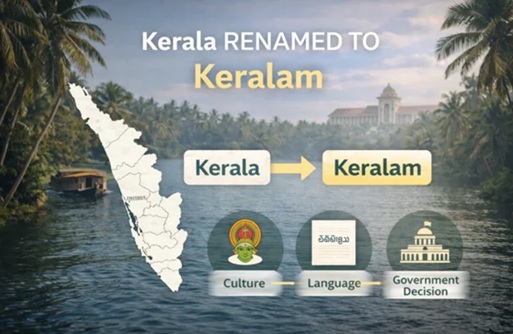
The State of Kerala was formed on 1 November 1956 following the linguistic reorganisation of states. While the English name “Kerala” is used in the Constitution, the name in Malayalam is “Keralam.”
The First Schedule of the Constitution lists the state as “Kerala,” creating a linguistic discrepancy between constitutional nomenclature and native usage. The Kerala Legislative Assembly passed resolutions seeking correction of this name to reflect historical and cultural authenticity.
A similar renaming attempt was made in 2023, but technical discrepancies required a fresh resolution in 2024, leading to the present proposal.
Article 3 of the Constitution empowers Parliament to:
Kerala was created during the linguistic reorganisation of states. “Keralam” is the original Malayalam name. Kerala Piravi Day commemorates the formation of the state on 1 November 1956.
The Assembly resolutions sought to align the constitutional name with local linguistic usage.
The 2023 resolution attempted modifications across all Eighth Schedule languages, which led to procedural discrepancies. A revised resolution in 2024 corrected these issues.
Several theories exist:
The name change was approved at the first Cabinet meeting held at Seva Teerth (new PMO complex). The decision is projected as reflecting the “will of the people” and has received cross-party support within Kerala.
The Cabinet adopted a governance pledge inspired by “Nagrik Devo Bhava,” emphasising:
Reinforces linguistic federalism and strengthens regional identity within the Union.
Demonstrates cooperative federalism:
Aligns constitutional nomenclature with historical and linguistic traditions.
FAQs1. Under which Article can a state’s name be changed ? Article 3 of the Constitution empowers Parliament to change a state’s name. 2. Does the State Legislature have veto power ? No. Its views are sought, but Parliament has the final authority. 3. Why is the change from Kerala to Keralam significant ? It aligns the constitutional name with the Malayalam linguistic identity. 4. Will the Constitution need amendment ? Yes, amendment of the First Schedule is required, though it does not require a special majority under Article 368. 5. Is this the first such renaming ? No. States like Odisha (formerly Orissa) and Tamil Nadu (formerly Madras State) have undergone similar changes. |
| Prelims: (Internantional Relations + CA) Mains: (GS 2 – India and its Neighbourhood & West Asia; Bilateral Relations; Strategic Affairs) |
Prime Minister Narendra Modi is on an official visit to Tel Aviv, marking his first trip to Israel since his landmark 2017 visit — the first-ever by an Indian Prime Minister after diplomatic ties were established in 1992.
However, the present visit unfolds amid a volatile regional context, including tensions involving the United States and Iran and a fragile ceasefire in Gaza. The visit highlights both the evolution and the growing strategic weight of India–Israel relations.
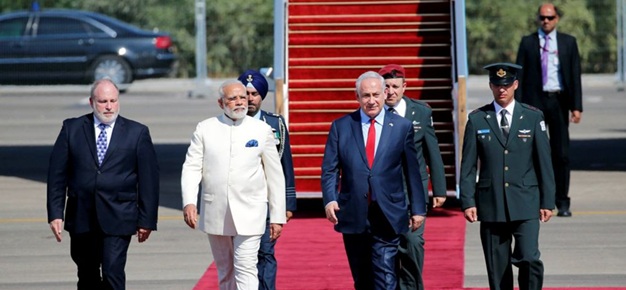
India recognised the state of Israel in 1950, soon after its creation in 1948. However, full diplomatic relations were delayed for over four decades due to:
In January 1992, during Yasser Arafat’s visit, Prime Minister P. V. Narasimha Rao conveyed that establishing ties with Israel could enhance India’s diplomatic leverage on Palestine.
On January 29, 1992, India formally established full diplomatic relations with Israel — a decisive turning point.
Even before formal ties:
This established Israel as a reliable defence partner.
After assuming office in 2014, PM Modi brought relations into the open.
PM Modi’s 2017 visit marked:
This signalled India’s confidence in pursuing an independent West Asia policy.
Under the Abraham Accords signed during Donald Trump’s presidency, Israel normalised ties with several Arab nations, reshaping West Asia’s diplomatic architecture.
The October 7, 2023 Hamas attack triggered a prolonged Gaza conflict. A fragile truce now holds, but regional tensions remain high.
In June 2025, a 12-day Israel–Iran confrontation heightened instability. U.S. military actions targeting Iranian nuclear facilities further escalated tensions.
The regional security environment is thus significantly more fragile than during Modi’s 2017 visit.
India must balance:
Any perceived tilt could impact India’s energy security and diaspora interests.
FAQs1. When did India establish diplomatic relations with Israel ? On January 29, 1992. 2. Why were ties delayed despite early recognition ? Due to support for Palestine, Cold War dynamics, and regional sensitivities. 3. What changed after 2014 ? Political engagement became open and strategic cooperation expanded visibly. 4. What is the significance of the 2017 visit ? It was the first visit by an Indian PM and marked a shift toward independent diplomatic positioning. 5. Why is the current visit diplomatically sensitive ? It occurs amid Gaza tensions and rising Iran–US–Israel friction, requiring careful diplomatic balancing. |
| Prelims: (History & Culture + CA) Mains: (GS 1 – Freedom Struggle & Social Reform; GS 2 – Democratic Institutions; GS 4 – Ethics in Public Life) |
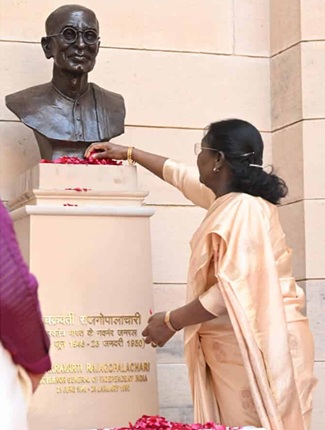
President Droupadi Murmu unveiled a statue of C. Rajagopalachari (Rajaji) in the central courtyard of Rashtrapati Bhavan, replacing the bust of Edwin Lutyens.
The decision, announced by Prime Minister Narendra Modi, symbolically recognises Rajaji’s legacy of public service, reformist vision, and principled politics. The move reflects a broader effort to reinterpret colonial-era symbols and honour national figures who shaped India’s democratic and moral foundations.
Born in December 1878 in Thorapalli (Tamil Nadu), Rajaji emerged as one of the most intellectually influential leaders of the national movement.
He attended the 1906 Calcutta and 1907 Surat sessions of the Indian National Congress, marking his early engagement with nationalist politics.
In 1919, Rajaji met Mahatma Gandhi in Madras. This encounter deepened his commitment to non-violent resistance and mass mobilisation.
Rajaji supported the 1919 Rowlatt Satyagraha and led the Non-Cooperation Movement in Tamil Nadu, giving up his lucrative legal practice.
He led the historic Trichy–Vedaranyam march as part of the Civil Disobedience Movement and faced multiple imprisonments.
While close to Gandhi, Rajaji differed during the Quit India Movement. He advocated negotiation with the Muslim League instead of immediate confrontation with the British.
To break the political deadlock between Congress and the Muslim League, Rajaji proposed a compromise formula:
In 1944, Gandhi conveyed the proposal to Muhammad Ali Jinnah, but it was rejected.
As Premier of Madras (1938), Rajaji introduced compulsory Hindi for Classes 6–8. However, during the anti-Hindi agitations of 1965, he opposed making Hindi the sole official language, defending English as a neutral link language.
His opposition was directed against coercion, not linguistic diversity.
After serving as Home Minister under Jawaharlal Nehru (1950–51), Rajaji grew critical of centralised planning and excessive state control.
In August 1959, he founded the Swatantra Party.
The party:
Though criticised as elitist, it emerged as a significant opposition force in the 1960s.
Rajaji authored accessible retellings of the Ramayana and Mahabharata, making classical texts widely readable.
Replacing a colonial-era statue with Rajaji’s image symbolises:
Rajaji’s life represents “principled flexibility” — balancing conviction with pragmatism, tradition with reform, and power with responsibility.
FAQs1. Who was C. Rajagopalachari ? An Indian freedom fighter, social reformer, Governor-General, and founder of the Swatantra Party. 2. What was the Rajaji Formula ? A proposal for a Congress–Muslim League agreement involving a plebiscite in Muslim-majority areas. 3. What role did Rajaji play in temple entry reform ? He enabled Dalit entry into temples through protective legislation in 1939. 4. Why is Rajaji considered a liberal thinker ? He opposed excessive state control and advocated constitutional democracy and economic freedom. 5. Why is the statue installation significant ? It symbolises honouring indigenous leaders and reinterpreting colonial-era symbolism in national spaces. |
The PRASHAD Scheme (Pilgrimage Rejuvenation and Spiritual Heritage Augmentation Drive) is a Central Sector Scheme launched in 2014–15 by the Ministry of Tourism, Government of India. The scheme aims at the integrated and holistic development of identified pilgrimage and spiritual heritage destinations across the country to provide better facilities and an enriched experience for pilgrims and tourists.
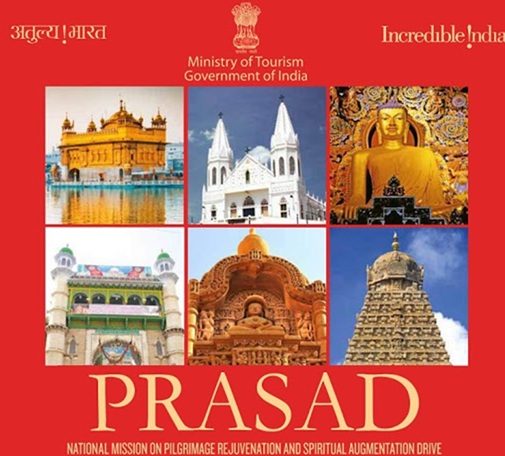
Recently, Union Civil Aviation Minister K. Ram Mohan Naidu stated that the Centre plans to further develop tourist destinations around prominent temples in Andhra Pradesh under the PRASHAD scheme.
After offering prayers at the Kanipakam Varasiddhi Vinayaka Swamy Temple, he highlighted that:

Our support team will be happy to assist you!


 Contact Us
  New Batch : 9555124124/ 7428085757
  Tech Support : 9555124124/ 7428085757