- UPSC Exam
- State PCS
- One Day Exam
- Current Affairs
- PT Quiz
- Downlaods
- About Coaching
- Blog
- Videos

According to a Save the Children analysis (2026), the United Kingdom recorded its highest child exposure to extreme heatwaves since 1995, with 10.7 million children (75% of the child population) affected during the first half of 2026. The report highlights the increasing impact of climate change and extreme weather events on children's health and well-being.

|
Region |
Children Exposed |
|
London |
100% |
|
West Midlands |
100% |
|
South West England |
93% |
|
East Midlands |
91% |
|
South East England |
89% |
|
Wales |
84% |
|
Period |
Average Annual Child Exposure |
|
1990s–2000s |
200–230 million |
|
2020s |
Around 360 million |
The report highlights that climate change is no longer only an environmental issue but also a public health and child rights challenge. Increasing heatwave exposure threatens children's health, education, and future productivity. Strengthening climate adaptation, improving disaster preparedness, and reducing emissions are essential to protect vulnerable populations.
Prelims QuestionQ. In the report, an "extreme heatwave" was defined as a period when:
Which of the statements given above are correct?
Mains Practice QuestionsQ. Heatwaves are emerging as one of the deadliest climate-induced disasters of the 21st century. Discuss their impact on vulnerable populations, particularly children. Suggest measures to enhance climate resilience. |
The scheme aims to:
|
Particular |
Details |
|
Implementing Ministry |
Ministry of Housing and Urban Affairs (MoHUA) |
|
Scheme Type |
Centrally Sponsored Scheme |
|
Operational Period |
FY 2025–26 to FY 2030–31 |
|
Extended Implementation |
Up to FY 2033–34 |
|
Total Central Assistance |
₹1 lakh crore |
|
Expected Total Investment |
Around ₹4 lakh crore |
The scheme supports projects under three broad themes:
This vertical focuses on making cities engines of economic growth through:
Objective: Generate employment and improve competitiveness of Indian cities.
This vertical supports:
Objective: Improve liveability while preserving cultural heritage.
Projects include:
Objective: Improve urban environmental sustainability and public health.
Instead of allocating funds uniformly, projects are selected through a transparent competitive process based on:
Only financially viable projects capable of attracting market financing are eligible.
These projects are expected to generate revenues or create long-term economic value.
The Centre's assistance is capped at 25% of the project cost.
This encourages states and cities to mobilise additional resources rather than depending solely on central grants.
At least 50% of the project cost must be raised through market mechanisms such as:
The remaining share may be funded by:
Cities participating under UCF are expected to undertake reforms in:
The scheme promotes greater private investment through:
To help financially weaker cities access institutional finance for the first time, the government has approved a ₹5,000 crore Credit Repayment Guarantee Scheme.
It is meant for:
The Central Government will provide:
The guarantee reduces lending risks for banks and encourages credit flow to smaller municipalities that otherwise struggle to raise funds.
The Urban Challenge Fund covers:
In principle, all cities can participate subject to the eligibility conditions and appraisal framework.
|
Source |
Share |
|
Central Government |
Maximum 25% |
|
Market-Based Sources |
Minimum 50% |
|
States/UTs/ULBs/Others |
Remaining share |
According to the Union Government, 33 projects have been approved or accorded in-principle approval.
|
State |
Projects |
|
Andhra Pradesh |
4 |
|
Gujarat |
6 |
|
Karnataka |
3 |
|
Madhya Pradesh |
6 |
|
Maharashtra |
3 |
|
Odisha |
7 |
|
Telangana |
3 |
|
Meghalaya |
1 |
India's urban population is projected to increase significantly over the coming decades. UCF seeks to create infrastructure capable of supporting future urban growth.
The scheme encourages cities to:
Since cities must mobilise most of the project funding themselves, they become more accountable for project design and implementation.
Cities compete for central assistance by demonstrating better planning, governance, and project quality.
Greater participation of private capital reduces dependence on government expenditure while improving efficiency and innovation.
The reform-linked nature of funding encourages improvements in:
| Prelims: Strait of Hormuz, Bab-el-Mandeb, Hodeidah Port, Houthis, 123 Agreement, Vision 2030. Mains GS-II: West Asia, India–Gulf Relations, Geopolitics, Regional Security. Mains GS-III: Energy Security, Maritime Security, Non-state Actors, Supply Chain Resilience. |
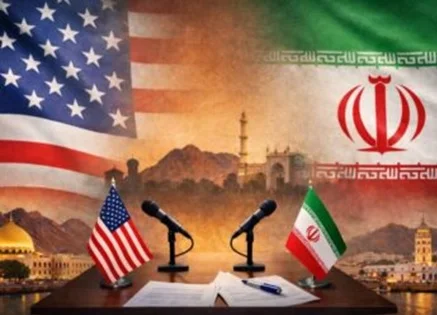
The ongoing US–Iran confrontation has triggered major strategic shifts in West Asia (Middle East). Gulf Arab countries are strengthening defence partnerships with Pakistan, hostilities between Saudi Arabia and the Houthis have resumed, and tensions around the Strait of Hormuz and Bab-el-Mandeb Strait have intensified. These developments have significant implications for regional security, global energy markets, and India's strategic interests.
The conflict in Yemen has entered a new phase.
Recent Escalation
For the first time in recent years:
both experienced conflict-related disruptions simultaneously.
This has increased concerns regarding:
Saudi Arabia is increasingly focused on long-term economic transformation under Vision 2030.
Saudi Arabia recently signed a 123 Agreement with the United States to develop a civilian nuclear energy programme.
A prolonged regional conflict could:
The recent drone attack on the Barakah Nuclear Power Plant (UAE) has further heightened concerns over nuclear security in the region.
Experts warn that prolonged instability could create a "Broken Windows Effect", where repeated security incidents gradually undermine investor confidence.
Possible consequences include:
|
Location |
Importance |
|
Strait of Hormuz |
Connects the Persian Gulf with the Gulf of Oman; one of the world's busiest oil shipping lanes. |
|
Bab-el-Mandeb Strait |
Connects the Red Sea with the Gulf of Aden and the Indian Ocean. |
|
Hodeidah Port |
Yemen's largest commercial and humanitarian port. |
|
Sana'a |
Capital of Yemen. |
|
Jazan Refinery |
Major Saudi oil refinery located on the Red Sea coast. |
|
Barakah Nuclear Power Plant |
UAE's first nuclear power plant. |
The evolving US–Iran confrontation has fundamentally altered the Gulf's security architecture. Gulf states are strengthening defence partnerships, Saudi Arabia is balancing security concerns with economic modernisation, and maritime chokepoints remain vulnerable to disruption.
For India, stability in West Asia is crucial for energy security, trade, diaspora welfare, and strategic interests. The developments reinforce the importance of balanced diplomacy, diversified energy sources, and secure maritime supply chains.
Prelims QuestionQ. With reference to the Strait of Hormuz, consider the following statements:
Which of the statements given above are correct?
Mains Practice QuestionQ. The US–Iran rivalry has significantly altered the security dynamics of West Asia. Discuss its implications for regional stability and India's strategic interests. |
Q1. What is the Strait of Hormuz?Answer: It is a strategic maritime chokepoint connecting the Persian Gulf with the Gulf of Oman. Q2. Why is the Strait of Hormuz strategically important?Answer: It carries about one-fifth of global oil trade, making it one of the world's most critical energy routes. Q3. What is the Bab-el-Mandeb Strait?Answer: It is a narrow waterway connecting the Red Sea with the Gulf of Aden and the Arabian Sea. Q4. Which countries border the Strait of Hormuz?Answer: Iran lies to the north, while Oman and the United Arab Emirates (UAE) lie to the south. Q5. Who are the Houthis?Answer: The Houthis are an Iran-backed Shia rebel group based in Yemen. |
| Prelims: Space Technology, ISRO, JAXA, Moon Missions, International Space Cooperation Mains: GS Paper III – Science & Technology, Space Technology, International Cooperation in Space, Innovation & Research Keywords: Chandrayaan-5, LUPEX, ISRO, JAXA, Lunar Polar Exploration Mission, H3 Rocket, Moon Mission 2028, Lunar South Pole, NASA, ESA, Water Ice on Moon |
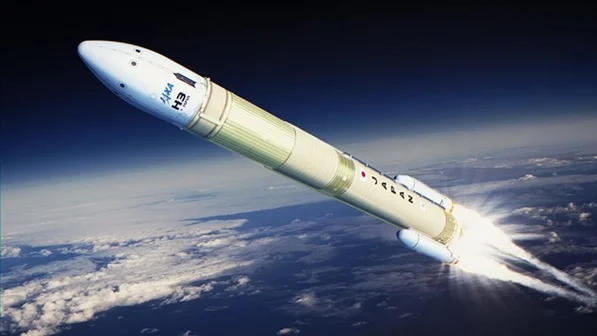
The Indian Space Research Organisation (ISRO) and the Japan Aerospace Exploration Agency (JAXA) held a high-level technical review meeting at the UR Rao Satellite Centre, Bengaluru, to assess the progress of Chandrayaan-5, also known as the Lunar Polar Exploration Mission (LUPEX).
Important Points
The lunar South Pole has emerged as one of the most scientifically important regions of the Moon because:
Scientists believe permanently shadowed craters contain frozen water accumulated over billions of years.
Water can be converted into:
Studying ice deposits helps scientists understand:
|
Component |
Responsibility |
|
Lander |
ISRO |
|
Rover |
JAXA |
|
Launch Vehicle |
Japan's H3 Rocket |
|
Mission Duration |
Around 100 Earth days |
|
Landing Site |
Lunar South Pole Region |
|
Launch Target |
2028 |
ISRO will develop:
The lander will safely deploy the rover onto the Moon's surface after touchdown.
JAXA is responsible for:
The rover will travel across the lunar surface to study subsurface ice and geological formations.
The mission also includes contributions from leading global space agencies.
|
NASA (USA) NASA will provide:
Purpose:
|
European Space Agency (ESA) ESA will contribute:
Purpose:
|
This makes Chandrayaan-5 a major multinational lunar exploration mission.
|
Water Ice Exploration
|
Lunar Geology
|
Surface Environment
|
During the Bengaluru meeting, scientists discussed:
The review is part of regular mission preparedness before the 2028 launch.
Recently, JAXA successfully conducted the second Payload Operations Simulation at the Tsukuba Space Center.
The exercise tested:
This marks another important milestone towards mission readiness.
The mission is expected to carry seven scientific instruments.
These instruments will study:
|
Mission |
Year |
Achievement |
|
Chandrayaan-1 |
2008 |
Discovery of water molecules on the Moon |
|
Chandrayaan-2 |
2019 |
Orbiter successful; lander hard landing |
|
Chandrayaan-3 |
2023 |
First successful landing near Lunar South Pole |
|
Chandrayaan-4 |
Upcoming |
Planned lunar sample return mission |
|
Chandrayaan-5 (LUPEX) |
2028 (Planned) |
India-Japan Lunar Polar Exploration Mission |
Prelims MCQWith reference to the Chandrayaan-5 (LUPEX) mission, consider the following statements:
Which of the statements given above are correct? A. 1, 2 and 4 only Mains Practice Question"Chandrayaan-5 (LUPEX) represents a new phase in international cooperation for lunar exploration. Discuss its scientific significance and strategic importance for India." |
Q1. What is Chandrayaan-5 (LUPEX)?It is a joint lunar exploration mission by ISRO and JAXA to study water and water-ice near the Moon's South Pole. Q2. Which country will launch Chandrayaan-5?The mission will be launched by Japan using the H3 rocket. Q3. What is the main objective of Chandrayaan-5?To explore and analyse water and water-ice deposits on and beneath the Moon's south polar surface. Q4. What are NASA and ESA contributing to the mission?NASA will provide a neutron spectrometer, while ESA will contribute a mass spectrometer. |
| Prelims: Environment, Environmental Impact Assessment (EIA), Environment (Protection) Act, 1986, Supreme Court Judgments Mains: GS Paper III – Environment, Environmental Governance, Sustainable Development, Judicial Activism Keywords: Ex-Post Facto Environmental Clearance, Supreme Court, EIA Notification 2006, Environment Protection Act 1986, Public Interest Test, Office Memorandum, Vanashakti Case, Environmental Jurisprudence |
The Supreme Court has quashed the Environment Ministry's July 2021 Office Memorandum (OM) that allowed ex-post facto (retrospective) Environmental Clearances (ECs) for projects that had begun without prior approval.
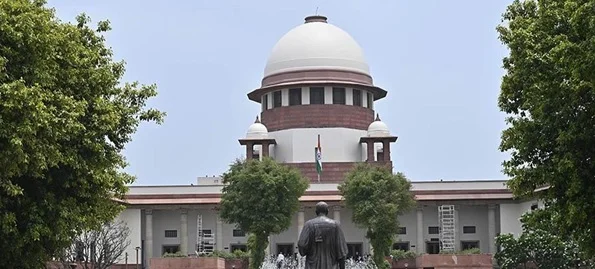
The Court adopted a balanced approach by distinguishing between executive instructions and statutory powers.
Key Observations
|
Office Memorandum (OM) |
Statutory Notification |
|
Administrative instruction |
Issued under statutory authority |
|
Does not have force of law |
Has legal force |
|
Cannot create new legal rights |
Can create legally enforceable mechanisms |
|
Easily modified by ministry |
Governed by delegated legislation |
The Supreme Court has now ruled that this continuing mechanism is unconstitutional.
The Court held that any future amnesty scheme must satisfy the following conditions:
UPSC Prelims MCQQ. With reference to Ex-Post Facto Environmental Clearance in India, consider the following statements:
Which of the statements given above is/are correct? A. 1 and 3 only Mains Practice Question"Environmental governance requires balancing ecological protection with developmental needs." In light of the Supreme Court's judgment on Ex-Post Facto Environmental Clearances, examine the evolving environmental jurisprudence in India. |
Q1. What is Ex-Post Facto Environmental Clearance?It is an environmental approval granted after a project has already started construction or operations. Q2. Why did the Supreme Court strike down the 2021 Office Memorandum?Because an administrative Office Memorandum cannot legally create a permanent mechanism for regularising environmental violations. Q3. Has the Supreme Court completely banned Ex-Post Facto Environmental Clearances?No. It has allowed the possibility of a limited statutory amnesty only in exceptional cases involving genuine public interest. Q4. What is the Public Interest Test?Any future amnesty must be narrowly tailored, exceptional, legally authorised through a statutory notification, and genuinely serve public interest rather than private commercial interests. Q5. Which law governs Environmental Clearances in India?The Environment (Protection) Act, 1986 and the Environmental Impact Assessment (EIA) Notification, 2006 govern the environmental clearance process. |
| Prelims: Science & Technology (Astronomy and Space Science), Current Affairs GS Paper III - Science and Technology (Developments and Applications of Science & Technology and Scientific Research). |
India has celebrated 25 years of successful operations of the 2-metre Himalayan Chandra Telescope (HCT) at Hanle, Ladakh. A three-day conference organized by the Indian Institute of Astrophysics (IIA) highlighted the telescope's achievements, scientific contributions, and future expansion plans.
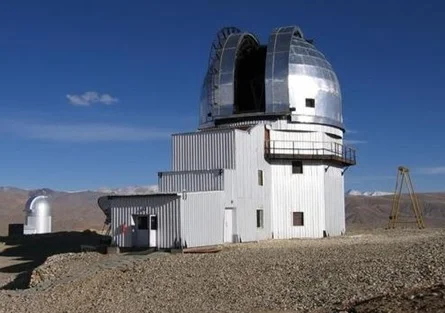
Hanle is one of the best astronomical sites in the world because of:
Over the past 25 years, HCT has made significant contributions in astronomy, including:
The HCT is equipped with:
Today, Hanle hosts several major astronomical facilities, including:
The Himalayan Chandra Telescope has played a key role in advancing optical and infrared astronomy in India. Its success has established Hanle as a globally recognized astronomical site and laid the foundation for India's next generation of world-class telescopes.
Prelims QuestionQ. Consider the following statements about the Himalayan Chandra Telescope (HCT):
Which of the statements given above is/are correct?
Mains QuestionQ. Discuss the significance of high-altitude astronomical observatories in advancing India's space and astronomical research. Illustrate your answer with reference to the Himalayan Chandra Telescope (HCT). |
Q1. What is the Himalayan Chandra Telescope (HCT)?Answer: The Himalayan Chandra Telescope (HCT) is a 2-metre optical telescope located at Hanle, Ladakh, and operated by the Indian Institute of Astrophysics (IIA) for astronomical research. Q2. Why is Hanle considered an ideal location for astronomical observations?Answer: Hanle offers over 250 clear nights a year, very low atmospheric water vapour, minimal light pollution, and highly transparent skies, making it one of the world's best sites for optical and infrared astronomy. Q3. Why is the Himalayan Chandra Telescope in the news?Answer: The HCT recently completed 25 years of successful operations, and India celebrated the milestone with a conference highlighting its scientific achievements and future expansion plans. Q4. What is unique about the operation of HCT?Answer: Since June 2001, HCT has been operated remotely in real time from the IIA campus in Bengaluru through a dedicated INSAT-3B satellite link provided by ISRO. |
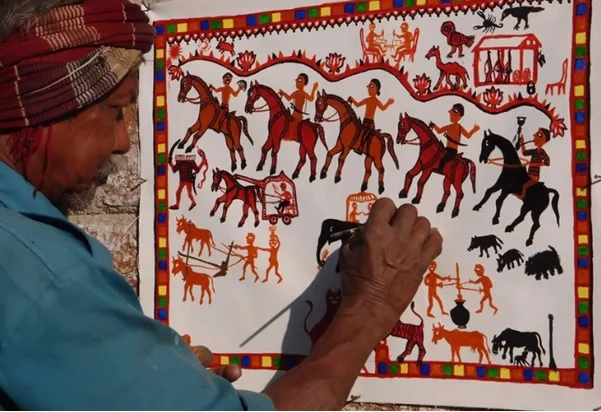
Pithora Painting is created as a sacred ritual rather than for decoration. Traditionally, the paintings are commissioned after the fulfillment of a vow or during important occasions such as:
The painting is considered an offering to the gods and forms an essential part of the spiritual life of the tribal communities.
Traditionally, the paintings are created on the interior walls of houses, especially the main wall.
The wall is prepared by applying a mixture of:
This creates a smooth white surface suitable for painting.
Pithora paintings are made using natural pigments obtained from:
Common colours include:
Traditional tools include:
The paintings are known for their vibrant colours and free-flowing compositions.
Pithora paintings portray a rich combination of mythology, religion, nature, and everyday tribal life.
Common motifs include:
The horse is regarded as the most important symbol, representing divine power, prosperity, and blessings.
Pithora Painting serves multiple social and cultural functions:
While traditionally painted only on house walls, modern Pithora artists now create artworks on:
These artworks are sold commercially, providing an important source of income for tribal artisans while helping the art gain national and international recognition.
Artists such as Paresh Rathwa and Kaushik Rathwa have emphasized that Pithora Painting remains an integral part of the identity of the Rathwa, Bhil, Bhilala, and Nayaka communities, keeping their traditions alive through artistic expression.
In 2026, Pithora Painting was awarded the Geographical Indication (GI) Tag, officially recognizing its unique cultural and geographical origin.
The GI tag:
According to officials, the GI recognition is expected to significantly improve the economic prospects of tribal artists while preserving one of India's most valuable indigenous art traditions.
Q1. What is Pithora Painting?Answer: Pithora Painting is a traditional ritualistic tribal wall painting of Gujarat, mainly practiced by the Rathwa tribe and other tribal communities such as the Bhil, Bhilala, and Nayaka. It is created to seek blessings, prosperity, and protection from tribal deities. Q2. Which state is Pithora Painting associated with?Answer: Gujarat, particularly the districts of Chhota Udaipur and Panchmahal. Q3. Which tribal communities practice Pithora Painting?Answer: It is primarily practiced by the Rathwa tribe and also by the Bhil, Bhilala, and Nayaka communities. Q4. Who is Pithora De?Answer: Pithora De is the tribal deity after whom the painting is named. He is believed to bless devotees with prosperity, marriage, fertility, and well-being. Q5. Who traditionally paints Pithora Paintings?Answer: The paintings are traditionally created by specialist ritual painters known as Lakharas, under the guidance of a tribal priest called the Badwa. |

Our support team will be happy to assist you!

 Contact Us
  New Batch : 9555124124/ 7428085757
  Tech Support : 9555124124/ 7428085757