(Preliminary Examination: Current Events of National Importance)
(Mains Examination, General Studies Paper 2: Topics Related to the Development and Management of Social Sectors/Services Related to Health, Education, Human Resources) |
Context
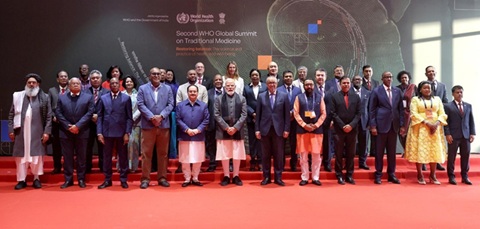
Recently, a new chapter in integrative medicine began with the release of the "Delhi Declaration" at the World Health Organization's (WHO) Second Global Summit on Traditional Medicine.
Key Points
- The Declaration takes into account emerging evidence in both traditional and modern medicine, emphasizing the integration of traditional medicine as a safe, effective, and evidence-based form into national health systems, especially universal health coverage (UHC) through primary health care.
- Building on the "Gujarat Declaration" that emerged from the first Summit on Traditional Medicine held in Gandhinagar, Gujarat in 2022, the "Delhi Declaration" also highlights the breadth of traditional medicine, its growing scientific evidence base, its potential for innovation and new solutions to emerging health challenges.
Resolutions of the Delhi Declaration
The Delhi Declaration focuses on resolutions related to four areas:
- Strengthening Evidence-Based Knowledge
- Participating countries pledged to promote rigorous, ethical, and multidisciplinary research on traditional medicine, balancing scientific standards with traditional knowledge.
- Resources such as the Global Library of Traditional Medicine will provide access to research, data, and policy documents.
- Ensuring Safety, Quality, and Public Trust
- Emphasis is placed on establishing consistent, risk-based regulations for safety and quality so that standards for traditional medicine products, procedures, and trainers are clear and reliable.
- Integrating Safe and Effective Traditional Medicine into Health Systems
- Integrating traditional medicine into national health systems, especially at the primary health care (PHC) level, which lays the foundation for universal health coverage.
- The goal is to integrate traditional medicine into health services in a safe, effective manner, providing people with greater choice and accessible health care at the local level.
- Innovation and Responsible Use of Digital Technology
- Digital technologies, data science, and innovation, such as AI and genomics, should be used to improve research and data access for traditional medicine.
- This will facilitate knowledge sharing globally and increase transparency in health systems.






 Contact Us
  New Batch : 9555124124/ 7428085757
  Tech Support : 9555124124/ 7428085757