Why in News?
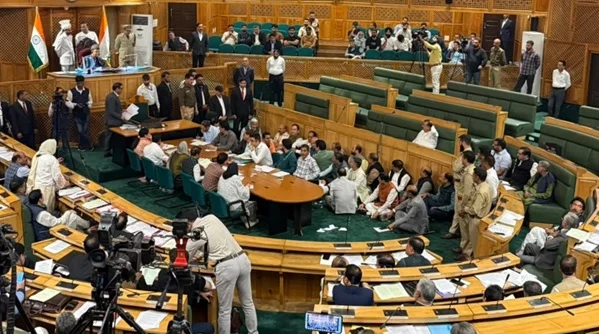
- Jammu and Kashmir Chief Minister Omar Abdullah introduced a resolution in the Assembly on September 28, 2026, seeking the immediate restoration of statehood to Jammu and Kashmir.
- Several amendments were moved to the resolution, some of which sought to include Articles 370 and 35A. However, these amendments were later withdrawn.
- The development is important for understanding the constitutional status of Jammu and Kashmir, Articles 370 and 35A, and the constitutional changes introduced in 2019.
Constitutional Status of Jammu and Kashmir
- At the time of India’s independence, Jammu and Kashmir was a princely state ruled by Maharaja Hari Singh. After Partition, he initially attempted to remain independent.
- Following the Pakistan-backed tribal invasion in October 1947, Maharaja Hari Singh signed the Instrument of Accession on October 26, 1947. India subsequently provided military assistance to Jammu and Kashmir.
- Under the Instrument of Accession, the Indian Parliament initially had the power to make laws for Jammu and Kashmir mainly on three subjects:
- Defence
- Foreign Affairs
- Communications
This special constitutional arrangement subsequently formed the background for the creation of Article 370.
What was Article 370?
Article 370 provided a special constitutional arrangement for Jammu and Kashmir under the Indian Constitution.
Under this arrangement:
- The legislative powers of the Indian Parliament over Jammu and Kashmir were limited.
- Initially, the Union’s legislative powers were mainly restricted to defence, foreign affairs and communications.
- Jammu and Kashmir had the right to have its own Constitution.
- Provisions of the Indian Constitution were extended to Jammu and Kashmir through a special constitutional procedure.
- Jammu and Kashmir had its own Legislative Assembly and constitutional framework.
Key Fact
- Article 370 was adopted by the Constituent Assembly on October 17, 1949.
- N. Gopalaswami Ayyangar, a member of the Drafting Committee of the Constituent Assembly, highlighted the special circumstances of Jammu and Kashmir as an important reason behind the provision.
Background of Article 370
- Following the Partition of India and Pakistan in 1947, the position of Jammu and Kashmir became complex.
- After the Pakistan-backed tribal invasion, Maharaja Hari Singh acceded to India. India subsequently took the Jammu and Kashmir issue to the United Nations Security Council in January 1948.
- UN Security Council Resolution 47 called for steps towards a ceasefire, withdrawal of forces and a plebiscite. However, the necessary conditions for conducting the plebiscite were not fulfilled.
- These circumstances contributed to the development of a separate constitutional arrangement for Jammu and Kashmir.
Delhi Agreement, 1952
Negotiations between the Union Government and Jammu and Kashmir continued over the constitutional relationship. The Delhi Agreement was concluded in 1952.
Its major provisions included:
- Acceptance of the jurisdiction of the Supreme Court over Jammu and Kashmir.
- Acceptance of the supremacy of the Indian national flag, while the state flag continued to remain in use.
- Acceptance of certain Union powers relating to Emergency provisions, subject to specified conditions.
- Further development of the constitutional relationship between the Indian Union and Jammu and Kashmir.
Related Political Developments
- Opposition to Article 370 also became prominent during this period. Syama Prasad Mookerjee and the Bharatiya Jana Sangh advocated the complete integration of Jammu and Kashmir with India.
- A prominent slogan associated with this demand was: “One country cannot have two constitutions, two heads and two flags.”
Political Developments in 1953
- Sheikh Abdullah was arrested in August 1953.
- He was succeeded by Bakshi Ghulam Mohammad as the Prime Minister of Jammu and Kashmir.
- During this period, the process of greater constitutional integration between Jammu and Kashmir and the Indian Union progressed.
- This phase is important because several constitutional and legal provisions of the Union were gradually extended to Jammu and Kashmir during the 1950s and 1960s.
What was Article 35A?
- Article 35A was incorporated into the Constitution through the Presidential Order of 1954, issued under Article 370.
- It was not included in the main text of the Constitution as an ordinary Article but was added through the Appendix to the Constitution.
Key Features of Article 35A
Article 35A empowered the Jammu and Kashmir Legislature to define “Permanent Residents” and provide them with special rights and privileges.
These included:
- Rights relating to property ownership
- Access to government employment
- Scholarships
- Other public welfare benefits
What Changed in 2019?
- On August 5, 2019, the Union Government introduced major constitutional changes concerning Jammu and Kashmir.
- A key step was the issuance of the Constitution (Application to Jammu and Kashmir) Order, 2019.
- It superseded the 1954 Presidential Order and provided for the wider application of the provisions of the Indian Constitution to Jammu and Kashmir.
Major Consequences
- Article 370 was rendered inoperative.
- The separate Constitution of Jammu and Kashmir ceased to operate.
- The provisions of the Indian Constitution were extended to Jammu and Kashmir.
- Article 35A also ceased to have effect.
How was Article 370 Rendered Inoperative?
- Article 370(3) empowered the President to declare, through a notification, that Article 370 would cease to operate or would operate with specified exceptions and modifications.
- However, there was an important condition:
- The recommendation of the Constituent Assembly of Jammu and Kashmir was required.
- The Constituent Assembly of Jammu and Kashmir had been dissolved in 1957 and did not exist thereafter.
- In 2019, the government used Article 367 to provide that the reference to the “Constituent Assembly of the State” in Article 370 would be read as a reference to the “Legislative Assembly of the State.”
- At that time, the Jammu and Kashmir Legislative Assembly was not functioning and President’s Rule was in force.
- Consequently, the role of the Governor became relevant in the constitutional process.
Reorganisation of Jammu and Kashmir, 2019
- Along with the constitutional changes of 2019, the Jammu and Kashmir Reorganisation Act, 2019 reorganised the former state into two Union Territories:
- Jammu and Kashmir – Union Territory with a Legislative Assembly
- Ladakh – Union Territory without a Legislative Assembly
The reorganisation came into effect on October 31, 2019, fundamentally changing the administrative and constitutional status of the region.
Supreme Court Judgment, 2023
- In December 2023, the Supreme Court of India upheld the Union Government’s decision to render Article 370 inoperative.
- The Court held that Article 370 was a temporary provision and was connected with the process of Jammu and Kashmir’s constitutional integration with the Union of India.
- The judgment is highly significant for understanding the constitutional debate surrounding Article 370 and its abrogation.
Current Issue: Demand for Restoration of Statehood
- In 2026, a resolution seeking the restoration of statehood was introduced in the Jammu and Kashmir Legislative Assembly.
- The demand for restoration of statehood is a separate constitutional issue from the restoration of Article 370.
Difference
- Restoration of Statehood → Reverting Jammu and Kashmir from a Union Territory to a State.
- Restoration of Article 370 → Seeking restoration of the earlier special constitutional arrangement applicable to Jammu and Kashmir.
Therefore, the two demands should be understood as distinct constitutional issues.
FAQs
Q1. What was Article 370?
Answer - Article 370 provided a special constitutional arrangement for Jammu and Kashmir, under which the application of the Indian Constitution and the legislative powers of Parliament were subject to special provisions.
Q2. When was Article 370 adopted?
Answer - Article 370 was adopted by the Constituent Assembly on October 17, 1949.
Q3. What was the Instrument of Accession?
Answer - The Instrument of Accession was the legal document through which Maharaja Hari Singh acceded Jammu and Kashmir to India on October 26, 1947. Initially, it covered subjects such as defence, foreign affairs and communications.
Q4. What was the Delhi Agreement of 1952?
Answer - The Delhi Agreement was an understanding between the Union Government and Jammu and Kashmir that further defined their constitutional relationship. It included matters such as the jurisdiction of the Supreme Court and the position of the Indian national flag.
Q5. What was Article 35A?
Answer - Article 35A was introduced through the 1954 Presidential Order under Article 370. It empowered the Jammu and Kashmir Legislature to define permanent residents and provide them with certain special rights and privileges.
Q6. What happened to Article 370 on August 5, 2019?
Answer - On August 5, 2019, constitutional changes were introduced that rendered the special operation of Article 370 ineffective and enabled the wider application of the Indian Constitution to Jammu and Kashmir.
|







 Contact Us
  New Batch : 9555124124/ 7428085757
  Tech Support : 9555124124/ 7428085757