New
Hindi Medium: (Delhi) - GS Foundation (P+M) : 14th Oct. 2026, 06:00 PM Hindi Medium: (Prayagraj) - GS Foundation (P+M) : 22nd Sept. 2026, 8:00 AM English Medium: (Delhi) - GS Foundation (P+M) : 26th Sept. 2026 English Medium: (Prayagraj) - GS Foundation (P+M) : 19th Aug 2026, 11:00 AM Hindi Medium: (Delhi) - GS Foundation (P+M) : 14th Oct. 2026, 06:00 PM Hindi Medium: (Prayagraj) - GS Foundation (P+M) : 22nd Sept. 2026, 8:00 AM English Medium: (Delhi) - GS Foundation (P+M) : 26th Sept. 2026 English Medium: (Prayagraj) - GS Foundation (P+M) : 19th Aug 2026, 11:00 AM

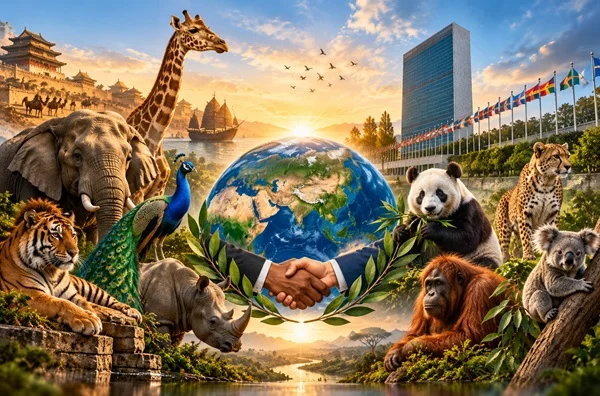
From Giraffes to Pandas: The Millennia-Long History of Animal Diplomacy

Prelims: Animal Diplomacy, Soft Power, Panda Diplomacy, CITES, Project Cheetah, Giant Panda, Indian Peacock, Wildlife Conservation.
Mains: GS Paper II: International Relations, Soft Power, Public Diplomacy and Multilateralism.

Why in news?

  • The use of animals as instruments of diplomacy has again attracted attention in 2026, highlighting a practice that stretches from ancient royal courts to modern international relations.

What is Animal Diplomacy?

  • Refers to the use of animals in relations between states or political authorities as gifts, loans, symbols, conservation partnerships or instruments of public diplomacy.
  • Unlike conventional diplomacy, which generally works through negotiations, treaties and official communication, animal diplomacy can communicate directly with the public of another country.

Types of Diplomacy

Type 

Meaning

Example

Bilateral Diplomacy

Engagement between two countries

India-Japan relations

Public Diplomacy

Direct engagement with foreign publics

Cultural outreach, international broadcasting

Cultural Diplomacy

Use of culture and heritage to build relations

Yoga, art, literature, festivals

Economic Diplomacy

Use of trade, investment and economic relations

FTAs, investment partnerships

Climate Diplomacy

International engagement on climate issues

COP negotiations

Humanitarian Diplomacy

Humanitarian assistance and disaster-relief cooperation

HADR operations

Animal Diplomacy

Use of animals as gifts, loans or symbols of cooperation

Panda, elephant and koala diplomacy

Conservation Diplomacy

Cross-border cooperation for wildlife/ecosystem protection

Project Cheetah and wildlife partnerships

Animal Diplomacy is not a Modern Phenomenon

  • Historically, exotic animals were particularly valuable diplomatic gifts because transporting and maintaining them required substantial resources.
  • Giving a rare animal could therefore communicate wealth, power, geographic reach, prestige and respect for recipient. 
  • One famous medieval example occurred in 802 CE, when Abbasid Caliph Harun al-Rashid sent an elephant named Abul-Abbas to Charlemagne.

The Famous Giraffe Diplomacy of the Ming Era

  • One of the most fascinating examples emerged during the reign of China's Yongle Emperor. In 1414, a giraffe reached the Chinese imperial court through Bengal. The animal was associated in China with the mythical qilin, an auspicious creature linked to virtuous rule. 
  • The episode was connected with the extraordinary maritime expeditions of Chinese admiral Zheng He, whose voyages extended China's diplomatic and commercial connections across the Indian Ocean and as far as East Africa. 

India and the Historic Giraffe Route

  • Historical accounts describe envoys from Malindi in East Africa interacting with Admiral Zheng He in Bengal, with giraffes eventually reaching the Ming court. 
  • This demonstrates the historical importance of the Indian Ocean as a diplomatic and commercial network connecting East Africa, Arabian Sea, Indian Subcontinent, Southeast Asia and China. 

Rhinoceros Diplomacy and India

  • Sultan Muzaffar II of Gujarat sent a rhinoceros to King Manuel I of Portugal. 
  • German artist Albrecht Dürer subsequently created his famous Rhinoceros (1515) despite never having personally seen the animal. 
  • The episode demonstrates how diplomatic animals could generate political prestige, scientific curiosity, artistic influence and public fascination. 

Mughal India and Exotic Animals

  • Emperor Jahangir was particularly interested in unusual species. His memoir, the Jahangirnama, contains observations relating to animals and plants.
  • Jahangir maintained channels through Goa for obtaining unusual objects and species from Portuguese trading networks. One such exotic animal reaching his court was the North American turkey. 

Elephant Diplomacy: India's Most Famous Example

  • Prime Minister Jawaharlal Nehru famously sent a baby elephant named Indira to Japan following requests from Japanese children.
  • India subsequently sent elephants to several other countries, including the United States, Soviet Union, China, Turkey and Iran. 
  • The elephant carries strong associations with Indian civilisation, Cultural heritage, Strength, Intelligence, Memory and Royal traditions. This made elephants an early instrument of India's post-independence cultural and public diplomacy.

China and Panda Diplomacy

  • The world's most recognisable form of animal diplomacy today is China's Panda Diplomacy. China initially gave giant pandas to friendly countries as diplomatic gifts.
  • A landmark moment came after US President Richard Nixon's visit to China in 1972. Chinese Premier Zhou Enlai gifted two giant pandas Ling-Ling and Hsing-Hsing to the American people. They arrived at the Smithsonian's National Zoo in Washington in April 1972. 

From Panda Gifts to Panda Loans

  • China largely moved away from permanently gifting pandas and shifted towards long-term cooperative loans.
  • China retains ownership → Pandas live temporarily in foreign zoos → Foreign institutions contribute financially and scientifically → Joint breeding/research programmes → Conservation cooperation.
  • For example, the Smithsonian's later pandas Mei Xiang and Tian Tian arrived under a cooperative research and breeding arrangement rather than as permanent gifts. 

Koala Diplomacy (Australia)

  • In 2015, Australia arranged for four koalas to go to Singapore on a 10-month loan to commemorate:
  • Singapore's 50th anniversary of independence
  • 50 years of Australia-Singapore diplomatic relations.
  • Australia's Department of Foreign Affairs and Trade explicitly described the initiative as “Koala diplomacy.” 

Orangutan Diplomacy (Malaysia)

  • Malaysia proposed another model in 2024 “Orangutan Diplomacy.” The initial idea involved sending orangutans to major palm-oil trading partners to demonstrate Malaysia's commitment to biodiversity and sustainable palm-oil production. 
  • Instead of sending orangutans abroad, Malaysia moved towards an adoption/sponsorship model in which foreign partners could financially support orangutan conservation while the animals remained in their natural habitat. 

India's Peacock Diplomacy at the United Nations

  • A contemporary Indian example came on 7 August 2026. India donated five Indian peacocks (Pavo cristatus) to the United Nations Office at Geneva. Four were blue peafowl and one was white. 
  • This was not the first such gesture. India had previously presented a pair of peacocks to UNOG in 1981. 
  • The 2026 donation symbolised Indian Natural Heritage, Biodiversity Conservation, India-UN Partnership, Multilateralism and International Cooperation.

Why Do Countries Use Animals in Diplomacy?

  • Soft Power: Animals can create positive associations with the country they represent. 
  • Emotional Connection: Foreign policy is usually abstract. Animals transform it into something visible and emotionally relatable.
  • Public Diplomacy: Animal diplomacy reaches ordinary citizens rather than remaining confined to governments and diplomats. Zoo visitors, children, schools and media audiences become part of the diplomatic interaction.
  • National Branding: Countries can associate themselves internationally with distinctive biodiversity.
  • Political Symbolism: Giving a rare and valuable animal can communicate trust, friendship and goodwill.

Can Animals be treated as Diplomatic Gifts?

  • Animals are living beings, not ordinary diplomatic objects. Transporting them across continents can involve stress, climate differences, dietary challenges, disease risks, inadequate habitats, breeding difficulties, social isolation and animal-welfare concerns.
  • Historical animal exchanges occurred in periods when modern concepts of animal welfare and biodiversity conservation were much less developed.

Role of CITES

  • A major turning point came with the Convention on International Trade in Endangered Species of Wild Fauna and Flora (CITES). CITES was adopted in 1973 and entered into force in 1975.
  • Its purpose is to ensure that international trade in specimens of wild animals and plants does not threaten the survival of species.

Animal Diplomacy vs Conservation Diplomacy

Animal Diplomacy

Conservation Diplomacy

Animal often serves as diplomatic symbol

Conservation is the central objective

Historically involved gifts

Usually involves partnerships

Focus on goodwill/prestige

Focus on species and ecosystem protection

Short-term symbolic impact possible

Long-term scientific cooperation

Public diplomacy important

Science and environmental diplomacy important

Eg.: Historical elephant gifts

Eg.: Project Cheetah cooperation


Prelims MCQ

Q. With reference to animal and wildlife diplomacy, consider the following statements:

  1. CITES seeks to ensure that international trade in wild species does not threaten their survival.
  2. India's Project Cheetah has involved cooperation with African countries including Namibia, South Africa and Botswana.
  3. The Indian Peacock is India's National Bird.

Which of the statements given above are correct?

(a) 1 and 2 only

(b) 2 and 3 only

(c) 1 and 3 only

(d) 1, 2 and 3

Mains Practice Question

Q. How can wildlife conservation strengthen India's soft power and international cooperation?

FAQs

What is animal diplomacy?

Use of animals to promote diplomatic goodwill.

What is Panda Diplomacy?

China’s use of giant pandas in international relations.

What is Koala Diplomacy?

Australia’s use of koalas for public diplomacy.

What is Orangutan Diplomacy?

Malaysia’s conservation-based diplomatic initiative involving orangutans.

What is India’s recent example of animal diplomacy?

Donation of five peacocks to UN Geneva in 2026.

Have any Query?

Our support team will be happy to assist you!

OR