
- UPSC Exam
- State PCS
- One Day Exam
- Current Affairs
- PT Quiz
- Downlaods
- About Coaching
- Blog
- Videos

| Prelims: (International Relations + CA) Mains: (GS 2 – International Relations; GS 2 – Constitutional & Political Systems of Other Countries; GS 3 – Internal Security & Geopolitics) |
The assassination of Ali Khamenei, Iran’s 86-year-old Supreme Leader, in a joint US–Israeli attack has marked the end of a defining chapter in the Islamic Republic’s post-1979 leadership.
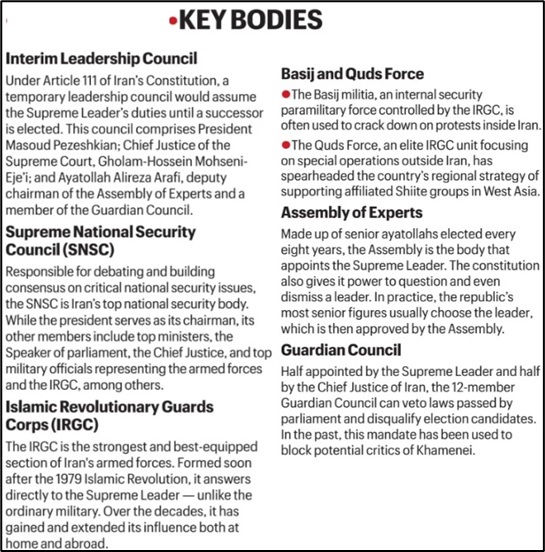
Following his death, the constitutional mechanism for succession was activated. The Assembly of Experts has begun deliberations to appoint the next Supreme Leader.
In the interim, a three-member Interim Leadership Council has assumed responsibilities, as provided under Iran’s Constitution — highlighting institutional continuity within the Islamic Republic.
The intertwining of religion and politics in Shia-majority Iran predates the 1979 Islamic Revolution.
Key historical moments include:
Shia clerics often adopted anti-monarchist positions and played central roles in political mobilisation.
During the Shah’s rule, public dissent was closely monitored by the secret police (SAVAK). Mosques functioned as relatively safe spaces (bast) for mobilisation and political expression. Friday sermons became platforms for religio-political messaging, enabling clergy-led resistance.
The ideological leadership of Ruhollah Khomeini, even while in exile in France, shaped the revolutionary movement and the Islamic Republic that followed.
Although workers, leftist groups, and nationalists participated in anti-Shah protests, the clerical establishment consolidated power due to its cohesive ideological direction.
Khomeini advanced the doctrine of velayat-e-faqih (rule of the Islamic jurist), arguing that a senior cleric should exercise ultimate authority in governance.
This principle became the constitutional foundation of the Islamic Republic.
The 1979 Constitution blended clerical authority with republican institutions such as:
However, the Supreme Leader retained overarching control over:
After Khomeini’s death in 1989, constitutional amendments abolished the Prime Minister’s post but preserved clerical supremacy.
Khamenei succeeded Khomeini in 1989. His selection was controversial, as Ayatollah Montazeri had earlier been designated successor. Khamenei had served as President (1981–1989), including during the Iran–Iraq War — a period that shaped his security-oriented worldview.
As Supreme Leader, Khamenei:
While internationally viewed as a hardliner, he approved the 2015 Joint Comprehensive Plan of Action (JCPOA), reflecting pragmatic engagement when necessary.
Domestically, his tenure witnessed:
The Islamic Revolutionary Guard Corps (IRGC) emerged as a central pillar of regime stability.
Beyond domestic security, it expanded Iran’s regional influence by supporting groups such as:
The IRGC became not only a military actor but also an economic and political force.
Despite clerical supremacy, Iran has regularly conducted elections for:
Politics has been shaped by rivalry between reformists and hardliners.
Khamenei often balanced factions while ensuring ultimate ideological control. His fatwa against nuclear weapons and conditional engagement with Western powers illustrated calibrated pragmatism.
1. Institutional Continuity
The swift activation of constitutional mechanisms underscores regime resilience despite leadership shock.
2. Power Realignment Risks
Succession could reshape factional balances among clerics, political elites, and the IRGC.
3. Regional Stability Concerns
Iran plays a pivotal role in West Asian geopolitics. Leadership transition amid external conflict increases uncertainty.
4. Nuclear Policy Implications
The new Supreme Leader’s stance may influence the trajectory of nuclear negotiations and regional diplomacy.
5. State–Society Tensions
Years of sanctions, inflation, and political restrictions have widened the gap between public expectations and governance performance.
FAQs1. What is the role of the Supreme Leader in Iran ? The Supreme Leader holds ultimate authority over political, military, and religious affairs, surpassing elected institutions. 2. Who appoints the Supreme Leader ? The Assembly of Experts selects and oversees the Supreme Leader. 3. What is velayat-e-faqih ? It is the doctrine of rule by an Islamic jurist, forming the constitutional basis of Iran’s political system. 4. What role does the IRGC play in Iran’s power structure ? The IRGC safeguards the revolution, influences regional policy, and wields significant political and economic power. 5. How could this leadership transition affect global politics ? It may influence nuclear negotiations, regional conflicts, sanctions regimes, and energy security dynamics. |



Our support team will be happy to assist you!

 Contact Us
  New Batch : 9555124124/ 7428085757
  Tech Support : 9555124124/ 7428085757