Prelims: (Polity & Governance + CA)
Mains: (GS 2 – Government Policies & Interventions in Education; GS 3 – Sports Development & Human Resource Development; GS 1 – Social Empowerment & Youth Development) |
Why in News ?
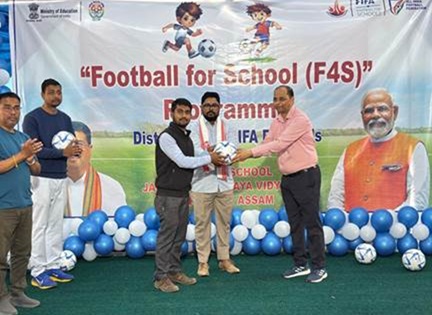
The Union Minister of State for Education & Development of North Eastern Region distributed footballs at PM SHRI Kendriya Vidyalaya, Dakshin Dinajpur, West Bengal, under the Football for Schools (F4S) Programme.
The initiative is part of a global campaign aimed at integrating football into school education systems to promote life skills, gender inclusion, and holistic child development.
Background and Context
Global Emergence of Sports-Based Education
Globally, sports are increasingly recognised not merely as recreational activities but as tools for:
- Life skills development
- Social inclusion
- Gender equality
- Public health promotion
The Fédération Internationale de Football Association (FIFA), in collaboration with UNESCO, launched the Football for Schools programme to leverage football as a pedagogical tool.
The initiative aligns sports with educational objectives rather than treating them as extracurricular add-ons.
About the Football for Schools (F4S) Programme
- Launched by: FIFA in partnership with UNESCO
- Core Aim: Promote education, development, and empowerment of children through football
- Target Group: School-going children (both boys and girls)
- Approach: Integrating football activities into school curricula
- Focus Areas:
- Life skills training
- Inclusion and equality
- Physical health
- Social cohesion
The programme also contributes to the achievement of the United Nations Sustainable Development Goals (SDGs).
Alignment with Global Frameworks
The F4S Programme is aligned with major international policy frameworks:
- UNESCO’s Kazan Action Plan (sports policy integration)
- Education 2030: Incheon Declaration and Framework for Action
- World Health Organization Global Action Plan on Physical Activity (GAPPA)
These frameworks emphasise inclusive education, physical well-being, and equitable access to sports.
Implementation in India
In India, the programme is implemented by:
- Department of School Education and Literacy (DoSEL) under the Ministry of Education
- With support from the All India Football Federation (AIFF)
- And the Sports Authority of India (SAI)
The integration of F4S into PM SHRI schools strengthens India’s push towards experiential learning and holistic development under the National Education Policy (NEP) 2020 framework.
Significance of the Initiative
1. Educational Transformation
- Promotes experiential and activity-based learning.
- Develops cognitive, emotional, and social competencies.
- Enhances classroom engagement and retention.
2. Life Skills Development
Football is used as a tool to inculcate:
- Teamwork
- Discipline
- Leadership
- Conflict resolution
- Decision-making skills
3. Gender Inclusion and Social Equity
- Encourages equal participation of girls.
- Reduces gender stereotypes in sports.
- Enhances social integration across socio-economic backgrounds.
4. Public Health and Fitness
- Addresses rising childhood obesity and sedentary lifestyles.
- Supports WHO’s global physical activity targets.
5. Soft Power and Global Integration
- Strengthens India’s engagement with global sports diplomacy.
- Aligns domestic educational initiatives with international commitments.
Key Components and Takeaways
1. Sports as Pedagogical Tool
Unlike traditional sports programmes focused on talent scouting, F4S integrates football into the educational curriculum as a medium of learning.
2. Structured Training Modules
- Teacher training resources
- Digital toolkits
- Curriculum-linked activity modules
- Age-appropriate engagement models
3. Infrastructure and Equipment Support
Distribution of footballs and sports materials ensures access even in resource-constrained schools.
4. Institutional Convergence
The programme reflects cooperative federalism and multi-stakeholder governance involving:
- International organisations
- National ministries
- Sports federations
- Schools
Lessons from India’s Sports Policy Evolution
- Earlier sports initiatives focused mainly on elite performance (e.g., Olympic preparation).
- Grassroots sports development received limited institutional emphasis.
- Recent policies increasingly recognise sports as a tool for nation-building and human capital formation.
The F4S Programme signals a shift from medal-centric to mass-participation sports policy.
Implications for the Indian Education and Sports Ecosystem
- Holistic Development: Promotes integration of sports with academics under NEP 2020 vision.
- Human Capital Formation: Enhances soft skills essential for the 21st-century workforce.
- Social Cohesion: Bridges socio-economic divides through shared team participation.
- Gender Empowerment: Strengthens equal access to sports education.
- Long-Term Sporting Culture: May expand the base of football participation in India, improving global competitiveness over time.
Challenges and Way Forward
Challenges
- Uneven sports infrastructure across rural and urban schools
- Teacher capacity constraints
- Sustained funding and monitoring
- Ensuring genuine gender parity in participation
Way Forward
- Integrate sports assessment into school evaluation systems
- Strengthen teacher training modules
- Expand partnerships with local football academies
- Promote community-based sports engagement
- Develop monitoring indicators linked to SDGs
FAQs
1. What is the primary objective of the Football for Schools Programme ?
It aims to use football as a tool for education, empowerment, and life skills development among school children.
2. Which organisations jointly run the F4S Programme ?
It is implemented by FIFA in collaboration with UNESCO.
3. How is the programme implemented in India ?
It is executed by the Department of School Education and Literacy with support from AIFF and SAI.
4. How does F4S contribute to Sustainable Development Goals ?
It promotes quality education, gender equality, good health, and reduced inequalities.
5. Why is sports integration important in school education ?
Sports enhance physical fitness, teamwork, discipline, and emotional intelligence, contributing to holistic development.
|




 Contact Us
  New Batch : 9555124124/ 7428085757
  Tech Support : 9555124124/ 7428085757