
- UPSC Exam
- State PCS
- One Day Exam
- Current Affairs
- PT Quiz
- Downlaods
- About Coaching
- Blog
- Videos

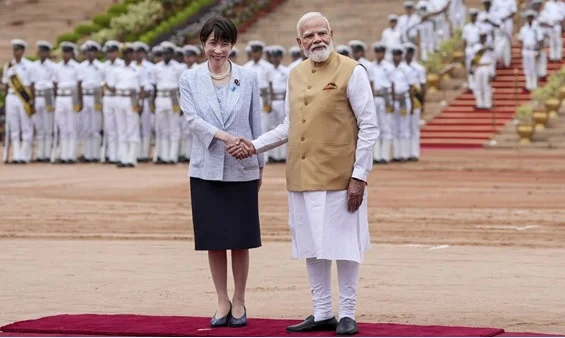
As Japanese companies diversify beyond China under the China+1 Strategy, India has emerged as one of the most attractive alternatives. A growing manufacturing base, supportive government policies, and a large domestic market make India an ideal destination for long-term investment.
Japan sees India not only as an economic opportunity but also as a reliable democratic partner. Both countries share similar views on regional stability, freedom of navigation, and maintaining a rules-based Indo-Pacific.
With one of the world's fastest-growing economies, India offers tremendous opportunities in infrastructure, digital technology, clean energy, and advanced manufacturing—areas where Japanese companies have significant expertise.
Japan is already one of India's biggest foreign investors. From metro rail projects and industrial corridors to the Mumbai-Ahmedabad Bullet Train, Japanese investments have played a major role in India's infrastructure growth.
Nearly 1,400 Japanese companies operate in India across manufacturing, automobiles, electronics, logistics, and financial services. The 2026 summit is expected to attract even more private-sector investment.
Trade between the two countries has crossed US$27.5 billion, with both governments aiming to further increase commerce by improving market access and promoting local currency trade.
India and Japan are strengthening cooperation to build secure semiconductor supply chains through chip manufacturing, packaging, research, and workforce development.
Artificial Intelligence has become a new pillar of the partnership. Both countries are expanding collaboration in AI research, digital infrastructure, cybersecurity, and trusted technologies.
Lithium, cobalt, and rare earth elements are becoming increasingly important for electric vehicles and clean energy. India and Japan are working together to secure reliable supplies of these strategic minerals.
India and Japan believe in a Free, Open and Inclusive Indo-Pacific, where international laws are respected and sea routes remain open for global trade.
Along with the United States and Australia, both countries are strengthening cooperation through the Quad, focusing on maritime security, disaster response, emerging technologies, and resilient supply chains.
Regular military exercises, defence dialogues, and technology cooperation have made India and Japan close security partners in the Indo-Pacific region.
Japan is the only country with a dedicated platform—the India-Japan Act East Forum—to support the development of India's North-East.
Both countries are investing in roads, bridges, urban infrastructure, tourism, energy, and skill development projects that connect North-East India with Southeast Asia.
The newly launched India-Japan Governors Network is encouraging direct cooperation between Indian states and Japanese prefectures, creating new opportunities for investment and cultural exchange.
The summit is expected to deliver new agreements in investment, semiconductors, AI, clean energy, critical minerals, defence technology, and supply chain resilience. Discussions on increasing Rupee-Yen trade could also reduce dependence on the US dollar and strengthen financial cooperation.
Despite strong relations, some issues continue to slow progress. Bilateral trade remains below its potential, infrastructure projects often face implementation delays, and global economic uncertainty continues to affect investment decisions.
India and Japan are no longer connected only through trade or development projects. Their relationship has evolved into a comprehensive strategic partnership based on shared democratic values, economic cooperation, and regional security.
As both countries prepare to celebrate 75 years of diplomatic relations in 2027, the India-Japan partnership is expected to play a major role in shaping the future of the Indo-Pacific and the global economy.



Our support team will be happy to assist you!

 Contact Us
  New Batch : 9555124124/ 7428085757
  Tech Support : 9555124124/ 7428085757