India-New Zealand Free Trade Agreement (FTA): A significant step towards a new era of global trade
Why in the news?
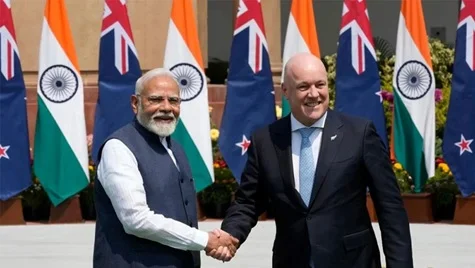
The proposed Free Trade Agreement (FTA) between India and New Zealand is considered a significant initiative to elevate the economic relationship between the two countries to new heights. Currently, India-New Zealand bilateral trade stands at approximately US$1.3 billion (FY 2024-25), which is significantly lower than the economic potential of both countries.
This agreement is not limited to increasing trade but also covers modern dimensions such as investment, digital trade, supply chain cooperation, regulatory transparency, and ease of doing business.
Importance of FTA in India-New Zealand Relations
India and New Zealand are supporters of democratic values, a rules-based international order, and a free and inclusive Indo-Pacific region. Consequently, the proposed FTA could provide new impetus to economic cooperation.
The main objectives of this agreement are :
To increase bilateral trade.
To encourage investment flows.
To provide new markets for exporters.
To strengthen supply chains.
To transform the economic partnership into a strategic cooperation.
Modern FTAs: More than Tariff Reduction
Traditionally, the primary objective of free trade agreements was to reduce import duties, but 21st-century trade agreements have gone far beyond this.
Today, trade competitiveness depends on the following factors :
Simplification of customs procedures
Digital documentation
Mutual recognition of product standards
Regulatory stability
Lower transaction costs
Efficient logistics and supply chains
Therefore, modern FTAs focus on making the trading environment more transparent, faster, and business-friendly.
A Golden Opportunity for Indian Exporters
Under the proposed agreement, New Zealand is expected to provide duty-free access to 100% of its tariff lines. This could provide a competitive advantage to Indian products.
Key Sectors to Benefit
Textile and Apparel Industry
Leather and Footwear Industry
Handicrafts and Cottage Industries
Engineering Products
Chemical and Pharmaceutical Industry
Agricultural and Food Processing Products
Access to a high-income market like New Zealand could create long-term opportunities for Indian exporters.
Services Sector: India's Biggest Strength
India has emerged as a global services powerhouse. The proposed FTA could provide new opportunities for Indian service providers.
Specifically, in areas such as :
Information Technology (IT)
Fintech Services
Engineering Consulting
Healthcare Services
Education and Skill Development
Research and Innovation
Greater mobility of professionals and students could boost Indian service exports.
India's Balanced Trade Strategy
India has pursued a policy of balancing liberalization and domestic interests in negotiations. The dairy sector, in particular, has been considered sensitive and has emphasized its protection.
New Zealand is one of the world's largest dairy exporters. Protecting the interests of Indian dairy farmers and cooperatives has been a priority for India.
This approach demonstrates that India supports trade expansion, but not at the expense of domestic industries.
Rules of Origin: A mandatory condition for availing benefits
Tariff concessions under FTAs will only be available to products that comply with the prescribed Rules of Origin.
This will include :
Proof of the product's actual origin
Detailed documentation
Supply chain transparency
Measures to prevent transshipment.
In today's global trade, compliance is becoming the new basis for competitiveness.
Special focus on reducing non-tariff barriers
Often, the biggest challenge to exports is not import tariffs but regulatory barriers. Therefore, the proposed FTA emphasizes reforms in the following areas:
Digital certification system
Customs modernization
Harmonization of standards
Faster regulatory approvals
Transparent trade processes
Pharmaceutical, agricultural, food processing, and chemical industries are particularly likely to benefit significantly.
Challenges Facing Indian Industries
While FTAs offer opportunities, their benefits will not be automatic.
Indian industries will need to :
Adopt global quality standards.
Develop digital compliance systems.
Increase efficiency in documentation.
Strengthen supply chain management.
Produce in line with the demands of export markets.
Only those industries that can adapt to these requirements will be able to reap the maximum benefits of FTAs.
Conclusion
The India-New Zealand Free Trade Agreement is not just a tariff reduction agreement, but a symbol of a 21st-century trade architecture. It attempts to integrate trade liberalization, investment promotion, digital trade, regulatory cooperation, and supply chain efficiency.
If implemented effectively, it will not only boost bilateral trade and investment but also strengthen India's global trade strategy. It can also play a key role in making Indian industries more competitive, innovation-driven, and integrated into global value chains.
The India-New Zealand FTA can serve as an example of future modern trade agreements, where success will be determined not solely by tariff reductions, but by trade facilitation, transparency, and competitiveness.






 Contact Us
  New Batch : 9555124124/ 7428085757
  Tech Support : 9555124124/ 7428085757