Context
The Union Budget 2026–27 announced the India Semiconductor Mission (ISM) 2.0, giving a new direction to India's technological aspirations. At a time when semiconductors have become the foundation of almost every modern digital and industrial system, this initiative provides a clear policy signal to deepen domestic capabilities and make India a strong partner in the global semiconductor value chain.
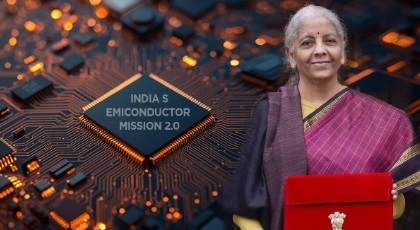
Semiconductors: The Invisible Backbone of the Modern Economy
- Semiconductors are the foundation of technologies such as computing, mobile communications, telecommunications, automobiles, defense systems, and artificial intelligence.
- Under ISM 1.0, India has made solid progress towards developing a full-stack semiconductor ecosystem, including design, manufacturing, assembly, and testing. This journey reflects the comprehensive vision of 'Atmanirbhar Bharat' and India's transition from policy-making to production-readiness.
- Building on these achievements, ISM 2.0 aims to establish India as a reliable, competitive, and long-term partner in the global semiconductor network.
Regional Perspective: India's Emerging Semiconductor Ecosystem
- India is gradually emerging as a global semiconductor hub. Large investments, expanding manufacturing capacity, and international platforms like Semicon India 2025 reflect growing global confidence in India's potential. According to industry estimates, the Indian semiconductor market could reach-
- approximately $38 billion in 2023
- $45–50 billion in 2024–25, and
- $100–110 billion by 2030.
- This growth is driven by the 'Make in India' and 'Make for the World' strategies, which are positioning India not only as a manufacturing base but also as a global supplier.
Foundation of India Semiconductor Mission 1.0
- Approved in December 2021, ISM 1.0 is supported by a ₹76,000 crore incentive package that includes:
- Silicon fabs
- Compound semiconductor units
- Assembly, testing, and packaging facilities
- Up to 50% financial assistance is provided for chip design.
- By December 2025, 10 projects with an investment of ₹1.60 lakh crore have been approved in 6 states. These projects are building a resilient and indigenous semiconductor ecosystem.
Towards Semiconductor 2.0
- The focus under ISM 2.0 is not limited to chip manufacturing but also includes the production of semiconductor equipment and materials, the development of full-stack Indian semiconductor intellectual property (IP), and the strengthening of domestic and global supply chains.
- The mission has been allocated ₹1,000 crore for the fiscal year 2026–27, with a special emphasis on industry-led research, training, and skill development centers to accelerate technological innovation and create a future-ready workforce.
- India's next goal is to enter advanced technology nodes. A clear roadmap has been developed to reach the 3-nanometer and 2-nanometer nodes under ISM 2.0.
- India aims to be among the top semiconductor countries in the world by 2035, while achieving the capability to design and manufacture 70–75% of its chips domestically by 2029.
Approved Semiconductor Projects: Diversity and Scale
Approved projects in India will meet growing demand in sectors such as consumer electronics, automobiles, telecommunications, aerospace, and power electronics. It is particularly noteworthy that many projects are using indigenous assembly, testing and packaging technologies, which will reduce external dependence and increase technological depth.
ISM Key Schemes Under
- Semiconductor Fabs Scheme: Up to 50% financial assistance to wafer fabrication units
- Display Fabs Scheme: Support for AMOLED and LCD display manufacturing
- Compound Semiconductor and ATMP/OSAT Scheme: Capital assistance for packaging and testing units
- Design Linked Incentive (DLI): ₹1,000 crore for chip design startups and MSMEs
Expected Impact in 2026–27
- The revised semiconductor program aims to:
- Accelerate capital investment
- Create high-quality jobs
- and expand domestic capabilities in design and manufacturing
- With an estimated financial outlay of ₹8,000 crore in fiscal year 2026–27, the program will elevate India's technological competitiveness.
Importance of the India Semiconductor Mission
- According to the Economic Survey 2025–26, semiconductors are fundamental to energy networks, financial markets, telecommunications, healthcare, transportation, and defense systems. The COVID-19 pandemic exposed the vulnerabilities of global supply chains, highlighting the significant risks of excessive dependence on a select few countries.
- The India Semiconductor Mission is a strategic response to this challenge—by developing indigenous capabilities in design, manufacturing, and innovation, India is not only strengthening its technological sovereignty but also making global supply chains more resilient.
Design, Microprocessors, and Talent Development
- The Design Linked Incentive Scheme, indigenous microprocessors like DHRUVA 64, and RISC-V-based initiatives are making India self-reliant in core semiconductor technologies.
- Additionally, a strong semiconductor network is being developed through Chips to Startups, the AICTE program, NIELIT Smart Labs, and industry partnerships.
Conclusion
India Semiconductor Mission 2.0 is a decisive step forward in moving beyond ecosystem creation to its consolidation and global integration. Increased budgetary support, a clear technology roadmap, and a robust design and skills strategy lay the foundation for India to become a trusted global hub for semiconductor design, manufacturing, and innovation. In the coming decade, this mission will not only make India technologically self-reliant but will also play a crucial role in establishing it among the world's leading semiconductor nations.






 Contact Us
  New Batch : 9555124124/ 7428085757
  Tech Support : 9555124124/ 7428085757