Prelims: Hepatitis B and C, National Viral Hepatitis Control Programme (NVHCP), vaccination, World Hepatitis Day, SDG 3.
Mains: GS Paper II Public health, government interventions, equitable access to healthcare and international cooperation.
Keywords: Viral hepatitis, Cirrhosis, Direct-acting antivirals, Antenatal screening, Elimination as a public health threat |
Why in News?
- India has reaffirmed its commitment to eliminating Hepatitis B and C as public health threats by 2030.
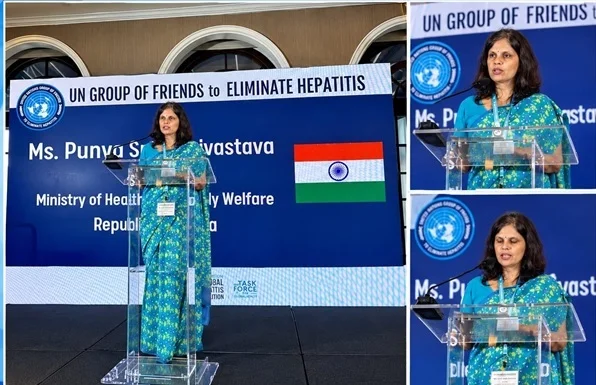
- Union Health Secretary Punya Salila Srivastava outlined India’s response at a side event of the 81st session of the United Nations General Assembly in New York, organised by the UN Group of Friends to Eliminate Hepatitis. She highlighted prevention, screening, diagnosis, treatment and continuing care, alongside the need for sustained international cooperation.
Background
- Hepatitis refers to inflammation of the liver. Viral hepatitis includes five main types—A, B, C, D and E—which differ in transmission, prevention and disease progression. Chronic Hepatitis B and C can cause serious liver damage, including cirrhosis and liver cancer.
- India launched the National Viral Hepatitis Control Programme on 28 July 2018, World Hepatitis Day. Its stated objectives include countrywide elimination of Hepatitis C by 2030 and reducing illness and deaths associated with Hepatitis A, B, C and E. The programme provides an institutional foundation for the country’s broader hepatitis response.
Key Points
1. A Comprehensive, People-Centred Response
The Health Secretary’s remarks, as reported in the supplied text, emphasised services across the entire course of care. Prevention must be accompanied by accessible testing, timely diagnosis, appropriate treatment and support that helps patients remain connected to healthcare services.
2. Maternal Screening and Hepatitis B Immunisation
India highlighted antenatal screening and Hepatitis B vaccination as important interventions. WHO recommends a Hepatitis B vaccine birth dose within 24 hours, followed by completion of the recommended vaccination schedule. Screening during pregnancy helps identify mothers who need further assessment and preventive care. [3]
3. Free Diagnosis and Treatment
The statement highlighted free diagnosis and treatment as central to India’s response. Their public health value depends on patients being able to reach services, receive confirmatory testing where required and obtain follow-up care without avoidable delays.
4. Blood Safety and Support for Vulnerable Groups
India also highlighted safe blood transfusion services, counselling and rehabilitation support for people who inject drugs. These measures need to be supported by infection prevention and respectful, confidential care that encourages people to seek help.
5. Global Cooperation
The Health Secretary called for sustained cooperation, equitable access to prevention, testing and treatment, and stronger health systems. This places hepatitis elimination within the wider debate on affordable healthcare and international responsibility.
Hepatitis B and C: Key Differences
|
Aspect
|
Hepatitis B
|
Hepatitis C
|
|
Causative agent
|
Hepatitis B virus (HBV)
|
Hepatitis C virus (HCV)
|
|
Main transmission routes
|
Infected blood and body fluids; mother-to-child transmission during birth
|
Primarily exposure to infected blood, including shared injecting equipment and unsafe procedures
|
|
Vaccine
|
An effective vaccine is available
|
No effective vaccine is currently available
|
|
Treatment
|
Antiviral medicines suppress infection and reduce complications; treatment is often long-term
|
Direct-acting antivirals can cure more than 95% of infections
|
Both infections may initially have few or no symptoms, making testing important.
What Does Elimination by 2030 Mean?
- Elimination as a public health threat does not mean that every infection disappears. It means reducing transmission and deaths to defined low levels through sustained public health action.
- WHO’s global framework includes a 90% reduction in new infections and a 65% reduction in mortality by 2030, compared with 2015. These are global reduction targets, not evidence that India has already achieved them. Prevention, surveillance and treatment must continue even after elimination thresholds are reached.
Significance
- Prevention of avoidable illness: Earlier intervention can reduce the progression to advanced liver disease.
- Financial protection: Accessible public services can reduce the cost of seeking diagnosis and continuing care.
- Health equity: Reaching underserved communities makes the response more inclusive.
- Stronger health systems: Reliable laboratories, referral networks and medicine supplies benefit wider healthcare delivery.
- Progress towards SDG 3: The response supports the global commitment to combat hepatitis and improve health and well-being.
Relevance for India
- For India, the challenge is to translate national commitments into reliable services across states and districts. A patient’s ability to complete the care process should not depend on location, income or social status.
- The NVHCP offers a platform for coordination. Closer links between maternal health services, immunisation, blood banks, laboratories and treatment centres can help reduce missed opportunities for prevention and care.
- India’s international engagement also creates opportunities to share implementation experience and promote more affordable access to diagnostics and medicines.
Challenges
The main implementation challenges include:
- Missed diagnosis: People without obvious symptoms may not seek testing.
- Gaps between services: A screening result may not lead promptly to confirmation, assessment and treatment.
- Unequal access: Travel, indirect expenses and uneven service availability can discourage follow-up.
- Stigma: Fear of disclosure or discrimination can keep people away from care.
- Continuity of care: Sustained medicine availability and patient follow-up require dependable financing and administration.
- Measurement of progress: Authorities need reliable data on outcomes, rather than relying only on the number of tests conducted.
Way Forward
- Strengthen Local Access: Expand convenient testing and referral pathways, with clear responsibility for ensuring that patients reach the next stage of care.
- Improve Prevention at Birth: Connect antenatal screening, delivery services and timely vaccination so that opportunities to protect newborns are not missed.
- Ensure Reliable Treatment Services: Maintain supplies of diagnostic materials and medicines, and simplify follow-up arrangements for patients who need continuing care.
- Build Community Trust: Use clear public information and confidential services to address misconceptions. Community organisations can help reach people who are reluctant or unable to attend conventional facilities.
- Track Meaningful Outcomes: Monitor diagnosis, treatment access, retention in care and health outcomes. District-level review can identify where patients are being lost between services and guide corrective action.
Conclusion
- India’s 2030 commitment makes hepatitis elimination an important public health priority.
- Its achievement will depend on converting policy commitments into accessible prevention, dependable testing and sustained care.
- Progress should be judged by whether people receive timely services and whether preventable infections and deaths decline.
Prelims MCQs
Q. Consider the following statements:
- An effective vaccine is available against Hepatitis B.
- An effective vaccine is currently available against Hepatitis C.
- Direct-acting antiviral medicines can cure most Hepatitis C infections.
Which of the statements given above are correct?
(a) 1 and 2 only
(b) 1 and 3 only
(c) 2 and 3 only
(d) 1, 2 and 3
Mains Practice Question
“Achieving hepatitis elimination requires both effective medical interventions and equitable health service delivery.” Discuss with reference to India’s 2030 commitment.
|
FAQs
1. What is India’s hepatitis elimination target?
India has reaffirmed its commitment to eliminating Hepatitis B and C as public health threats by 2030, according to the supplied report.
2. Which programme supports India’s response to viral hepatitis?
The National Viral Hepatitis Control Programme, launched on 28 July 2018, is a key national initiative.
3. Is a vaccine available for both Hepatitis B and C?
No. An effective vaccine is available for Hepatitis B, while no effective Hepatitis C vaccine is currently available.
4. Can Hepatitis C be cured?
Yes. Direct-acting antiviral medicines can cure more than 95% of infections.
5. Does the 2030 target mean zero hepatitis cases?
No. It means reducing transmission and deaths to defined public health thresholds, with prevention and care continuing thereafter.
|




 Contact Us
  New Batch : 9555124124/ 7428085757
  Tech Support : 9555124124/ 7428085757