
- UPSC Exam
- State PCS
- One Day Exam
- Current Affairs
- PT Quiz
- Downlaods
- About Coaching
- Blog
- Videos

| Prelims: UNESCO World Heritage Sites, Tentative List, Gupta Period, Buddhist Rock-Cut Architecture, Gandhi and Satyagraha. Mains: GS Paper I – Indian Art and Culture; GS Paper II – International Relations and India’s cultural diplomacy; GS Paper III – Conservation of heritage and tourism. Keywords: UNESCO Tentative List, World Heritage Convention, Udaigiri Caves, Bagh Cave Paintings, Ginnorgarh Fort, Chambal Valley Temples, Satyagraha, Mahatma Gandhi, Cultural Heritage Conservation. |
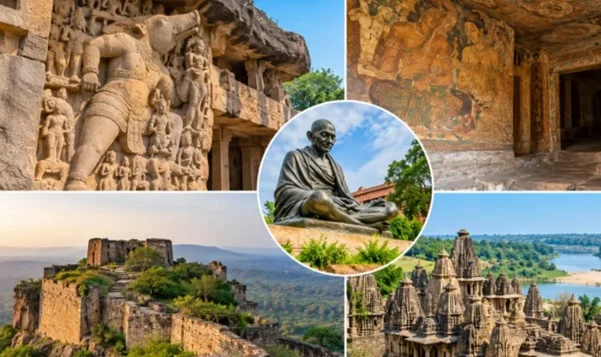
The Udaigiri Caves represent an important example of India’s early historic rock-cut religious architecture. Developed mainly during the Gupta period, particularly in the late fourth and early fifth centuries CE, the site reflects the relationship between religious traditions, royal patronage and artistic expression.
The complex comprises 20 excavated caves, sculptural panels, inscriptions and pathways integrated into the surrounding rocky landscape. Its famous sculptures, including the depiction of Vishnu as Varaha, provide insights into the development of Hindu iconography during the Gupta period.
The Bagh Caves are a group of nine rock-cut Buddhist caves situated on the southern slopes of the Vindhyan range, near the Baghni River in western Madhya Pradesh. They are known for their Buddhist associations, architectural features and mural paintings.
The paintings provide evidence of ancient Indian artistic traditions, religious life and the use of colour and narrative in mural art. The caves’ sandstone geological setting also influenced their architecture and the preservation of their paintings.
Ginnorgarh Fort is a historic fortified site associated with the Gond rulers of central India. Its strategic location and defensive character reflect the importance of hill forts in regional political and military history.
The fort offers opportunities to study the relationship between terrain, defence, regional kingdoms and the historical development of tribal polities in central India.
This proposed heritage entry includes three temple complexes: Bateshwar, Padavali and Kakarmath. Together, they represent the region’s architectural and religious heritage.
The Bateshwar complex is known for its cluster of historic temples, while Padavali is noted for its richly carved temple architecture and fortification. The Kakarmath temple complex at Amrol adds to the evidence of medieval temple-building traditions in the region.
These sites help explain the evolution of temple architecture, stone carving, religious patronage and regional artistic traditions in central India.
The proposed Sites of Satyagraha property is a serial transnational nomination linking nine locations across India and South Africa. It traces the development of Gandhi’s philosophy of Satyagraha, based on truth and non-violent resistance.
The proposal connects places associated with the beginnings of Gandhi’s political experiments in South Africa with locations where the philosophy was further developed, organised and applied in India’s freedom struggle.
The additions can strengthen India’s cultural diplomacy by presenting its heritage as part of a wider human history. The proposed Satyagraha property is particularly relevant because it connects India’s freedom movement with the experiences that shaped Gandhi’s philosophy in South Africa.
For Madhya Pradesh, the four entries draw attention to the state’s diverse heritage, ranging from ancient religious art to historic forts and temple complexes. Their long-term value will depend on conservation, scientific documentation, responsible tourism and community participation.
The five additions to India’s reported UNESCO Tentative List highlight the country’s diverse cultural heritage and the international significance of its historical connections. The four Madhya Pradesh entries reflect the region’s architectural and artistic traditions, while the proposed Sites of Satyagraha property connects India and South Africa through the history of non-violent resistance.
Prelims MCQQ. With reference to UNESCO’s Tentative List, consider the following statements:
Which of the statements given above is/are correct? (a) 1 only Mains Practice Question“India’s cultural heritage contributes to both national identity and international cultural diplomacy.” Discuss with reference to the latest additions to India’s UNESCO Tentative List. |
Q1. What is UNESCO’s Tentative List?It is a list of properties a country may nominate for future inclusion on the World Heritage List. Q2. How many new entries have been reported?Five new entries have been reported, taking the stated total to 78. Q3. Which state accounts for four of the new entries?Madhya Pradesh. Q4. What is the Sites of Satyagraha proposal?It is a proposed transnational heritage property linking nine locations in India and South Africa associated with the development of Gandhi’s philosophy of Satyagraha. Q5. Does Tentative List inclusion mean a site is already a UNESCO World Heritage Site?No. A separate nomination and evaluation process is required before inscription on the World Heritage List. |



Our support team will be happy to assist you!

 Contact Us
  New Batch : 9555124124/ 7428085757
  Tech Support : 9555124124/ 7428085757