Prelims : (Polity & Constitution + Judiciary + CA)
Mains : (GS 2 – Judiciary, Governance, Judicial Ethics) |
Why in News ?
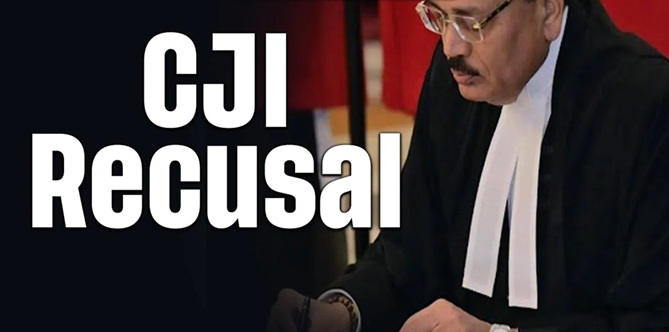
The Supreme Court of India has witnessed successive recusals by Chief Justices in a case challenging the Chief Election Commissioner and Other Election Commissioners Act, 2023, reigniting debate on judicial ethics, recusal standards, and the need for codification.
- Surya Kant recused citing conflict of interest
- Earlier, Sanjiv Khanna had also stepped aside in the same matter
Background and Context
The Case
- The petitions challenge the 2023 law which :
- Replaced the CJI with a Union Minister in the panel appointing Election Commissioners
- The dispute raises questions on :
- Judicial independence
- Executive influence
What is Judicial Recusal ?
Recusal refers to a judge withdrawing from a case due to :
- Conflict of interest
- Possibility of bias
- Perception of partiality
Foundational Principle :
- Nemo judex in causa sua (No one should be a judge in their own cause)
Evolution of Recusal Doctrine in India
1. Manak Lal v. Dr. Prem Chand
- Established :
- Automatic disqualification in case of pecuniary interest
2. Ranjit Thakur v. Union of India
- Introduced :
- Reasonable apprehension of bias
- Shift from :
- Rigid → Perception-based standard
Key Evolution :
- From actual bias → to perceived bias
- Based on :
- What a reasonable person would believe
Current Framework: Key Features
1. Decision by Judge’s Conscience
- Recusal is :
- No external authority can compel it
2. Absence of Codified Law
- No statute governs :
- When to recuse
- How to decide
3. No Review Mechanism
- Once a judge recuses :
- Decision cannot be challenged
Comparative Perspective
United States Model
- Governed by :
- Section 455, Title 28 (U.S. Code)
Features:
- Codified standards
- Objective criteria for disqualification
- Greater transparency
Issues Highlighted by the Current Case
1. Institutional Uncertainty
- Successive recusals create :
- Delays
- Ambiguity in bench formation
2. Lack of Transparency
- Reasons for recusal :
- Not always formally recorded
3. Over-Reliance on Personal Discretion
- No uniform standard
- Risk of inconsistency
4. Impact on Important Cases
- Critical constitutional questions may be :
Significance of the Issue
1. Judicial Independence
2. Public Confidence in Judiciary
- Transparency enhances :
- Trust in judicial processes
3. Ethical Governance
4. Institutional Integrity
- Prevents :
- Conflict of interest
- Bias
5. Constitutional Balance
Need for Codification
Why It Matters :
- Ensures :
- Consistency
- Transparency
- Accountability
Possible Features :
- Clear grounds for recusal
- Mandatory disclosure of reasons
- Limited review mechanism
- Institutional guidelines
Way Forward
- Develop a formal recusal framework
- Draw from global best practices
- Balance :
- Judicial independence
- Institutional accountability
- Encourage :
- Written, reasoned recusal orders
FAQs
1. What is judicial recusal ?
It is the withdrawal of a judge from a case due to potential bias or conflict of interest.
2. Who decides recusal in India ?
The judge concerned decides based on personal conscience.
3. Is there a law governing recusal in India ?
No, there is no codified legal framework.
4. Why is the current case significant ?
It involves successive recusals in a major constitutional matter, exposing institutional gaps.
5. What reform is suggested ?
Codifying recusal standards to ensure transparency, consistency, and accountability.
|






 Contact Us
  New Batch : 9555124124/ 7428085757
  Tech Support : 9555124124/ 7428085757