Koraga Tribe and India’s Housing Challenge: Analysis of the UN-Habitat World Cities Report 2026
The recently released UN-Habitat World Cities Report 2026 has highlighted the growing severity of housing inequality, housing accessibility issues, social exclusion, and urban crises at the global level.
The report specifically mentions the Koraga tribe of India, stating that social discrimination, caste-based barriers, and policy gaps continue to deprive many communities of secure and dignified housing.
According to the report, the rental burden in India has been increasing continuously. In 2010, households spent nearly 20% of their income on rent, which increased to 26% in 2023.
Koraga Tribe: Introduction and Geographical Distribution
The Koraga are an indigenous tribal community of India, primarily residing in the Dakshina Kannada and Udupi districts of Karnataka and the Kasaragod district of Kerala.
In addition, small populations of the community are found across several districts of Karnataka.
The Government of India has classified the Koraga community as a Particularly Vulnerable Tribal Group (PVTG), reflecting their social, economic, and educational backwardness.
Language and Social Structure
Members of the Koraga community use the Koraga language (Koraga Bhasha), while Tulu is also widely spoken among them. Socially, the community follows a matrilineal family system, where lineage and social identity are associated with women.
Their social organization is based on a distinct clan system called “Bali”, which plays an important role in community organization. The community is led by the senior-most person of the village, known as the “Mooppan”, who ensures welfare and social coordination among members.
Economic Life and Cultural Identity
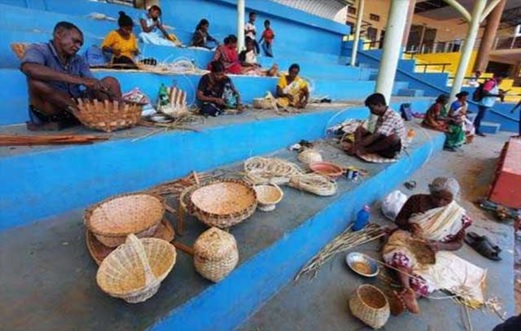
The livelihood of the Koraga community is primarily based on agriculture and forest resources. They are also known for traditional handicrafts, especially basket making.
The community actively participates in folk dances, music, and traditional rituals, reflecting its rich cultural heritage. Music occupies an important place in their social and religious ceremonies.
Dholu and Voote are their major traditional musical instruments, corresponding respectively to the drum and flute. The rhythmic sound of the Dholu is regarded as an integral part of Koraga cultural identity and is widely used during religious and community events.
Religious Beliefs
Although the Koraga community broadly follows Hinduism, they also retain distinct tribal religious beliefs.
The community worships “Bhutas” (spirits) and believes in magical and ritualistic traditions.
Community members believe that religious ceremonies and traditional rituals provide protection from evil forces and negative influences.
Why is the Koraga Community Mentioned in the UN-Habitat Report?
The UN-Habitat World Cities Report 2026 mentions the Koraga community in the context of their housing challenges.
According to the report, home ownership remains difficult for the Koraga people, influenced not only by economic conditions but also by caste structures and policy gaps.
The report states that limited education, social exclusion, and structural barriers prevent the community from adequately accessing government housing schemes.
It also highlights the initiative “Restoration of Dignity and Human Rights of Indigenous Tribal Community in Karnataka”, undertaken by ActionAid India, Koraga Federation, and Samagra Grameena Ashram.
Through this initiative, Koraga families were assisted in accessing state government housing schemes.
Global Housing Crisis and Urbanization Challenges
According to the report, nearly 40% of the world’s population, approximately 3.4 billion people, are currently affected by housing challenges. Expensive housing, housing shortages, poor-quality settlements, and lack of basic urban services such as water and sanitation are the major causes of this crisis.
The report warns that the situation could become more severe if timely action is not taken. It is estimated that by 2050, around 2 billion additional people will be added to urban areas worldwide, placing greater pressure on already stressed housing systems.
Furthermore, the report states that climate change-induced disasters may destroy nearly 167 million homes by 2040.
Every City Has a Different Problem
At the World Urban Forum (WUF13), Jeffrey D. Sachs stated that the global urban crisis cannot be viewed through a uniform approach.
He emphasized that economic, demographic, and land-related conditions differ across regions; therefore, urban challenges also vary accordingly.
According to him, Latin America is experiencing significant social change due to smaller family sizes, whereas Sub-Saharan Africa faces serious challenges related to rapidly increasing urban populations, land use, urban planning, and housing systems.
He also noted that South Asia and Southeast Asia continue to face relatively lower but still important urban challenges requiring special attention.
Conclusion
The situation of the Koraga tribe is not merely the issue of one tribal community; rather, it represents a broader question of social justice, inclusive development, and housing equality.
The UN-Habitat World Cities Report 2026 makes it clear that housing construction schemes alone will not be sufficient.
Ensuring secure and dignified housing requires addressing social discrimination, caste barriers, and policy deficiencies. Only then can the goals of “Housing for All” and inclusive urban development be effectively realized.







 Contact Us
  New Batch : 9555124124/ 7428085757
  Tech Support : 9555124124/ 7428085757