Prelims: Sankoo district, Ladakh districts, Union Territory of Ladakh, J&K Reorganisation Act 2019, Lieutenant Governor, Ladakh Autonomous Hill Development Councils (LAHDC), Suru Valley, Land Revenue Act.
Mains: GS Paper II: Governance, Decentralisation, Federalism and Union Territories, Government Policies and Interventions, Regional Development and Aspirations. |
Why in news?
On 16 October 2026, the Ladakh administration notified the creation of Sankoo as a new district, making it the eighth district of the Union Territory (UT) of Ladakh.
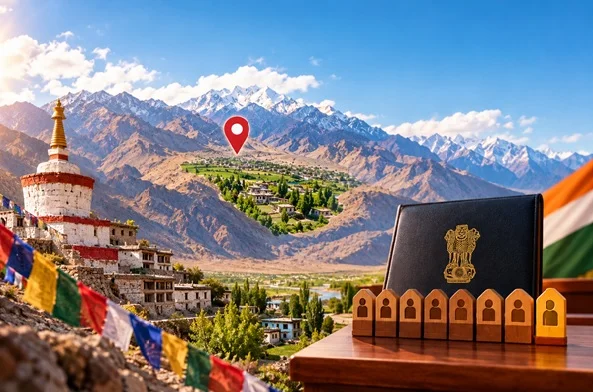
Key Facts
|
Particular
|
Details
|
|
New district
|
Sankoo (eighth district of Ladakh)
|
|
Date of notification
|
16 October 2026
|
|
Notification
|
S.O. 284 dated 16 October 2026, issued by the Revenue Department
|
|
Legal basis
|
Section 5 of the Jammu and Kashmir Land Revenue Act, 1996
|
|
Headquarters
|
Sankoo
|
|
Composition
|
Four tehsils: Sankoo, GM Pore (Gound Mangal Pore), TSG and Taisuru, along with their revenue villages
|
|
Carved out of
|
Kargil district (its jurisdiction was modified to exclude these tehsils)
|
|
Region
|
Suru Valley, Kargil region
|
|
Announced by
|
Lieutenant Governor of Ladakh, V. K. Saxena
|
|
Total districts in Ladakh
|
Eight: Leh, Kargil, Sham, Nubra, Changthang, Zanskar, Drass and Sankoo
|
Where is Sankoo?
- Sankoo lies in the Suru Valley, in the Kargil region of Ladakh, roughly 40 km from Kargil town according to local commentators.
- Until now it functioned as a sub-division of Kargil district.
- Local representatives have argued that the area has a large population, several administrative blocks and a number of elected hill council members, and that remote villages such as Parkachik, Umba and Pangbar in Barsoo are far from the earlier district headquarters.
Background: How Ladakh Reached Eight Districts
- Before 2019: Ladakh was part of the erstwhile State of Jammu and Kashmir and was administered through two districts, Leh and Kargil.
- 31 October 2019: Ladakh became a separate Union Territory under the Jammu and Kashmir Reorganisation Act, 2019, without a Legislative Assembly.
- August 2024: The Centre announced the creation of five new districts, namely Zanskar, Drass, Sham, Nubra and Changthang. Sankoo and Shakar-Chiktan were left out, which led to protests and a shutdown in the Sankoo sub-division.
- 2024-25: A group called the United Movement for Sankoo District Status was formed. Memoranda were submitted to the Union Government and a large protest march was held in Sankoo in February 2025.
- 27 April 2026: The five districts were formally notified, taking the total to seven.
- 16 October 2026: Sankoo was notified as the eighth district.
Role of Local Organisations
- In announcing the decision, the administration credited the constructive approach of Anjuman-e-Sahib Zaman and its leadership, along with elected representatives from Kargil and Leh.
- It described the move as the culmination of a long-standing local aspiration, in line with the 'Sabka Saath, Sabka Vikas' vision of the Union Government.
Significance of the New District
- Administrative efficiency: A smaller jurisdiction brings district-level offices closer to people in a terrain of long distances and harsh winters.
- Service delivery: Improved access to revenue, health, education and welfare services, particularly for remote villages.
- Decentralised governance: Reflects the principle that governance works better when units are closer to citizens.
- Regional balance: Addresses the sense of exclusion in Sankoo after the 2024 announcement and helps balance development across the Kargil region.
- Responsiveness to demand: Shows that a sustained democratic demand through memoranda, representation and peaceful protest can influence policy.
- Local development: A district headquarters usually attracts offices, staff, infrastructure and economic activity.
Challenges and Concerns
- Setting up institutions: A new district needs a Deputy Commissioner's office, police, health, education and revenue departments, which takes time and trained staff.
- Fiscal burden: Additional offices and staff increase administrative expenditure for a small UT.
- Recruitment and capacity: Filling posts in remote, high-altitude areas is difficult and attracting officials can be a challenge.
- Infrastructure and connectivity: Roads, buildings, power and internet need to match the new administrative role.
- Cascading demands: Other areas, such as Shakar-Chiktan, which also sought district status in 2024, may press similar claims.
Prelims MCQ
Q. With reference to the newly created Sankoo district of Ladakh, consider the following statements:
- It is the eighth district of the Union Territory of Ladakh.
- It was created from the territory of Kargil district.
- Its creation required an amendment to the Constitution of India.
Which of the statements given above are correct?
(a) 1 and 2 only
(b) 2 and 3 only
(c) 1 and 3 only
(d) 1, 2 and 3
Mains Practice Question
Q. Creation of smaller districts improves governance but also raises new administrative challenges. Discuss with reference to the creation of new districts in Ladakh.
|
FAQs
Which is the eighth district of Ladakh?
Sankoo.
When was Sankoo notified as a district?
On 16 October 2026.
From which district was Sankoo carved out?
Kargil district.
Which tehsils form Sankoo district?
Sankoo, GM Pore, TSG and Taisuru.
How many districts did Ladakh have before Sankoo?
Seven: Leh, Kargil, Sham, Nubra, Changthang, Zanskar and Drass.
|







 Contact Us
  New Batch : 9555124124/ 7428085757
  Tech Support : 9555124124/ 7428085757