New
Hindi Medium: (Delhi) - GS Foundation (P+M) : 8th June 2026, 6:30 PM Hindi Medium: (Prayagraj) - GS Foundation (P+M) : 1st June 2026, 5:30 PM English Medium: (Prayagraj) - GS Foundation (P+M) : 7th June 2026, 8:00 AM Hindi Medium: (Delhi) - GS Foundation (P+M) : 8th June 2026, 6:30 PM Hindi Medium: (Prayagraj) - GS Foundation (P+M) : 1st June 2026, 5:30 PM English Medium: (Prayagraj) - GS Foundation (P+M) : 7th June 2026, 8:00 AM

Mishmi Takin: Species Profile, Habitat, Distribution and Conservation Status

Why in News

  • The first-ever video footage of a herd of Mishmi Takin has been recorded in Tingda Reserve Forest in North Sikkim. The sighting is considered significant as it provides rare visual evidence of the species' presence in the region and highlights the importance of conserving its fragile Himalayan habitat. 
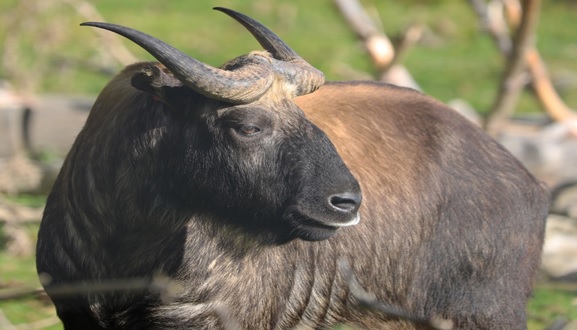
Species Profile

  • Scientific Name: Budorcas taxicolor
  • The Mishmi Takin is a large goat-antelope belonging to the family Bovidae and order Artiodactyla (even-toed ungulates). 
  • It is one of the four recognised subspecies of the Takin and is regarded as the largest among them. 
  • Despite its appearance resembling both a goat and a musk ox, it is genetically more closely related to wild sheep and goats. 

Habitat and Distribution

  • The species is native to the Eastern Himalayas
  • It is found in Arunachal Pradesh (India), northern Myanmar, southeastern Tibet, and parts of southwestern China
  • It inhabits temperate broadleaf and conifer forests, bamboo thickets, sub-alpine meadows, and rocky alpine slopes at elevations ranging from about 1,500 to 4,500 metres
  • During summer, herds migrate to higher alpine pastures, while in winter they descend to lower forested valleys. 

Physical Characteristics

  • It has a massive, muscular body, short sturdy legs, a large head, and a distinctive arched Roman nose
  • Both males and females possess thick, curved horns, which are used for defence and dominance. 
  • Its dense coat varies from golden-yellow to dark brown, becoming thicker during winter to withstand harsh weather. 
  • The animal secretes an oily substance from its skin, making its fur water-resistant and protecting it from cold and damp mountain conditions. 
  • Adult individuals can weigh 250–400 kg, making them among the largest mountain ungulates in Asia. 

Behaviour and Ecology

  • Mishmi Takins are generally social animals, living in small to medium-sized herds, although older males are often solitary outside the breeding season. 
  • They are herbivores, feeding on grasses, bamboo shoots, shrubs, leaves, herbs, and lichens. 
  • They play an important ecological role by dispersing seeds and maintaining the health of Himalayan mountain ecosystems. 

Threats

  • Habitat loss and fragmentation due to road construction, infrastructure development, and deforestation. 
  • Poaching and illegal hunting for meat and body parts. 
  • Climate change, which is altering alpine habitats and affecting seasonal migration patterns. 
  • Human disturbance in high-altitude ecosystems. 

Conservation Status

  • IUCN Red List: Vulnerable (VU)
  • The species is protected in several national parks and wildlife sanctuaries across its range, including protected areas in Arunachal Pradesh and neighbouring Himalayan regions. 
  • Improved monitoring, habitat protection, anti-poaching measures, and transboundary conservation cooperation are essential for its long-term survival.
Have any Query?

Our support team will be happy to assist you!

OR