


National Education Day is observed every year on 11 November in India to commemorate the birth anniversary of Maulana Abul Kalam Azad, India's first Education Minister.
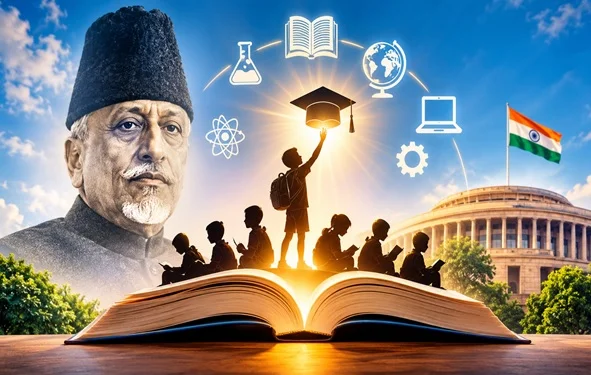
|
Particular |
Details |
|
Occasion |
National Education Day |
|
Date |
11 November |
|
First observed |
2008 |
|
Celebrated in |
India |
|
Birth anniversary |
Maulana Abul Kalam Azad |
|
Who declared it? |
Ministry of Human Resource Development (now Ministry of Education) |
|
Main objective |
Promote education and spread awareness about its importance |
|
Area |
Contribution |
|
Primary Education |
Emphasised free and compulsory education for children up to 14 years of age |
|
Women's Education |
Supported women's education and equal educational opportunities |
|
Technical Education |
Promoted technical and scientific education |
|
Higher Education |
Supported the development of universities and higher educational institutions |
|
Cultural Education |
Encouraged the preservation of India's cultural heritage |
|
Scientific Research |
Advocated scientific research and modern knowledge |
|
Article |
Provision |
|
Article 21A |
Provides free and compulsory education to children aged 6-14 years |
|
Article 29 |
Protects the interests of minorities in conserving their language, script and culture |
|
Article 30 |
Gives religious and linguistic minorities the right to establish and administer educational institutions |
|
Article 41 |
Directs the State to make effective provision for education within its economic capacity and development |
|
Article 45 |
Directs the State to provide early childhood care and education for children below six years |
|
Article 46 |
Promotes the educational and economic interests of weaker sections, particularly SCs and STs |
|
Article 51A(k) |
Makes it a Fundamental Duty of parents or guardians to provide educational opportunities to children aged 6-14 years |
|
Scheme / Initiative |
Year |
Major Objective |
|
Samagra Shiksha Abhiyan |
2018 |
Integrated school education from pre-school to Class 12 |
|
PM POSHAN Scheme |
2021 (renamed from Mid-Day Meal) |
Improve nutrition and school participation among children |
|
NIPUN Bharat Mission |
2021 |
Achieve Foundational Literacy and Numeracy |
|
National Education Policy (NEP) |
2020 |
Transform school and higher education |
|
PM SHRI Schools |
2022 |
Develop more than 14,500 model schools |
|
DIKSHA Platform |
2017 |
Provide digital learning resources to teachers and students |
|
SWAYAM |
2017 |
Provide online courses for school and higher education |
|
ULLAS: Nav Bharat Saaksharta Karyakram |
2022–27 |
Promote education and lifelong learning among non-literates aged 15 years and above |
Prelims MCQQ. National Education Day in India is celebrated to commemorate the birth anniversary of whom? A. Dr. Sarvepalli Radhakrishnan B. Maulana Abul Kalam Azad C. Dr. Zakir Husain D. Jawaharlal Nehru Mains Practice QuestionQ. How can education contribute to women's empowerment, poverty reduction and inclusive economic growth in India? |
When is National Education Day celebrated in India?11 November every year. Who was Maulana Abul Kalam Azad?He was an Indian freedom fighter, scholar, journalist and the first Education Minister of independent India. When was Maulana Abul Kalam Azad born?11 November 1888 in Mecca When was National Education Day first celebrated?11 November 2008. What was the tenure of Maulana Abul Kalam Azad as Education Minister?He served from 1947 to 1958. |




