Why in News?
A new COVID-19 variant, PJ.2.1, is attracting global attention following its detection in multiple countries, including Canada, the United States, Australia, New Zealand and several European and Asian countries.
- The variant was first identified in Ontario, Canada, on 2 May 2026.
- Research published in the Journal of Infection on 24 October 2026 identified changes in its spike protein that may improve its ability to enter human cells.
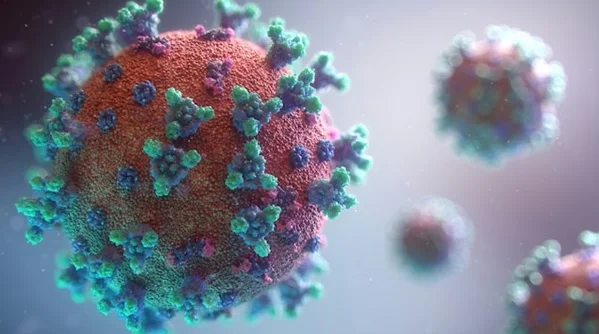
Evolution of SARS-CoV-2
COVID-19 is an infectious respiratory disease caused by the Severe Acute Respiratory Syndrome Coronavirus 2 (SARS-CoV-2).
Since its emergence in 2019, the virus has undergone repeated genetic mutations, giving rise to variants such as Alpha, Beta, Delta, Omicron and numerous Omicron sublineages.
- Genetic Mutation: A change in the genetic material of a virus during replication.
- Variant: A viral form carrying a particular combination of genetic changes.
- Lineage: A genetically related group of viruses sharing a common evolutionary ancestor.
- Spike Protein: A surface protein that helps SARS-CoV-2 attach to and enter human cells.
PJ.2.1 belongs to the broader Omicron evolutionary family and is descended from the JN.1-related lineage MC.10.1.7.
What is the PJ.2.1 COVID-19 Variant?
- PJ.2.1 is an emerging lineage of SARS-CoV-2 characterised by substantial genetic changes in its spike protein.
- Researchers describe it as a saltation variant, meaning it exhibits an unusually large accumulation of mutations compared with its known evolutionary predecessor.
Key Characteristics
|
Feature
|
Details
|
|
Variant name
|
PJ.2.1
|
|
Virus
|
SARS-CoV-2
|
|
Evolutionary lineage
|
MC.10.1.7, within the JN.1 family
|
|
First reported detection
|
2 May 2026, Ontario, Canada
|
|
Important characteristic
|
Highly mutated spike protein
|
|
Cellular receptor
|
ACE2
|
|
Major scientific concern
|
Enhanced cell-entry efficiency
|
|
Severity
|
No confirmed increase established
|
|
India status
|
Detection not established by verified public evidence
|
Global Spread of PJ.2.1
- Following its initial detection in Canada, PJ.2.1 has been reported in several countries.
- Major reported locations: Canada, United States, Australia, New Zealand, Singapore, Israel, France and Spain.
- The United States reportedly recorded its first detection in New York City on 30 June 2026. Subsequent detections were reported across several other states.
Why is the PJ.2.1 Variant Causing Concern?
The major scientific concern relates to changes in the virus's spike protein and its interaction with human cells.
- Spike Protein Mutations: The variant contains numerous spike protein mutations that may alter its ability to bind to human receptors.
- Enhanced ACE2 Interaction: The ACE2 (Angiotensin-Converting Enzyme 2) receptor is a protein found on the surface of various human cells. SARS-CoV-2 uses its spike protein to interact with this receptor and initiate entry into cells.
- Increased Cell-Entry Efficiency: Laboratory experiments found that PJ.2.1 spike-bearing pseudo viruses entered four of five tested cell lines approximately 1.5–2.5 times as efficiently as the LP.8.1 comparator.
Is PJ.2.1 More Dangerous Than Previous Variants?
- There is currently insufficient clinical evidence to conclude that PJ.2.1 causes more severe disease, hospitalisation or death than previously circulating variants.
- The October 2026 research primarily investigated virological characteristics, including cell entry, receptor dependence and antibody neutralisation.
- Although the researchers observed PJ.2.1 relatively frequently among people aged 70 and above in their analysed data, this does not demonstrate that the variant specifically targets older individuals.
Can Existing COVID-19 Vaccines Protect Against PJ.2.1?
Initial laboratory findings provide some reassurance.
- Researchers assessed antibodies from individuals vaccinated with an LP.8.1-adapted COVID-19 vaccine.
- The antibodies retained neutralising activity against PJ.2.1.
- The findings did not suggest substantially greater antibody escape than most of the comparison variants.
Nevertheless, laboratory neutralisation findings cannot establish the precise real-world effectiveness of vaccination against PJ.2.1 infection. The WHO continues to recognise vaccination as an important protective measure against severe COVID-19, especially for people at higher risk.
Has PJ.2.1 Been Detected in India?
- As of 11 November 2026, there is no independently verified public evidence establishing the detection of PJ.2.1 in India.
- India monitors emerging coronavirus variants through its genomic surveillance network, particularly the Indian SARS-CoV-2 Genomics Consortium (INSACOG).
What is INSACOG?
The Indian SARS-CoV-2 Genomics Consortium (INSACOG) is a network of laboratories established by the Government of India in December 2020 to monitor genetic variations in SARS-CoV-2.
Its major functions include:
- Identifying emerging coronavirus variants through genome sequencing.
- Monitoring the geographical distribution of circulating viral lineages.
- Studying mutations that may affect transmission, virulence or immune escape.
- Supporting public health decision-making through genomic surveillance.
- Strengthening India's preparedness for emerging infectious diseases.
World Health Organization's Classification of COVID-19 Variants
The WHO categorises SARS-CoV-2 variants according to their genetic characteristics and potential public health impact.
|
Classification
|
Meaning
|
|
Variant Under Monitoring (VUM)
|
A variant with genetic changes requiring closer observation
|
|
Variant of Interest (VOI)
|
A variant with characteristics and epidemiological evidence warranting further assessment
|
|
Variant of Concern (VOC)
|
A variant demonstrating significant adverse effects on public health
|
Significance of PJ.2.1 for India
- Public Health Preparedness: The emergence of new coronavirus lineages highlights the importance of maintaining functional disease surveillance and healthcare response systems.
- Strengthening Genomic Surveillance: INSACOG and associated laboratories can help identify emerging viral strains and monitor their distribution across India.
- Protection of Vulnerable Populations: Older adults, immunocompromised individuals and people with underlying medical conditions remain more vulnerable to severe COVID-19.
- Vaccine Research and Development: Continued viral evolution underlines the importance of evaluating vaccine effectiveness against emerging lineages and adapting vaccination strategies when necessary.
- International Health Cooperation: The exchange of genomic data and scientific findings strengthens cooperation between India, the WHO and international research institutions.
Challenges in Monitoring Emerging COVID-19 Variants
- Limited Genomic Sequencing: Reduced sampling can delay the identification of emerging lineages.
- Rapid Viral Evolution: Continuous mutations complicate long-term surveillance and assessment.
- Underreporting: Declining testing and reporting can obscure actual infection trends.
- Uncertain Clinical Impact: Laboratory findings may not accurately predict real-world disease severity.
- Vaccine Inequality: Unequal access to vaccines and healthcare continues to increase vulnerability in some populations.
- Public Misinformation: Exaggerated claims regarding new variants can create unnecessary anxiety.
Way Forward
- Expand genomic surveillance: Strengthen whole-genome sequencing capacity and timely reporting through INSACOG.
- Enhance international cooperation: Promote genomic information sharing through platforms such as GISAID and WHO surveillance networks.
- Protect high-risk populations: Encourage vaccination according to current public health recommendations and individual risk.
- Strengthen healthcare infrastructure: Maintain diagnostic facilities, respiratory disease surveillance and hospital preparedness.
- Promote scientific research: Conduct epidemiological studies to assess transmissibility, vaccine effectiveness and disease severity.
- Improve public awareness: Communicate verified health information and discourage misinformation.
Conclusion
- The emergence of PJ.2.1 demonstrates the continuing evolution of SARS-CoV-2 even years after the initial COVID-19 pandemic.
- Although laboratory findings suggest increased efficiency in entering certain human cells, there is currently no conclusive evidence that PJ.2.1 causes more severe illness or a substantially greater risk of death.
- For India, the development reinforces the importance of genomic surveillance, scientific research, vaccination of vulnerable populations and evidence-based public health preparedness.
Prelims Practice Questions
Q. Consider the following statements about INSACOG: 1. It monitors genetic variations in SARS-CoV-2. 2. It was established in December 2020. 3. It is headquartered in Geneva under the WHO. Which statements are correct?
A. 1 only
B. 2 and 3 only
C. 1 and 2 only
D. 1, 2 and 3
Mains Practice Question
“The continuous emergence of new SARS-CoV-2 variants highlights the significance of genomic surveillance and scientific preparedness in public health management.” Discuss with reference to the PJ.2.1 variant and India's genomic surveillance capabilities.
|
FAQs
1. What is the PJ.2.1 COVID-19 variant?
PJ.2.1 is an emerging lineage of the SARS-CoV-2 virus.
2. Where was PJ.2.1 first identified?
It was first identified in Ontario, Canada, in 2026.
3. What is the role of ACE2 receptors?
They facilitate coronavirus attachment and entry into human cells.
4. Can existing vaccines protect against PJ.2.1?
Laboratory findings indicate retained antibody neutralisation against PJ.2.1.
5. What is INSACOG?
It is India's consortium for SARS-CoV-2 genomic surveillance.
|