Why in the news?
The Telangana government recently announced a ban on paraquat. This makes Telangana the third state in India to ban the use of this highly toxic herbicide. Kerala and Odisha have also taken similar steps.
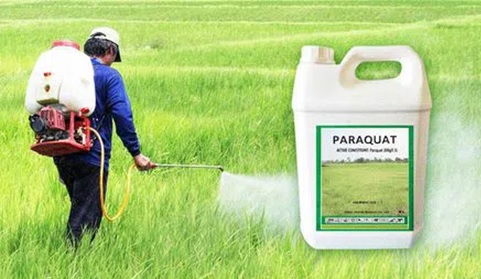
What is Paraquat ?
- Paraquat is a highly toxic chemical herbicide used to kill weeds and unwanted grass in fields.
- It is a synthetic chemical. It was discovered in the 1880s as a chemical dye. Its herbicidal properties were discovered in the 1950s. In the 1960s, it began to be sold commercially under the name Gramoxone.
- It is a non-selective contact herbicide, meaning it can kill any plant. It is also used as a desiccant and a plant growth regulator before harvest.
- It has no long-term residual effect in soil.
Why is paraquat so dangerous ?
- Paraquat is considered one of the world's deadliest herbicides.
- Its key characteristics
- Even very small amounts can be fatal.
- There is no effective antidote available.
- Once in the body, it rapidly damages organs.
- Effects on the body
- Burns the lining of the mouth, throat, and intestines.
- Spreads throughout the body through the bloodstream.
- Damages the kidneys.
- Affects the liver.
- Causes fibrosis in the lungs.
- Can cause multiple organ failure.
- According to experts, more than 70% of paraquat poisoning cases result in death.
The dire state of hospitals
- The severity of paraquat poisoning can be gauged from a study conducted at Gandhi Hospital in Hyderabad.
- According to the study, 217 cases of paraquat poisoning were reported during 2024-25. Of these, 54 percent were farmers, while 16 percent were students.
- Of the 100 cases studied, 94 percent were suicides, while 5 percent were accidental poisonings.
- According to doctors, there is no specific treatment available for paraquat, and patients can only be given supportive therapy.
Doctors' Campaign: "Doctors Against Paraquat"
Why do farmers still use it ?
- Despite its highly toxic nature, paraquat has been used by farmers for a long time.
- There are several practical reasons behind this. Due to labor shortages and rising labor costs in the agricultural sector, farmers rely on chemicals that can destroy weeds in a short time
- Paraquat shows rapid action and is relatively inexpensive, at around ₹280 per liter.
- Currently, it is used on approximately 8 million acres of agricultural land in India.
Increasing Use in India
- Data presented in the Lok Sabha clearly shows that paraquat use in India has increased rapidly.
- While its imports were 8,598 tons in 2019-20, they increased to 20,786 tons in 2022-23.
- That is, its imports more than doubled in just a few years.
Regulatory Status in India
- Pesticides in India are primarily regulated under the Insecticides Act, 1968. However, a complete ban on paraquat has not yet been implemented nationwide.
- Kerala became the first state to ban it in 2011. Odisha, Telangana, and Andhra Pradesh subsequently banned its use.
Global Perspective
- Paraquat is considered a highly hazardous chemical globally.
- This is why more than 74 countries have banned its use.
- Despite this, its use continues in many countries. It is noteworthy that in 2013, India opposed the proposal to include paraquat in the list of "Severely Hazardous Pesticides" under the Rotterdam Convention.
The Challenge of Online Sales
- Experts believe that a state-level ban alone will not completely solve the problem.
- Following the ban, major e-commerce platforms like Amazon and Flipkart stopped selling it in Telangana, but it remains available on several smaller agricultural e-commerce portals.
- This makes it challenging to fully implement the ban.
Industry View
- The agrochemical industry argues that paraquat is a low-cost and effective alternative for farmers.
- According to the industry, it is particularly useful for small farmers, and a sudden ban could increase production costs and create weed control problems.
Initial impact of the ban in Telangana
- According to doctors and health experts, there has been a significant reduction in paraquat-related deaths in Telangana since the ban was implemented.
- While previously around 30 to 50 deaths were reported per month, this number has now dropped to 3 to 5 per month.
- However, long-term data and detailed studies are needed to confirm this claim.
Conclusion
Paraquat is one of the world's most lethal herbicides. Its low cost, easy availability, and extreme toxicity make it a serious threat to public health. The ban imposed by Telangana is being considered an important step toward protecting farmers and the public. However, experts believe that a permanent solution to this problem will not be possible unless a nationwide ban is implemented, online sales are controlled, and safe alternatives are made available to farmers.






 Contact Us
  New Batch : 9555124124/ 7428085757
  Tech Support : 9555124124/ 7428085757