Why in News
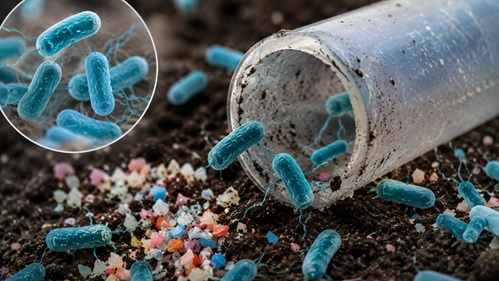
Researchers from Cairo University, Egypt have identified bacterial strains capable of degrading Polyvinyl Chloride (PVC) microplastics, one of the most difficult plastics to break down naturally. The findings, published in the journal Microbial Cell Factories (June 2026), offer a promising eco-friendly approach to tackling persistent plastic pollution.
Scientific Profile
- Polyvinyl Chloride (PVC) is a chlorine-containing synthetic polymer widely used in water pipes, electrical cables, flooring, packaging materials, window frames, and medical devices due to its durability, low cost, and chemical resistance.
- Microplastics are plastic particles smaller than 5 mm that originate from the breakdown of larger plastic products or are manufactured directly for industrial and commercial applications.
- PVC is considered one of the most difficult plastics to biodegrade because of its complex chemical structure and chlorine content.
Key Findings
- The bacterial strain Stutzerimonas sp. NH2 reduced the weight of PVC microplastics by more than 23% during laboratory experiments.
- Another strain, Glutamicibacter nicotinae NH27, also demonstrated a significant ability to degrade PVC.
- When both strains were used together as a bacterial consortium, PVC degradation increased to nearly 27%, indicating a synergistic effect.
Experimental Observations
- The bacteria were isolated from plastic-contaminated soils, suggesting that microorganisms in polluted environments can naturally evolve the ability to utilize plastic as a carbon source.
- Microscopic examination revealed cracks, pits, grooves, and surface erosion on treated PVC samples.
- Chemical analyses confirmed changes in the polymer's molecular structure, providing strong evidence of actual biodegradation rather than mere surface damage.
- The bacterial consortium proved more efficient than individual strains, highlighting the importance of microbial cooperation in plastic degradation.
Significance of the Study
- This is the first reported evidence linking Stutzerimonas sp. NH2 and Glutamicibacter nicotinae NH27 to the degradation of PVC microplastics.
- The discovery could support the development of bioremediation technologies for cleaning plastic-contaminated soils and water bodies.
- It contributes to the growing field of Environmental Microbiology, which explores the use of microorganisms to solve environmental challenges such as pollution and waste management.
- The findings also advance research on sustainable plastic waste management and the development of biological alternatives to conventional plastic disposal methods.
Key Facts
- PVC is the third most widely produced synthetic plastic polymer in the world.
- Environmental Microbiology studies the interactions of microorganisms with their environment, including their role in degrading pollutants.
- A bacterial consortium is a group of two or more bacterial species that work together, often performing complementary metabolic functions that enhance the breakdown of complex substances like plastics.
- Although the results are promising, the research is currently laboratory-based, and further studies are needed before these bacteria can be applied effectively on an industrial or environmental scale.






 Contact Us
  New Batch : 9555124124/ 7428085757
  Tech Support : 9555124124/ 7428085757