|
Prelims
International Relations
Mains
GS Paper II – India and its Neighbourhood; Bilateral & Regional Groupings
GS Paper III – Critical Minerals; Energy Security; Strategic Resources
|
Why in News ?
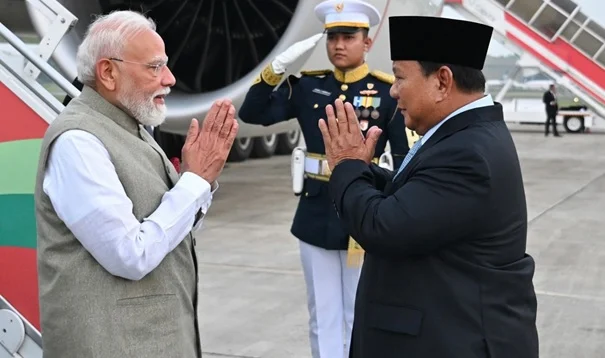
- Prime Minister Narendra Modi is on a three-nation tour, with Indonesia being the first stop. During the bilateral meeting, both countries are expected to deepen cooperation in defence, maritime security, critical minerals, trade, connectivity, and the Indo-Pacific.
- This is PM Modi's fourth visit to Indonesia but the first bilateral visit since India and Indonesia elevated their relationship to a Comprehensive Strategic Partnership (CSP) in May 2018, highlighting renewed momentum in bilateral ties amid changing geopolitical and economic realities.
Comprehensive Strategic Partnership (CSP)
A Comprehensive Strategic Partnership is an advanced level of bilateral relationship involving cooperation across multiple sectors such as :
- Defence and security
- Trade and investment
- Maritime cooperation
- Technology and digital economy
- Energy and critical minerals
- Education and people-to-people exchanges
It reflects a long-term strategic commitment between two countries.
Background
|
Year
|
Development
|
|
1950
|
India established diplomatic relations with Indonesia.
|
|
2005
|
Strategic Partnership established.
|
|
2018
|
Relationship upgraded to Comprehensive Strategic Partnership during PM Modi's visit.
|
|
2023
|
Cooperation strengthened under India's ASEAN engagement and Indo-Pacific initiatives.
|
|
2026
|
PM Modi's first bilateral visit to Indonesia after the CSP; focus on defence and critical minerals.
|
India–Indonesia Relations at a Glance
Political Relations
- Comprehensive Strategic Partnership since 2018
- Regular high-level political exchanges
- Cooperation through ASEAN, G20, East Asia Summit, and Indian Ocean Rim Association (IORA)
|
Economic Relations
- Indonesia is among India's largest trading partners in ASEAN.
- Bilateral trade exceeds USD 30 billion (approx.).
|
|
India imports
|
India exports
|
|
Palm Oil
|
Refined petroleum
|
|
Coal
|
Pharmaceuticals
|
|
Natural Gas
|
Engineering goods
|
|
Nickel-related products
|
Rice
|
Maritime Relations
- Both countries share maritime interests near the Andaman Sea and the Malacca Strait.
Cooperation includes :
- Maritime domain awareness
- Anti-piracy
- Search & Rescue (SAR)
- Blue Economy
Important Facts for Exam
Indonesia
- Capital : Jakarta (administrative transition towards Nusantara is underway)
- Currency : Indonesian Rupiah
- Official Language : Indonesian (Bahasa Indonesia)
- Largest archipelagic nation in the world
- Largest economy in ASEAN
Shared Maritime Connectivity
India and Indonesia are connected through :
- Andaman Sea
- Malacca Strait
- Indian Ocean
The Sabang Port (Indonesia) lies close to India's Andaman & Nicobar Islands, making it strategically significant.
Critical Minerals
Critical minerals are essential for :
- Electric Vehicles (EVs)
- Batteries
- Semiconductors
- Renewable Energy
- Defence Manufacturing
Indonesia possesses major reserves of :
- Nickel
- Cobalt
- Tin
- Bauxite
Nickel is crucial for lithium-ion batteries.
Defence Cooperation
Regular cooperation includes :
- Naval exercises
- Coast Guard cooperation
- Maritime surveillance
- Defence dialogue
- Counter-terrorism cooperation
Regional Forums
Both countries are members of :
- ASEAN-led mechanisms (Indonesia)
- G20
- East Asia Summit
- Indian Ocean Rim Association (IORA)
Indonesia also plays a central role in ASEAN Outlook on the Indo-Pacific (AOIP).
Why India and Indonesia Matter to Each Other
- Controls one of the world's busiest maritime routes near the Malacca Strait.
- Reliable partner in the Indo-Pacific.
- Source of critical minerals, especially nickel.
- Important ASEAN partner under India's Act East Policy.
- Supports maritime connectivity and regional stability.
Why India Matters to Indonesia
- One of the world's fastest-growing major economies.
- Large market for Indonesian exports.
- Trusted defence and maritime partner.
- Important player in the Indian Ocean Region.
- Cooperation in digital economy, healthcare, and infrastructure.
Significance of the Development
- Enhances cooperation for a free, open, inclusive, and rules-based Indo-Pacific, ensuring secure sea lanes and regional stability.
- Access to Indonesian nickel and other strategic minerals supports India's electric vehicle ecosystem, clean energy transition, and semiconductor manufacturing.
- Expands naval cooperation, maritime surveillance, defence dialogues, and interoperability, improving security in the Indian Ocean Region.
- Reduces dependence on concentrated sources of strategic minerals and strengthens resilient supply chains.
- Deepens engagement with ASEAN and reinforces India's role as a key Indo-Pacific stakeholder.
Challenges
- China has significant economic and infrastructure investments in Indonesia, creating strategic competition.
- India relies heavily on imports such as palm oil and coal, while exports remain comparatively limited.
- Global demand for nickel and other critical minerals is increasing, intensifying competition.
- Illegal fishing, piracy, and tensions in nearby maritime regions continue to pose security concerns.
- Delays in investment projects and regulatory hurdles may affect bilateral cooperation.
Way Forward
- Expand defence technology and naval cooperation.
- Develop long-term partnerships in critical minerals and battery manufacturing.
- Increase investments in manufacturing and infrastructure.
- Strengthen maritime security cooperation in the Indian Ocean.
- Enhance collaboration in renewable energy, digital technologies, AI, and semiconductors.
- Promote tourism, education, and cultural exchanges to deepen people-to-people ties.
Keywords to Remember
- Comprehensive Strategic Partnership
- Act East Policy
- Indo-Pacific
- ASEAN
- Malacca Strait
- Sabang Port
- Critical Minerals
- Nickel
- Maritime Security
- Supply Chain Resilience
- Blue Economy
|
Prelims Practice Questions
Q. With reference to India–Indonesia relations, consider the following statements :
- India and Indonesia elevated their bilateral ties to a Comprehensive Strategic Partnership in 2018.
- Indonesia possesses one of the world's largest nickel reserves.
- Sabang Port is strategically located near India's Andaman and Nicobar Islands.
Which of the statements given above are correct ?
A. 1 and 2 only
B. 2 and 3 only
C. 1 and 3 only
D. 1, 2 and 3
Mains Practice Question
"India and Indonesia are emerging as key maritime partners in the Indo-Pacific. Examine the significance of India–Indonesia relations in ensuring regional security, resilient supply chains, and critical mineral cooperation."
|
FAQs
|
Q1. Why is PM Modi's Indonesia visit significant?
Answer: It is the first bilateral visit since 2018, aimed at strengthening defence, critical minerals, trade, and Indo-Pacific cooperation.
Q2. Why are critical minerals important for India?
Answer: Critical minerals like nickel are essential for EV batteries, semiconductors, renewable energy, and defence manufacturing.
Q3. How does India–Indonesia defence cooperation benefit both countries?
Answer: It enhances maritime security, naval cooperation, and regional stability in the Indo-Pacific and Indian Ocean Region.
Q4. What is the significance of the India–Indonesia Comprehensive Strategic Partnership (CSP)?
Answer: The 2018 CSP expands cooperation in defence, trade, technology, maritime security, energy, and people-to-people ties.
|







 Contact Us
  New Batch : 9555124124/ 7428085757
  Tech Support : 9555124124/ 7428085757