Why in the news ?
- Following the recent attacks on merchant oil tankers in conflict-ridden waters that killed three Indian sailors, the question of whether attacking neutral merchant ships during war is legal under international law has become a topic of international discussion.
- International Humanitarian Law (IHL), the Law of Naval Warfare, and the Law of the Sea lay down clear rules regarding the protection of neutral ships. However, under certain circumstances, these ships may be considered military targets.
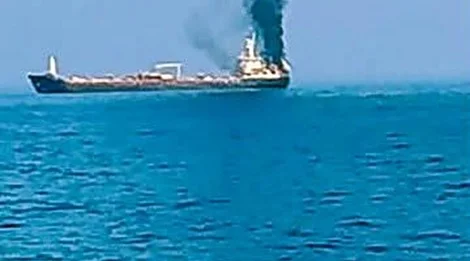
What are neutral ships ?
- Neutral ships are merchant vessels that are not part of any belligerent party and operate under the flag of a neutral country.
- Under normal circumstances, such ships cannot be directly targeted in war because they are considered civilian property.
Legal Basis for the Protection of Neutral Ships
- According to international law, the protection of neutral merchant ships is primarily ensured by three legal regimes:
- International Humanitarian Law (IHL)
- Law of Naval Warfare
- United Nations Convention on the Law of the Sea (UNCLOS)
- These laws determine how warfare at sea is conducted, which targets may be attacked, and how neutral ships are treated.
Two Major Legal Frameworks
1. Law of Naval Warfare
- It regulates military activities at sea during war.
- It includes :
- Attacks on ships
- Visit and Search
- Seizure of ships
- Naval Blockade
- Rights and obligations of belligerent and neutral countries
2. Law of the Sea (UNCLOS)
- The United Nations Convention on the Law of the Sea (UNCLOS) determines the legal status of the following maritime zones:
- Territorial Sea
- Exclusive Economic Zone (EEZ)
- International Waters (High Seas)
- International Straits
- Transit Passage
- Although not all countries are parties to UNCLOS, many of its rules are today considered part of customary international law.
What protections are offered to neutral merchant ships ?
- International humanitarian law prohibits attacks on civilians and civilian property.
- For this reason, the following types of merchant ships are generally protected:
- Oil tankers
- Container ships
- Ships carrying food grains
- Ships carrying fertilizers and other commercial goods
- Undersea pipelines and communication cables
- Similarly, neutral ships have the right of transit through international sea lanes such as the Strait of Hormuz, even during wartime.
Under what circumstances can neutral ships lose their protection ?
- The protection of neutral ships is not absolutely absolute.
- According to San Remo Manual (1994), action can be taken against neutral merchant ships in the following circumstances-
- If they are carrying war material (contraband).
- If they are in violation of a lawful naval blockade.
- Refuse to stop even after warning.
- Resist search or arrest.
- Make direct and effective contribution to the enemy's military action.
- That is, merely carrying out commercial activity does not make a ship a military target. It is necessary to have a solid legal basis against it.
Can oil tankers be attacked ?
- In some circumstances, the legal situation may change if the oil directly serves the enemy's military needs or is considered contraband.
- However, not every tanker carrying only oil automatically becomes a legitimate military target.
- According to international law, a ship is considered a military target only if :
- It directly contributes to the enemy's military operations.
- Its destruction provides a clear military advantage.
- Although some countries, including the United States, have supported the "War-Sustaining Theory," which states that objects that provide economic resources for war can also be targets, this theory is still not widely accepted in international law.
What is a naval blockade ?
- A naval blockade can be a legitimate military measure used during war, provided it is publicly announced. It must be effective. It must apply equally to ships of all nations. It must be enforced in accordance with international law.
- If a neutral ship intentionally breaks a legitimate blockade, action can be taken against it.
Difference between Jus ad Bellum and Jus in Bello
- Two important principles apply in international law:
- Jus ad Bellum - relates to the legality of initiating war or using force.
- Jus in Bello - relates to the legality of conduct and military action during war.
- A blockade may have a weak legal basis if it does not have the authorization of the United Nations Security Council or cannot be justified on the basis of self-defense (Article 51).
What legal options does India have ?
- The death of Indian sailors is not just a humanitarian or diplomatic issue but also a significant international legal question.
- Under the principle of Diplomatic Protection, India can file an international claim on behalf of its citizens.
- India can take the following steps :
- Seek clarification from the concerned country.
- Demand accountability.
- Demand an independent international investigation.
- Demand compensation.
- Raise the issue at the United Nations and other international forums.
Important Legal Questions
- Several important questions arise in the context of this incident :
- What intelligence underpinned the attack?
- Were the ships given adequate warning?
Was the attack a last resort?
- Could less drastic measures, such as stopping and searching or seizing the ship, have been adopted?
- Was an effort made to ensure the safety of the civilian sailors?
- All of these questions relate to four key principles of international humanitarian law :
- Distinction
- Proportionality
- Military Necessity
- Precaution
Conclusion
Neutral merchant ships are generally protected under international law during war and can only be targeted militarily in limited and clear legal circumstances. The recent deaths of Indian sailors have once again brought serious questions concerning maritime security, international humanitarian law, and the legal protection of neutral ships to the forefront of global discussion. India has ample legal and diplomatic options available to seek accountability, independent investigation, and compensation under international law.






 Contact Us
  New Batch : 9555124124/ 7428085757
  Tech Support : 9555124124/ 7428085757