New
Hindi Medium: (Delhi) - GS Foundation (P+M) : 8th June 2026, 6:30 PM Hindi Medium: (Prayagraj) - GS Foundation (P+M) : 1st June 2026, 5:30 PM English Medium: (Prayagraj) - GS Foundation (P+M) : 7th June 2026, 8:00 AM Hindi Medium: (Delhi) - GS Foundation (P+M) : 8th June 2026, 6:30 PM Hindi Medium: (Prayagraj) - GS Foundation (P+M) : 1st June 2026, 5:30 PM English Medium: (Prayagraj) - GS Foundation (P+M) : 7th June 2026, 8:00 AM

Pseudocapritermes novus

Why in the News?

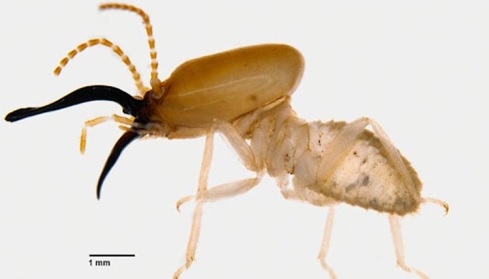
  • Recently, researchers in the dense forests of West Bengal identified a new species of soil-dwelling termite, named Pseudocapritermes novus.
About Pseudocapritermes novus

  • This is a new species of termite that lives in the soil.
  • It was discovered during a scientific survey conducted in the Chapramari Wildlife Sanctuary in West Bengal.
  • It is different from commonly found destructive termites.
  • This termite feeds on soil and humus, playing a vital role in increasing soil fertility in the ecosystem.
  • It is considered an important indicator of soil health and quality in any ecosystem.
  • With this discovery, the number of Pseudocapritermes species recorded in India has increased to five.

Key features of Pseudocapritermes novus

  • This species is distinguished from its closely related termites primarily by the unique structure of its mouthparts and body structure.
  • Like other termites in its group, it possesses asymmetrical, snapping jaws, which it uses for defense and to produce sound to warn.
  • Compared to its closest relative, P. bhutanensis, its left jaw is more curved and its tip is slightly inwardly inclined.
  • The lower part of its mouth (postmentum) is more rounded, prominent, and has a relatively long and wide structure.
  • Its front legs have strong and distinct spurs.
  • Its head is broader than that of another closely related species, P. tikadari.
Have any Query?

Our support team will be happy to assist you!

OR