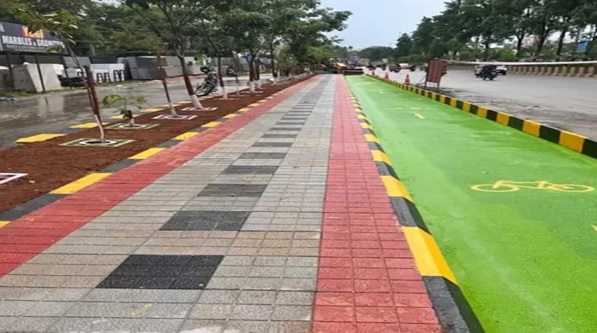
- Recently, the Supreme Court of India, in a landmark judgment, held that the right to walk on safe and demarcated footpaths is a Fundamental Right under the Constitution.
- The Court urged the Union and State Governments to consider enacting a comprehensive law to legally recognize this right and ensure the construction, maintenance, and protection of pedestrian infrastructure.
What Was the Case About?
- The judgment arose from a motor accident compensation case involving the death of a five-year-old boy who was walking to school with his father.
- A tanker hit the child from behind, resulting in fatal injuries. The accident occurred on a road that had neither a footpath nor a pedestrian crossing.
- The Supreme Court not only enhanced the compensation awarded to the victim’s family to ₹11.44 lakh, but also made significant constitutional observations regarding pedestrian safety and rights.
Key Observations of the Court
- The right to move freely throughout the territory of India under Article 19(1)(d) includes the right to walk.
- Access to safe and demarcated footpaths is also linked to Article 21, which guarantees the Right to Life and Personal Liberty.
- The right to walk is not subordinate to motorized transport; rather, it is a primary and fundamental mode of movement.
- Urban development authorities, municipal corporations, municipalities, and panchayats have a duty to construct, demarcate, maintain, and protect footpaths.
- Citizens whose right to walk safely is violated are entitled to seek constitutional remedies, legal relief, and compensation.
Observation on the Motor Vehicles Act, 1988
- The Court observed that the Motor Vehicles Act, 1988 primarily focuses on the regulation of motor vehicles and does not adequately protect pedestrian rights.
- In several respects, the existing framework has failed to provide sufficient safeguards for walkers.
Need for a Dedicated Law
The Supreme Court emphasized the need for a statutory framework that would :
- Explicitly recognize the right to walk on safe footpaths.
- Identify and define the responsibilities of duty-bearing authorities.
- Provide quick remedies and compensation mechanisms for violations.
- Establish a dedicated regulatory body to plan, enforce, and implement pedestrian rights.
Significance
- The judgment is a major step toward strengthening pedestrian rights, road safety, inclusive urban development, and people-centric transportation planning in India.
- The Court underscored that roads are not meant exclusively for motor vehicles; they must also be safe, accessible, and equitable spaces for pedestrians.






 Contact Us
  New Batch : 9555124124/ 7428085757
  Tech Support : 9555124124/ 7428085757