Prelims: SAT-SAAW, DRDO, Bharat Dynamics Limited, glide bombs and stand-off weapons.
Mains (GS Paper III): Defence indigenisation, technological self-reliance and military modernisation.
Keywords: SAT-SAAW, Glide bomb, Stand-off capability, Precision guidance, Indigenisation |
Why in News?
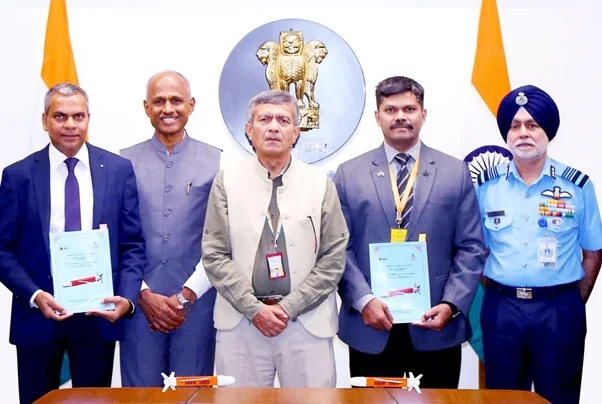
- The Ministry of Defence signed a ₹810.79 crore contract with Bharat Dynamics Limited (BDL) for 160 Satellite Smart Anti Airfield Weapons (SAT-SAAW) and associated equipment for the Indian Air Force.
- The agreement falls under the Buy (Indian–Indigenously Designed, Developed and Manufactured), or Buy (Indian-IDDM), category.
Background
- Airfields support aircraft operations and military logistics. Disrupting their functioning can affect an adversary’s ability to sustain air operations.
- Stand-off weapons allow an aircraft to release a weapon at a distance from its target. Such capability can reduce the need to approach heavily defended locations, although it does not eliminate operational risk.
- India’s SAAW programme represents an effort to develop precision air-to-surface weapons domestically. BDL describes SAAW as a long-range weapon capable of engaging ground targets after release from fighter aircraft.
Key Points of the Agreement
- Developer: Defence Research and Development Organisation (DRDO).
- Supplier: Bharat Dynamics Limited.
- Weapon type: Air-to-ground precision-guided glide bomb.
- Platforms named: Jaguar, Hawk and Su-30 MKI.
- Indigenous content: 60%, with further subsystem indigenisation envisaged.
- Delivery schedule: Between 2027–28 and 2028–29.
- Operational role: Neutralising enemy airfields from a long stand-off range.
Technical Context: SAAW
- BDL’s general SAAW product page lists a weight of 125 kg, a length of 1.85 metres and a range of approximately 90–100 km, depending on release conditions.
- These are general product specifications. The September 2026 contract announcement does not state the precise range of the SAT-SAAW configuration being procured.
Significance
Strengthening Precision-Strike Capability
The acquisition is intended to improve the IAF’s ability to engage airfield targets from a distance. Its practical value will depend on effective aircraft integration, mission preparation and operational availability.
Supporting Domestic Defence Production
The contract links indigenous research with manufacturing and military procurement. Such orders can help sustain specialised production facilities and encourage suppliers to invest in quality and capacity.
Improving Long-Term Preparedness
Reliable access to domestically produced weapons can support inventory planning and replenishment. This makes production capacity and delivery consistency strategically important alongside weapon performance.
Relevance for India
For India, the broader policy issue is how to turn indigenous designs into dependable military capability at scale. Procurement alone is only one stage; testing, production, training and maintenance also determine operational outcomes.
The agreement provides a useful example for examining the relationship between defence modernisation and industrial policy. Greater domestic capability can give India more control over future upgrades and supply arrangements.
Challenges
The following are broader implementation considerations, rather than reported shortcomings of this contract.
- Timely production: Manufacturers must meet delivery commitments while maintaining consistent quality.
- Supply-chain dependence: Domestic assembly should be accompanied by deeper capability in critical components.
- System integration: Aircraft compatibility, support equipment and personnel training require coordinated planning.
- Technology resilience: Precision weapons need continued evaluation as electronic warfare and defensive systems evolve.
- Lifecycle support: Storage, inspection and maintenance arrangements are essential for long-term readiness.
Way Forward
- India should combine timely procurement with realistic testing, strong quality assurance and predictable production planning. Regular coordination among the armed forces, developers and manufacturers can help identify integration and support requirements early.
- Indigenisation should focus on critical technologies and reliable domestic suppliers. Continued research, user feedback and lifecycle planning can ensure that production growth translates into sustained operational capability.
Conclusion
The SAT-SAAW agreement connects India’s precision-strike requirements with domestic defence manufacturing. Its lasting value will depend on timely delivery, dependable integration and continued progress in critical technologies.
Prelims MCQs
1. SAT-SAAW is primarily a:
A. Surface-to-air interceptor
B. Air-to-ground precision-guided glide bomb
C. Submarine-launched ballistic missile
D. Anti-submarine torpedo
2. Consider the following statements about the September 2026 SAT-SAAW agreement:
- DRDO developed the weapon.
- BDL is the contracted supplier.
- The procurement is for the Indian Navy.
Which statements are correct?
A. 1 and 2 only
B. 2 and 3 only
C. 1 and 3 only
D. 1, 2 and 3
Mains Practice Question
“Defence self-reliance requires more than indigenous design; it demands reliable production and sustained operational support.” Discuss with reference to India’s precision-weapon programmes. (150 words, 10 marks)
|
FAQs
|
1. What does SAT-SAAW stand for?
Satellite Smart Anti Airfield Weapon.
2. What is the value of the new agreement?
₹810.79 crore, commonly rounded to ₹811 crore.
3. Is a glide bomb the same as a conventional unguided bomb?
No. A guided glide bomb combines aerodynamic travel with guidance to improve targeting accuracy.
4. Why does release condition matter?
The aircraft’s altitude and speed at release influence the distance a glide weapon can travel.
5. Does indigenous design necessarily mean every component is domestic?
No. Design origin and the share of domestic content are distinct measures.
|






 Contact Us
  New Batch : 9555124124/ 7428085757
  Tech Support : 9555124124/ 7428085757