GS Paper III: Infrastructure, Energy Security, Renewable Energy, Environment and Sustainable Development
Keywords: India Renewable Energy Market Report 2026, International Energy Agency (IEA), Renewable Energy Capacity, Solar PV Manufacturing, Energy Security, Green Energy Transition, 500 GW Non-Fossil Capacity, Biofuels, Solar Power, Net Zero 2070 |
Why in News?
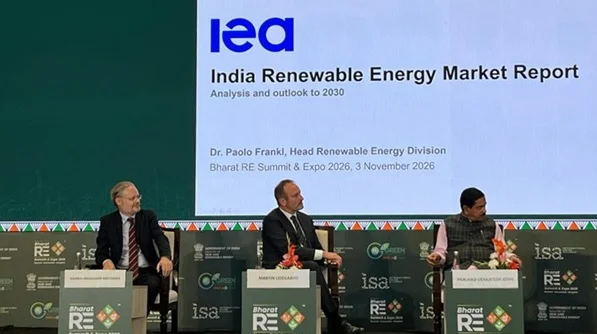
- On 3 November 2026, the International Energy Agency (IEA) released the India Renewable Energy Market Report 2026 at the Bharat Renewable Energy Summit in New Delhi.
- According to the report, India's installed renewable electricity capacity surpassed 300 GW in 2026, almost quadrupling over the past decade.
- India has emerged as the world's second-fastest-growing renewable energy market and the second-largest manufacturer of solar photovoltaic (PV) modules.
- The report highlights that renewable electricity helped India save more than USD 100 billion in coal and natural gas import costs between 2011 and 2025.
Key Facts at a Glance
|
Particular
|
Details
|
|
Report
|
India Renewable Energy Market Report 2026
|
|
Released by
|
International Energy Agency (IEA)
|
|
Release date
|
3 November 2026
|
|
Launch venue
|
Bharat Renewable Energy Summit, New Delhi
|
|
India's global renewable market rank
|
2nd fastest-growing
|
|
Solar PV module manufacturing
|
2nd largest globally
|
|
Renewable power capacity (2026)
|
Over 300 GW
|
|
Renewable capacity forecast (2030)
|
Around 530 GW
|
|
Solar PV capacity forecast (2030)
|
Over 350 GW
|
|
Wind capacity forecast (2030)
|
Nearly 90 GW
|
|
Hydropower capacity forecast (2030)
|
Around 75 GW
|
|
Import cost savings (2011–2025)
|
Over USD 100 billion
|
|
Non-fossil installed capacity milestone
|
50% achieved in 2025
|
|
India's non-fossil capacity target (2030)
|
500 GW
|
|
Net-zero emissions target
|
2070
|
Key Findings of the IEA Report 2026
1. Rapid Growth in Renewable Energy Capacity
- India's renewable electricity capacity increased nearly fourfold over the past decade, exceeding 300 GW in 2026.
- Solar energy has emerged as the primary driver of India's renewable electricity expansion.
- According to IEA projections, renewable capacity will reach approximately 530 GW by 2030.
- Solar PV is expected to account for more than 80% of renewable capacity additions during the forecast period.
2. Strengthening India's Energy Security
- Renewable electricity reduced India's cumulative coal and natural gas import expenditure by more than USD 100 billion between 2011 and 2025.
- Without solar, wind and bioenergy capacity added since 2010, India's coal imports in 2025 would have been approximately 110 million tonnes higher.
- Biofuels also reduced India's crude oil import dependence by approximately four percentage points in 2025.
- The expansion of domestic renewable energy reduces India's exposure to international fuel price volatility and supply disruptions.
3. Expansion of Renewable Electricity Generation
- Renewable electricity generation exceeded 500 terawatt-hours (TWh) in 2025, representing approximately 25% of India's electricity supply.
- Renewable electricity generation is expected to approach 950 TWh by 2030.
- Renewables are projected to supply around 35% of India's total electricity by 2030.
- Solar PV overtook hydropower as India's largest renewable electricity source in 2025.
4. India's Growing Solar Manufacturing Industry
- India has become the world's second-largest manufacturer of solar PV modules.
- Annual solar PV module manufacturing capacity reached approximately 225 GW in September 2026.
- Government policies, including the Production Linked Incentive (PLI) Scheme and domestic sourcing requirements, have encouraged manufacturing investment.
- Domestic manufacturing expansion offers opportunities to diversify global clean energy supply chains and reduce import dependence.
5. Competitive Renewable Energy Costs
- Competitive auctions have contributed to declining renewable electricity prices in India.
- India's utility-scale solar PV projects have the world's second-lowest levelised generation costs, estimated at USD 30–35 per megawatt-hour.
- Solar PV tariffs for projects commissioned in 2025 were approximately 40% below the average cost of coal-fired electricity.
- Lower renewable electricity costs can improve energy affordability and support industrial competitiveness.
6. Growth of Hybrid Renewable Energy Projects
- India has emerged as a global leader in procuring hybrid renewable energy projects combining technologies such as solar, wind and energy storage.
- In 2025, India auctioned 15 GW of hybrid renewable projects, increasing cumulative auctioned capacity to 64 GW.
- Hybrid projects can reduce variability in power generation and improve the utilisation of transmission infrastructure.
- Their expansion supports the integration of renewable energy into India's electricity grid.
7. Expansion of Biofuels and Clean Transport
- India's liquid biofuel production increased sixfold between 2020 and 2025.
- Liquid biofuel consumption reached approximately 11 billion litres in 2025 and is projected to reach 16 billion litres by 2030.
- India became the world's fourth-largest liquid biofuel market.
- Electric vehicles accounted for more than 11% of new vehicle sales in 2026, reflecting growing electrification of the transport sector.
8. Renewable Energy Targets and Future Outlook
- India achieved 50% non-fossil fuel-based installed electricity capacity in 2025, five years ahead of its 2030 target.
- The IEA expects India to meet its target of 500 GW of non-fossil electricity capacity by 2030.
- Continued progress will require stronger electricity grids, additional storage capacity and improved power distribution infrastructure.
- Addressing infrastructure and regulatory challenges could accelerate renewable capacity deployment by more than 20% during 2026–2030.
India's Renewable Energy Outlook: 2025–2030
|
Indicator
|
2025–2026
|
2030 Projection
|
|
Renewable power capacity
|
Over 300 GW (2026)
|
Around 530 GW
|
|
Solar PV capacity
|
—
|
Over 350 GW
|
|
Wind power capacity
|
—
|
Nearly 90 GW
|
|
Hydropower capacity
|
—
|
Around 75 GW
|
|
Renewable electricity generation
|
Over 500 TWh (2025)
|
Nearly 950 TWh
|
|
Renewable share in electricity generation
|
Around 25% (2025)
|
Around 35%
|
|
Liquid biofuel consumption
|
11 billion litres (2025)
|
16 billion litres
|
Source: IEA 2026. A dash indicates that the corresponding baseline was not specified in the report summary.
Significance for India
1. Energy Security
- Renewable energy reduces dependence on imported coal, natural gas and petroleum-based fuels.
- Domestic clean energy generation can improve resilience against geopolitical conflicts and international supply disruptions.
2. Economic Development
- Expansion of renewable energy supports investment in manufacturing, power infrastructure and associated services.
- Competitive renewable electricity costs can strengthen India's long-term industrial competitiveness.
3. Climate Change Mitigation
- Greater renewable electricity generation helps reduce dependence on carbon-intensive energy sources.
- It supports India's nationally determined climate commitments and net-zero emissions ambition for 2070.
4. Global Energy Leadership
- India's position as a major renewable energy market increases its importance in international energy cooperation.
- Expansion of solar and wind manufacturing creates opportunities for India to participate more strongly in global clean technology supply chains.
5. Employment and Rural Development
- Renewable energy projects can create employment opportunities in manufacturing, installation, operations and maintenance.
- Rooftop solar and agricultural solarisation programmes can improve energy access and support rural development.
Challenges
- Grid Infrastructure: Rapid renewable expansion requires significant investment in transmission networks and electricity distribution systems.
- Energy Storage: Intermittent solar and wind generation requires batteries, pumped storage and other flexibility solutions.
- Financial Constraints: Weak finances of electricity distribution companies (DISCOMs) can reduce investor confidence.
- Land Acquisition: Land availability, environmental clearances and project implementation delays affect renewable projects.
- Supply Chain Dependence: India remains exposed to concentrated global supply chains for certain upstream solar manufacturing components.
- System Integration: Increasing variable renewable electricity generation requires improved forecasting, dispatch and grid management.
Way Forward
- Modernise Electricity Grids: Accelerate the expansion of transmission infrastructure and Green Energy Corridors.
- Expand Storage Capacity: Encourage battery energy storage systems and pumped-storage hydropower projects.
- Strengthen Domestic Manufacturing: Promote domestic manufacturing of solar cells, wafers and other strategic clean energy components.
- Improve DISCOM Finances: Implement financial and operational reforms to ensure reliable electricity distribution and timely payments.
- Support Distributed Renewable Energy: Expand rooftop solar, agricultural solarisation and decentralised renewable energy systems.
- Accelerate Clean Fuel Development: Strengthen sustainable biofuel, compressed biogas and green hydrogen supply chains.
Conclusion
India's renewable energy expansion represents a significant transformation in its energy sector. According to the IEA's India Renewable Energy Market Report 2026, the country has emerged as a major global clean energy market while achieving substantial fuel import savings and expanding domestic manufacturing. However, sustained progress will depend on grid modernisation, energy storage, financial reforms and efficient project implementation. Strengthening these areas will be essential for achieving India's 2030 energy targets and long-term energy security.
Prelims Practice Question
Q. Consider the following statements regarding the India Renewable Energy Market Report 2026:
- India has emerged as the world's second-fastest-growing renewable energy market.
- India's renewable power capacity surpassed 300 GW in 2026.
- India is projected to achieve approximately 530 GW of renewable power capacity by 2030.
Which of the statements given above are correct?
(a) 1 and 2 only
(b) 2 and 3 only
(c) 1 and 3 only
(d) 1, 2 and 3
Mains Practice Question
Q. Examine the role of renewable energy expansion in strengthening India's energy security and economic development. Discuss the major challenges in achieving India's renewable energy targets by 2030.
|
FAQs
Q1. What is the India Renewable Energy Market Report 2026?
It is a report published by the International Energy Agency on 3 November 2026, examining India's renewable energy growth, energy security benefits, manufacturing expansion and outlook to 2030.
Q2. What is India's position in the global renewable energy market?
According to the IEA, India is the world's second-fastest-growing renewable energy market and second-largest solar PV module manufacturer.
Q3. How much renewable energy capacity did India achieve in 2026?
India's installed renewable electricity capacity surpassed 300 GW in 2026.
Q4. What is India's renewable energy capacity projection for 2030?
The IEA projects approximately 530 GW of installed renewable electricity capacity by 2030, including over 350 GW of solar PV capacity.
Q5. What is India's net-zero emissions target?
India aims to achieve net-zero greenhouse gas emissions by 2070.
|