Why in News ?
- The Sub-Mission on Agricultural Mechanization (SMAM) has significantly expanded access to farm machinery across India, especially for small and marginal farmers, women, SC/ST farmers, Farmer Producer Organizations (FPOs), and North-Eastern States.
- Since its launch, the scheme has supported the distribution of over 21.61 lakh agricultural machines, establishment of thousands of Custom Hiring Centres and Farm Machinery Banks, and large-scale adoption of drone technology for precision agriculture.
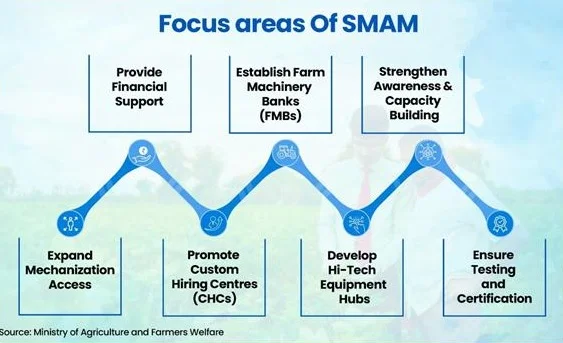
Sub-Mission on Agricultural Mechanization (SMAM)
- The Sub-Mission on Agricultural Mechanization (SMAM) is a Centrally Sponsored Scheme (CSS) launched in 2014-15 under the Rashtriya Krishi Vikas Yojana (RKVY) by the Ministry of Agriculture and Farmers Welfare.
- The scheme seeks to improve farm productivity by promoting mechanization across all stages of agriculture, including land preparation, sowing, irrigation, plant protection, harvesting, threshing, and post-harvest operations.
- The guiding principle of SMAM is "Reach the Unreached", ensuring that modern agricultural machinery becomes accessible to farmers who traditionally lack the financial capacity to purchase expensive equipment.
Need for Farm Mechanization in India
Agriculture in India continues to face several structural challenges, including :
- Small and fragmented landholdings
- Rising labour shortages due to migration
- Increasing cost of cultivation
- Delayed agricultural operations
- Low labour productivity
- Low mechanization levels in several eastern and North-Eastern states
- High capital cost of modern agricultural machinery
Farm mechanization addresses these issues by enabling timely farm operations, reducing dependence on manual labour and animal power, improving input-use efficiency, lowering production costs, minimizing post-harvest losses, and increasing overall agricultural productivity.
Mechanization also supports climate-resilient agriculture through precision farming technologies such as drones, GPS-enabled equipment, and efficient crop residue management.
Objectives of SMAM
The major objectives of the scheme are :
- Increase farm mechanization across the country.
- Improve access to agricultural machinery for small and marginal farmers.
- Promote inclusive mechanization by supporting women, SC/ST farmers, FPOs, SHGs, and rural entrepreneurs.
- Reduce the cost of cultivation through shared access to machinery.
- Improve agricultural productivity and farm efficiency.
- Promote precision agriculture through modern technologies such as drones.
- Strengthen post-harvest mechanization and crop residue management.
- Encourage establishment of institutional infrastructure for machinery hiring.
- Promote mechanization in low farm-power and underserved regions, particularly North-Eastern States.
Major Components of SMAM
1. Promotion of Agricultural Mechanization
SMAM supports mechanization throughout the crop production cycle by promoting :
- Land preparation
- Sowing and planting
- Irrigation
- Plant protection
- Harvesting
- Threshing
- Post-harvest processing
- Crop residue management
The scheme also organizes demonstrations, farmer training, capacity building, and awareness programmes to encourage adoption of modern agricultural technologies.
2. Financial Assistance for Agricultural Machinery
SMAM provides subsidies for purchasing agricultural machinery through the Direct Benefit Transfer (DBT) system.
Subsidy Pattern
- 40% subsidy for General Category farmers.
- 50% subsidy for :
- SC/ST farmers
- Small and marginal farmers
- Farmers of North-Eastern States.
Additionally, small and marginal farmers receive ₹2,000 per hectare for accessing mechanized services through Custom Hiring Centres, SHGs, and FPOs, including drone services.
3. Custom Hiring Centres (CHCs)
One of the flagship interventions under SMAM is the establishment of Custom Hiring Centres (CHCs).
These centres provide agricultural machinery on rent, allowing farmers to use expensive equipment without purchasing it.
Benefits
- Reduces capital investment.
- Enables timely agricultural operations.
- Makes advanced machinery affordable.
- Particularly benefits small and marginal farmers.
Financial assistance is available up to 40% of project cost for projects costing up to ₹250 lakh.
4. Farm Machinery Banks (FMBs)
Farm Machinery Banks are established mainly by :
- Farmer Producer Organizations (FPOs)
- Self Help Groups (SHGs)
- Panchayats
- Cooperatives
- Local institutions
These institutions collectively own machinery and rent it to farmers.
Financial support under SMAM includes :
- 80% subsidy
- Projects up to ₹30 lakh
- 90% subsidy in selected cases
5. Hi-Tech Agricultural Equipment Hubs
SMAM promotes the establishment of Hi-Tech Hubs equipped with advanced machinery such as :
- Laser land levellers
- Precision seeders
- Happy Seeders
- Zero Till Seed Drills
- Combine harvesters
- High-capacity planters
These hubs improve operational efficiency and promote adoption of precision agriculture.
6. Promotion of Mechanization in North-Eastern Region
Recognizing low mechanization levels in North-Eastern India, SMAM provides special incentives.
These include :
- Region-specific interventions
- Up to 100% subsidy for small agricultural machinery
- 95% financial assistance for Farm Machinery Banks
- Greater central financial support
This reduces regional disparities in access to farm machinery.
Financial Pattern of the Scheme
SMAM follows a shared funding model.
|
Region
|
Funding Pattern
|
|
General States
|
60:40 (Centre : State)
|
|
North-Eastern & Himalayan States
|
90:10
|
|
Union Territories
|
100% Central Assistance
|
This differentiated funding structure enables wider adoption across geographically diverse regions.
Achievements of SMAM (2014–15 to 2025–26)
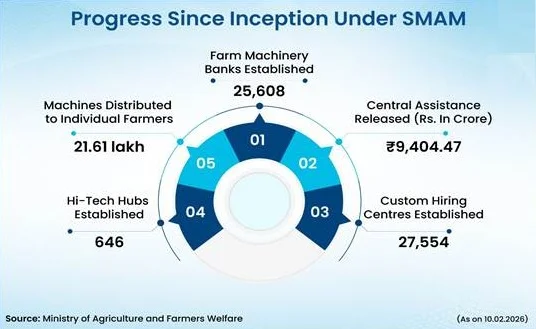
Since its launch, SMAM has achieved significant progress.
Financial Assistance
- Central Assistance : ₹9,404.47 crore
Agricultural Machinery Distributed
- 21.61 lakh machines distributed to individual farmers.
Institutional Infrastructure Created
- 27,554 Custom Hiring Centres
- 25,608 Farm Machinery Banks
- 646 Hi-Tech Hubs
Increase in Beneficiaries The number of beneficiaries receiving individual farm machinery increased from:
- 2.07 lakh (2020–21) to 2.32 lakh (2024–25) indicating expanding coverage of the scheme.
Drone-Based Farming under SMAM
SMAM actively promotes the use of drones in agriculture to encourage precision farming.
The initiative is implemented in collaboration with :
- Indian Council of Agricultural Research (ICAR)
- State Agricultural Universities (SAUs)
- Krishi Vigyan Kendras (KVKs)
Drone Demonstrations
Between 2023–24 and 2025–26 :
- 40,928 Kisan Drone demonstrations were conducted.
- Demonstrations covered 40,918 hectares.
The demonstrations focused on :
- Nutrient application
- Fertilizer spraying
- Pesticide application
- Agrochemical spraying
- Precision crop management
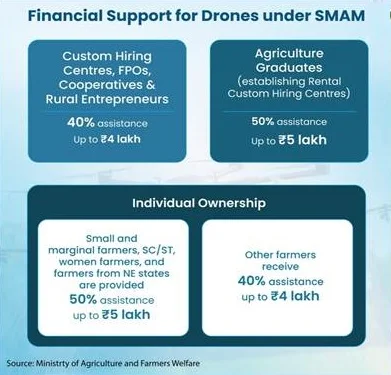
Financial Support for Drones
SMAM provides financial assistance for drone procurement.
Eligible Institutions
- ICAR Institutes
- State Agricultural Universities
- Krishi Vigyan Kendras
These institutions receive :
- 100% financial assistance
- Up to ₹10 lakh per drone
Farmer Producer Organizations (FPOs)
FPOs receive :
Service Providers
Drone service agencies receive :
Women-Centric Provisions
SMAM emphasizes gender inclusion.
The objective is to improve women's access to modern agricultural machinery, reduce drudgery, and enhance their participation in mechanized agriculture.
Rashtriya Krishi Vikas Yojana (RKVY)
SMAM operates under the umbrella of the Rashtriya Krishi Vikas Yojana (RKVY).
About RKVY
- Launched in 2007
- Centrally Sponsored Scheme
- Encourages states to increase public investment in agriculture
- Provides flexibility to states for designing location-specific agricultural projects
In 2017-18, RKVY was restructured as :
RKVY-RAFTAAR (Remunerative Approaches for Agriculture and Allied Sector Rejuvenation)
The restructured programme emphasizes :
- Pre-harvest infrastructure
- Post-harvest management
- Agri-entrepreneurship
- Value addition
- Agri-startups
- Agricultural innovation
Significance of SMAM
SMAM contributes significantly to India's agricultural transformation.
Economic Benefits
- Reduces cost of cultivation.
- Improves labour productivity.
- Enables timely farm operations.
- Increases crop yields.
- Enhances farmers' income.
Social Benefits
- Supports small and marginal farmers.
- Promotes women empowerment.
- Benefits SC/ST communities.
- Strengthens Farmer Producer Organizations.
Environmental Benefits
- Promotes precision agriculture.
- Encourages efficient use of fertilizers and pesticides.
- Supports crop residue management.
- Reduces stubble burning through mechanized residue management.
Technological Benefits
- Promotes drones.
- Encourages digital agriculture.
- Facilitates precision farming.
- Increases adoption of modern farm technologies.
Challenges
Despite notable progress, several challenges remain.
- Low awareness among farmers regarding advanced machinery.
- High maintenance costs.
- Limited availability of repair services in rural areas.
- Small and fragmented landholdings.
- Inadequate rural infrastructure.
- Limited access to institutional credit.
- Low mechanization levels in rainfed and tribal regions.
- Need for skilled operators to handle advanced machinery and drones.
Way Forward
To maximize the impact of SMAM, the following measures are essential :
- Expand the network of Custom Hiring Centres in remote and tribal areas.
- Promote AI, IoT, GPS, drones, and precision agriculture technologies.
- Strengthen training programmes for farmers and rural youth.
- Encourage indigenous manufacturing under Make in India.
- Enhance credit support for mechanization.
- Promote climate-smart and energy-efficient farm machinery.
- Integrate mechanization with Digital Agriculture Mission and AgriStack.
- Increase awareness through Krishi Vigyan Kendras and extension services.
- Strengthen research and innovation in affordable farm machinery suitable for small landholdings.
Conclusion
The Sub-Mission on Agricultural Mechanization (SMAM) has emerged as one of India's most important initiatives for modernizing agriculture through inclusive access to farm machinery. By combining financial assistance, Custom Hiring Centres, Farm Machinery Banks, Hi-Tech Hubs, and drone-based precision farming, the scheme has substantially improved mechanization among small and marginal farmers while reducing labour drudgery and enhancing productivity. Going forward, greater emphasis on digital technologies, climate-smart mechanization, indigenous innovation, and last-mile accessibility will be essential to achieving sustainable, efficient, and globally competitive agriculture in line with the vision of Viksit Bharat 2047.
Frequently Asked Questions (FAQs): Sub-Mission on Agricultural Mechanization (SMAM)
Q1. What is the Sub-Mission on Agricultural Mechanization (SMAM)?
Answer : SMAM is a Centrally Sponsored Scheme launched in 2014–15 under the Rashtriya Krishi Vikas Yojana (RKVY) to promote farm mechanization by improving farmers' access to modern agricultural machinery and equipment.
Q2. Which ministry implements the SMAM?
Answer : The scheme is implemented by the Ministry of Agriculture and Farmers Welfare, Government of India.
|






 Contact Us
  New Batch : 9555124124/ 7428085757
  Tech Support : 9555124124/ 7428085757