Why is it in the News?
- The Government of India has temporarily suspended the fortification of rice under the Pradhan Mantri Garib Kalyan Anna Yojana (PMGKAY) based on findings from a study conducted by the Indian Institute of Technology Kharagpur.
- The study found that prolonged storage significantly affects the stability of micronutrients in fortified rice, limiting the expected nutritional benefits for beneficiaries.
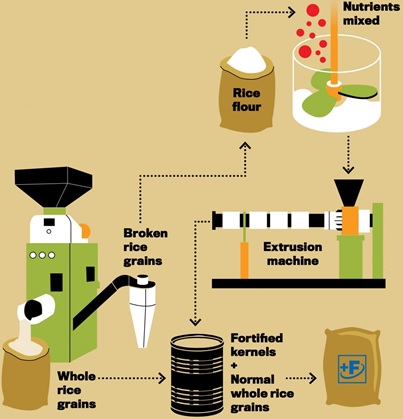
Background of the Rice Fortification Scheme
India faces a high burden of anemia and micronutrient deficiencies, particularly among women and children. To address this issue, the government introduced rice fortification as a large-scale nutritional intervention.
Key Features of the Scheme:
- Regular rice is blended with Fortified Rice Kernels (FRK) enriched with:
- Iron
- Folic Acid
- Vitamin B12
- Distribution through existing welfare channels:
- Public Distribution System (PDS)
- Integrated Child Development Services (ICDS)
- Mid-Day Meal Scheme
- PMGKAY
- Objective: Deliver essential micronutrients to vulnerable populations using the existing food grain distribution network.
What is Food Fortification?
Food fortification is the deliberate addition of essential micronutrients (vitamins and minerals) to food to improve its nutritional quality.
Examples of Fortified Foods in India:
- Wheat flour and rice: Iron, Folic Acid, Vitamin B12
- Milk and edible oil: Vitamins A and D
- Double-fortified salt: Iodine and Iron
Regulatory Framework
Fortification in India is regulated by the Food Safety and Standards Authority of India under the Food Safety and Standards (Fortification of Foods) Regulations, 2018.
Reason for Suspension: Key Findings of the IIT Kharagpur Study
The government commissioned a study to assess the shelf life of fortified rice under real storage conditions across different agro-climatic regions.
Major Findings:
- Micronutrient stability is affected by:
- Moisture
- Temperature
- Relative humidity
- Packaging conditions
- Fortified rice and FRK can lose nutrients during long-term storage (2–3 years).
- Large quantities of rice are stored in central warehouses for extended periods.
- This raises concerns about whether beneficiaries receive the intended nutritional benefits.
Supply and Storage Context
- Annual allocation: ~372 lakh metric tonnes (LMT)
- Central pool stock: ~674 LMT (approximate)
- Extended storage and large-scale logistics make maintaining nutrient stability challenging.
This highlights the difficulty of implementing sensitive nutritional interventions within a massive public distribution system.
Perspective of Public Health Experts and Activists
Activists who challenged the scheme in the Supreme Court welcomed the suspension.
Key Concerns Raised:
- Not all anemia cases are due to iron deficiency.
- Universal fortification may not be the most effective approach.
- Alternative strategies suggested:
- Improving dietary diversity
- Providing targeted supplementation
- Strengthening broader public health interventions
- Concerns regarding safety, cost-effectiveness, and regulatory oversight.
This reflects a policy debate between universal interventions and targeted strategies.
Broader Policy Implications
According to the National Family Health Survey (NFHS), anemia rates in India remain high. Rice fortification was seen as a scalable solution through the PDS network. However, the recent findings highlight important lessons.
Key Policy Lessons:
- Scientific validation is essential before scaling up large interventions.
- Storage conditions and climatic variations must be factored into design.
- Periodic monitoring of micronutrient levels is necessary.
- Food policy must align with logistical realities.
The government has clarified that this is a temporary suspension, not a permanent termination. Future policy may involve improved delivery mechanisms to ensure better nutrient retention and effectiveness.






 Contact Us
  New Batch : 9555124124/ 7428085757
  Tech Support : 9555124124/ 7428085757